Trafalgar Square: the home of Nelson’s column, Landseer’s lions, Lutyens’s fountains, and, when the British begin to feel that Really Things Have Gone a Bit Too Far, a stage for political demonstrations. The National Gallery provides the backdrop. There are also four plinths which formerly aroused little interest, indeed prior to the millennium one of them had stood empty since money for statues ran out in 1841. In 1999 the Royal Society of Artists inaugurated the Fourth Plinth Project and since then a new artwork has appeared on the plinth every two years.
Here are my three favourites:
In 2010 Yinka Shonibare presented us with his Ship in a Bottle, a replica of Nelson’s flagship HMS Victory, its sails decorated with African patterns.
When Ship in a Bottle completed its two year tenure in Trafalgar Square it moved to a permanent home outside the Greenwich museum.
Hans Haacke’s Gift Horse, a skeletal, riderless bronze horse, based on an etching by Stubbs found in the National Gallery, appeared in 2015. An electronic ribbon linked by tickertape machine to the London Stock Exchange was tied to its front leg.
Haake’s horse, focusing on the links between power, money, and history.
The Invisible Enemy Should not Exist, created in 2018 by Michael Rakowitz, recalled 7,000 objects looted from the Iraq museum or destroyed at archaeological sites across the country by ISIS. It is dominated by the Lamassu, which stood at the Nergal gate entrance to Ninevah. The reconstruction was made from 10,500 recycled date syrup cans, mirroring the recycled cannon used for the reliefs at the base of Nelson’s column.
The Lamassu
The Lamassu is a deity with a human head, the body of a bull or lion, and the wings of an eagle.
Overlapping date syrup containers; the syrup was a major export from Iraq before the war.
Last time I visited the Square, I inspected the other three plinths. They bear undistinguished statues of George IV, Major-General Henry Havelock and Charles James Napier respectively. But the latter reminded me of a more dramatic, albeit equally ugly, image of Napier which lies outside the garrison church in Portsmouth where he was buried.
Stretched out on his back, an uncomfortable looking Napier clutches his sword.The plinth bears the names of the battles in which he participated.
Napier was buried inside the church which was extensively damaged by bombing during World War II.
Garrison church, Portsmouth
As a young man Charles James Napier (1782-1853) took up a commission in the British army. He fought in the Peninsula War (1808-14) and the War of 1812 against the United States. From 1822-30 he was military resident in Cephalonia. Between 1839-41, as the chief of troops in the north of England, he was responsible for the violent suppression of the Chartist demonstrations.
When he was appointed Commander-in-Chief of the army of the East India Company Napier seized the opportunity for self-aggrandisement and military glory. The East India Company already had direct or indirect control over much of the Indian subcontinent. In the Sindh province however the Amirs of the Talpur dynasty still held nominal control although the passage of “friendship” treaties had left them paying tribute to the British, providing a base for their troops and military hardware, and supplying them with auxiliary forces.
By 1842 the British were seeking to expand their influence in the area developing trade routes along the Indus river and securing their defences against Russian attack through Afghanistan. The Talpurs opposed this, and there was increasing hostility towards the East India Company, but the disaffected Amirs were divided and lacked a professional army.
Napier shifted British policy from a combination of diplomacy and bullying, to outright aggression. He pushed the Amirs into open conflict by imposing a new treaty forcing them to cede territory and by marching on and destroying the desert fortress of Imamgarh.
On the grounds their alleged disloyalty, Napier then received orders that the “rebel” forces of the Amirs should be put down. He had easy victories at the battles of Meanee and Hyderabad. But Napier went further, exceeding his mandate to suppress the rebels, and in a ruthless and unauthorised campaign he subjugated Sindh, conquering the whole province. He knew that his action was neither legal nor moral,
We have no right to seize Sindh. Yet we shall do it,
but used the habitual spurious and hypocritical justification for colonial expansion,
and a very advantageous, humane and useful piece of rascality it shall be.
Advantageous and useful it undoubtedly was for the East India Company and for Napier himself. The military conquest of Sindh paved the way for further annexations of the Punjab, and Napier became the first Governor-General of Sindh.
Even in Britain however Napier’s conduct was controversial: he faced criticism for his barbaric action, quest for personal glory and for exceeding his authority. Nonetheless he received a knighthood and later there was widespread public mourning and a military tribute at his funeral.
Moreover generations of Latin teachers in British schools delighted in elucidating Napier’s putative wit in a telegram which he allegedly sent home informing his superiors of his conquest. “Peccavi,” it read.
There was no telegraph in the Subcontinent until the 1850s.
But in Manchester in 1843 there was a sixteen-year-old schoolgirl called Catherine Winkworth. She coined the pun, substituting “I have sinned” for “I have Sindh” in the supposed dispatch to highlight the immorality of Napier’s assault on the territory. Amused, and in sympathy with her view, her teacher suggested that she forward her witticism to Punch magazine, where it was erroneously credited to Napier.
Catherine Winkworth (1827-1878) studied under the Unitarian William Gaskell. As a young woman she belonged to the circle of Manchester Liberals whose commitment to a more equal society led to their support for free trade, the repeal of the Corn Laws, pacifism, a free press, the separation of church and state, and opposition to slavery.
In adulthood she was known for her translations of German hymns and her support for higher education for women. After moving to Bristol, she became a founder and governor of girls’ schools including Cheltenham Ladies’ College, Red Maids’ School, and Clifton High School for Girls.
She died suddenly of heart disease while in Savoy, but there is a monument to her memory in Bristol Cathedral.
This pious memorial is devoid of puns. A suitable epitaph for a middleaged German hymn translator perhaps, but giving no hint of the smart,witty, radical young girl from Manchester.What a pity.
Henry Cole (1808-1882) combined administrative skills with a practical flair for production and design. Between 1837-40 when he worked as an assistant to Rowland Hill, these twin talents became apparent. He played a key role in the introduction of the Penny Post and was responsible for the design of the world’s first postage stamp, the Penny Black.
Under the pseudonym of Felix Summerly he created his own award-winning designs, including a tea service produced by Minton. But it was his organisational talents which were truly breath taking. In 1851 Cole proposed an International Great Exhibition of Culture and Industry to celebrate, and to stimulate the improvement of, modern manufacture and decoration. He sought to promote international trade, providing a platform for British products; British manufacturers were to get the best locations at the exhibition. Despite opposition from Parliament, and the press doubting the success of his venture, he launched his scheme, and under his management it became an enormous success, the first in a series of World Fairs.
Joseph Paxton designed the massive glasshouse, the Crystal Palace, in which the Great Exhibition was held at Hyde Park. The prefabricated structure with a cast iron frame was an engineering triumph. Within it more than a million objects were displayed, with sectors showcasing raw materials, machinery, manufactured goods, and fine arts. A massive pink glass fountain stood in the centre. William Morris found the latter in bad taste, but the public loved it.
Exhibits included the entire process of cotton production, electric telegraphs, steam powered machines, a lighthouse, locomotives, scientific tools, microscopes, barometers, surgical instruments, kitchen appliances, an early adding machine, an umbrella which doubled as a weapon, a neo-gothic medieval court designed by Pugin, Indian textiles, musical instruments including a folding piano, silks, porcelain, tapestries, majolica. From glass vitrines the Koh-I-Noor diamond and the eighth century Tara Brooch flaunted their mystique. Who would not have wanted to be there amid the extravagant opulence and exciting new inventions? Everyone did: in the sixth months of the exhibition six million people, a third of the population, visited. The railways offered discounted tickets and Thomas Cook arranged one of his earliest excursions, bringing 150,000 people from the North and Midlands.
The Crystal Palace witnessed the first international chess tournament, and played host to the first modern pay toilets, use of the latter priced at one old penny, bringing a new coy euphemism into the English language. Canny businessman that he was, Henry Cole persuaded Schweppes, the world’s first soft drink company, to sponsor the exhibition, and organised a tempting line in souvenirs with stereoscopic cards, fans, and plates. A huge financial as well as a popular success, the exhibition made a profit of £186,000, around £34 million in today’s money.
This enabled Cole to embark on his next great project, the founding of the South Kensington Museum for Education in Applied Art and Science. With the profits of the Great Exhibition, he organised the purchase of land in South Kensington, supervised the building works, and became the first director of the museum from 1857-73. It subsequently became the Victoria and Albert museum, specialising in decorative arts and design, while the Science and Natural History museums became independent entities. Always concerned with the educational function of the collections, Cole also helped to develop the Royal Colleges of Art and Music, and the Imperial College of Science and Technology.
Under Cole’s guidance the Victoria and Albert Museum became a magnificent show case for outstanding designs of furniture, textiles, glass and metal work, and ceramics. Determined to instruct people in superior design and good taste, Cole also set up a Gallery of False Principles, displaying what he perceived as bad designs. These included fabrics and wallpapers with naturalistic images of foliage and flowers, which he considered excessive and illogical ornamentation. Their failings were spelled out on their labels, and alongside them sat “correct” versions. The Gallery proved popular and caused much amusement, but the display was closed after two weeks following complaints from manufacturers whose work was pilloried there. But the memory of the intended lesson lives on, for Charles Dickens, more sentimental and sympathetic towards anyone who might like something pretty, satirised Cole’s judgment in Hard Times when the Utilitarian School Board Superintendent visits Gradgrind’s schoolroom:
Now, let me ask you girls and boys, Would you paper a room with representations of horses?’
After a pause, one half of the children cried in chorus, ‘Yes, sir!’ Upon which the other half, seeing in the gentleman’s face that Yes was wrong, cried out in chorus, ‘No, sir!’—as the custom is, in these examinations.
‘Of course, No. Why wouldn’t you?’
A pause. One corpulent slow boy, with a wheezy manner of breathing, ventured the answer, Because he wouldn’t paper a room at all, but would paint it.
‘You must paper it,’ said the gentleman, rather warmly.
‘You must paper it,’ said Thomas Gradgrind, ‘whether you like it or not. Don’t tell us you wouldn’t paper it. What do you mean, boy?’
‘I’ll explain to you, then,’ said the gentleman, after another and a dismal pause, ‘why you wouldn’t paper a room with representations of horses. Do you ever see horses walking up and down the sides of rooms in reality—in fact? Do you?’
‘Yes, sir!’ from one half. ‘No, sir!’ from the other.
‘Of course no,’ said the gentleman, with an indignant look at the wrong half. ‘Why, then, you are not to see anywhere, what you don’t see in fact; you are not to have anywhere, what you don’t have in fact. What is called Taste, is only another name for Fact.’ Thomas Gradgrind nodded his approbation.
‘This is a new principle, a discovery, a great discovery,’ said the gentleman. ‘Now, I’ll try you again. Suppose you were going to carpet a room. Would you use a carpet having a representation of flowers upon it?’
There being a general conviction by this time that ‘No, sir!’ was always the right answer to this gentleman, the chorus of No was very strong. Only a few feeble stragglers said Yes: among them Sissy Jupe.
‘Girl number twenty,’ said the gentleman, smiling in the calm strength of knowledge.
Sissy blushed, and stood up.
‘So you would carpet your room—or your husband’s room, if you were a grown woman, and had a husband—with representations of flowers, would you?’ said the gentleman. ‘Why would you?’
‘If you please, sir, I am very fond of flowers,’ returned the girl.
‘And is that why you would put tables and chairs upon them, and have people walking over them with heavy boots?’
‘It wouldn’t hurt them, sir. They wouldn’t crush and wither, if you please, sir. They would be the pictures of what was very pretty and pleasant, and I would fancy—’
‘Ay, ay, ay! But you mustn’t fancy,’ cried the gentleman, quite elated by coming so happily to his point. ‘That’s it! You are never to fancy.’
‘You are not, Cecilia Jupe,’ Thomas Gradgrind solemnly repeated, ‘to do anything of that kind.’
‘Fact, fact, fact!’ said the gentleman. And ‘Fact, fact, fact!’ repeated Thomas Gradgrind.
‘You are to be in all things regulated and governed,’ said the gentleman, ‘by fact. We hope to have, before long, a board of fact, composed of commissioners of fact, who will force the people to be a people of fact, and of nothing but fact. You must discard the word Fancy altogether. You have nothing to do with it. You are not to have, in any object of use or ornament, what would be a contradiction in fact. You don’t walk upon flowers in fact; you cannot be allowed to walk upon flowers in carpets. You don’t find that foreign birds and butterflies come and perch upon your crockery; you cannot be permitted to paint foreign birds and butterflies upon your crockery. You never meet with quadrupeds going up and down walls; you must not have quadrupeds represented upon walls. You must use,’ said the gentleman, ‘for all these purposes, combinations and modifications (in primary colours) of mathematical figures which are susceptible of proof and demonstration. This is the new discovery. This is fact. This is taste.’
The girl curtseyed, and sat down. She was very young, and she looked as if she were frightened by the matter-of-fact prospect the world afforded.
Yet, notwithstanding a little pomposity and a common weakness for conflating his own taste with good taste, Cole gave us something very precious in the V and A. It is magical at any time but especially in winter when the rainbow colours of the textiles and costumes, the gleam and shine of the jewellery and metalwork, triumph over the prevailing gloom of the December skies. I choose a few favourite objects to visit, perhaps Shah Jahan’s winecup or Tipu’s tiger, the carved oak facade of Paul Pindar’s sixteenth century house or the Hereford screen, or Dale Chihuly’s extravagant glass sculpture, before heading for the refreshment rooms.
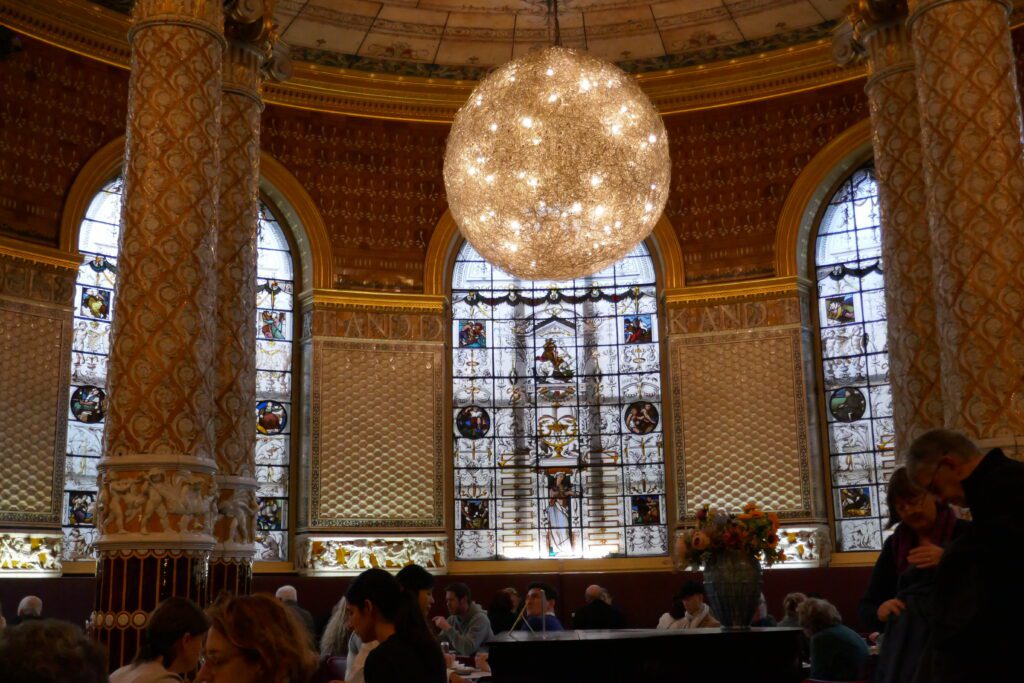
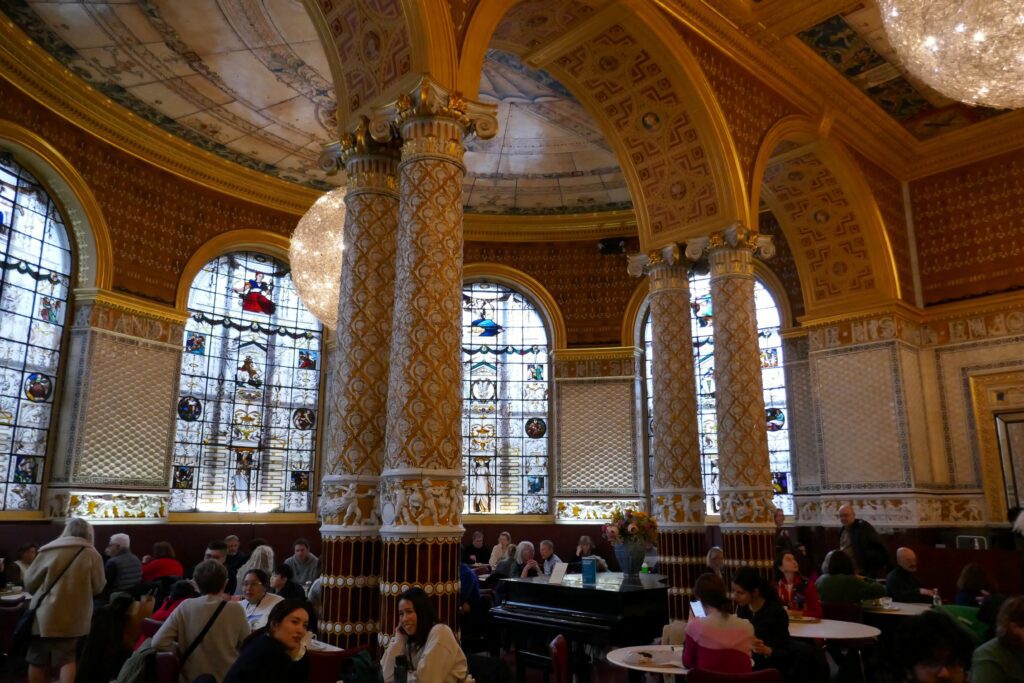
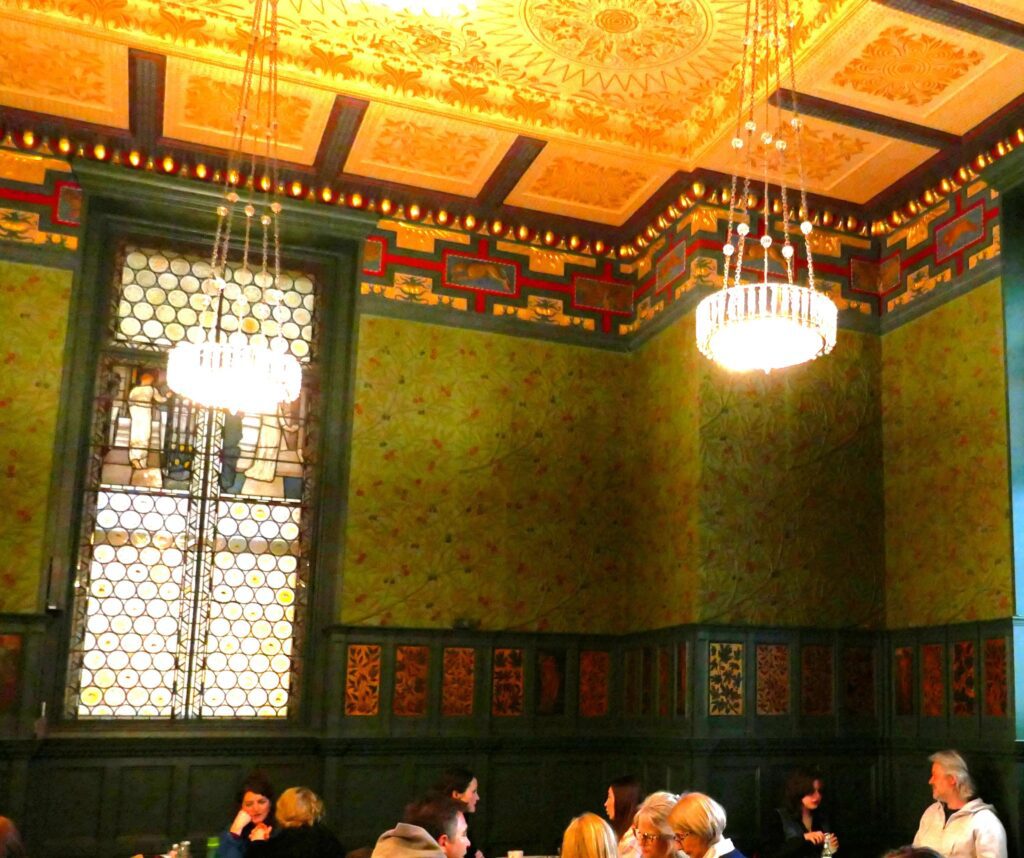
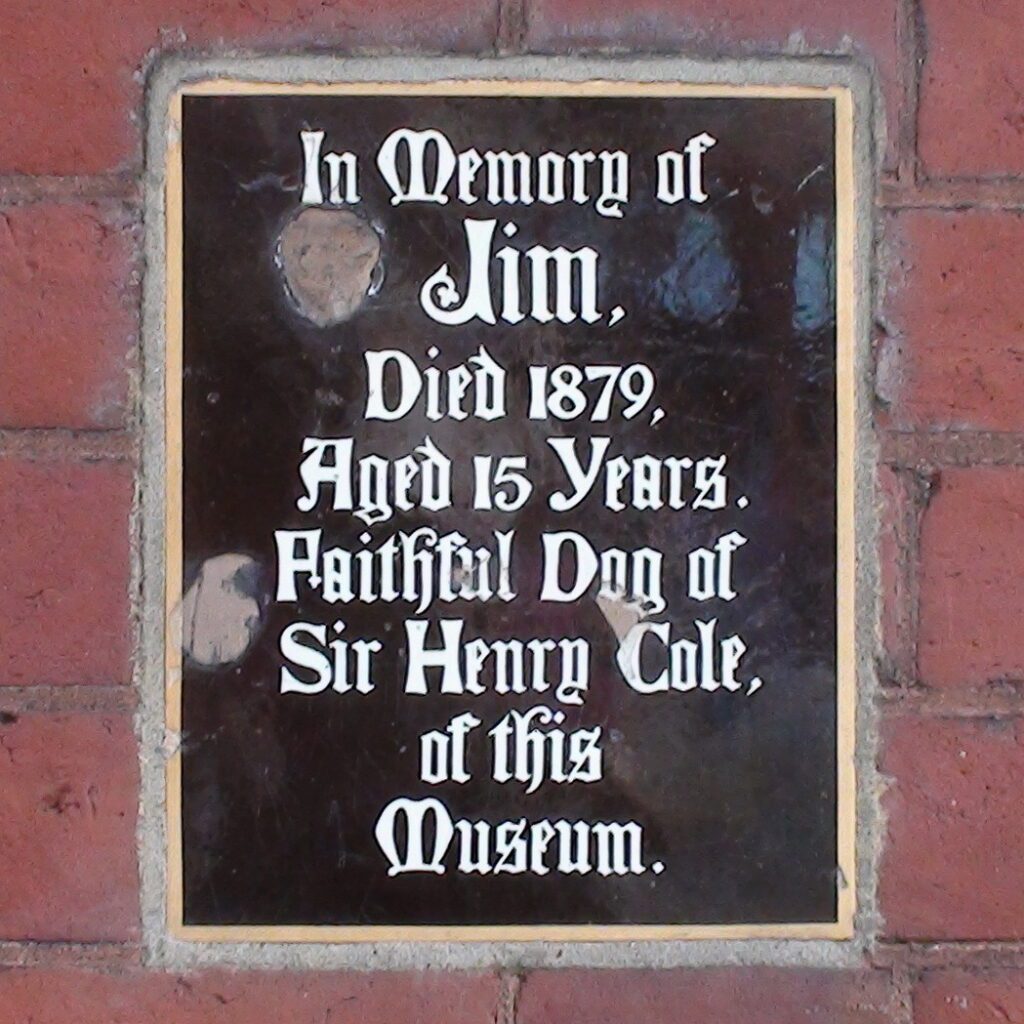
The V and A was the first museum in the world to have a catering service, and what sublime trio of rooms they are. Ensconced in the warmth with a cup of tea and a bun, surrounded by the magnificently eclectic décor featuring ceramics, stained glass, panelling and enamelling, in the Gamble, Poynter or Morris Room, all is right with the world. I could go into semi-hibernation here, sleeping at night in the Great Bed of Ware, by day wandering the labyrinthine corridors from one gallery to another, taking my meals in the refreshment rooms, emerging to the garden court only in Spring. There to meet with the spirit of Jim, Henry Cole’s Yorkshire terrier, who accompanied his master on his daily site inspections as the museum buildings rose from the ground, and who is buried somewhere here in the garden.
Gamble Room
Poynter Room
Morris Room
Detail, Poynter Room
Detail, Poynter Room
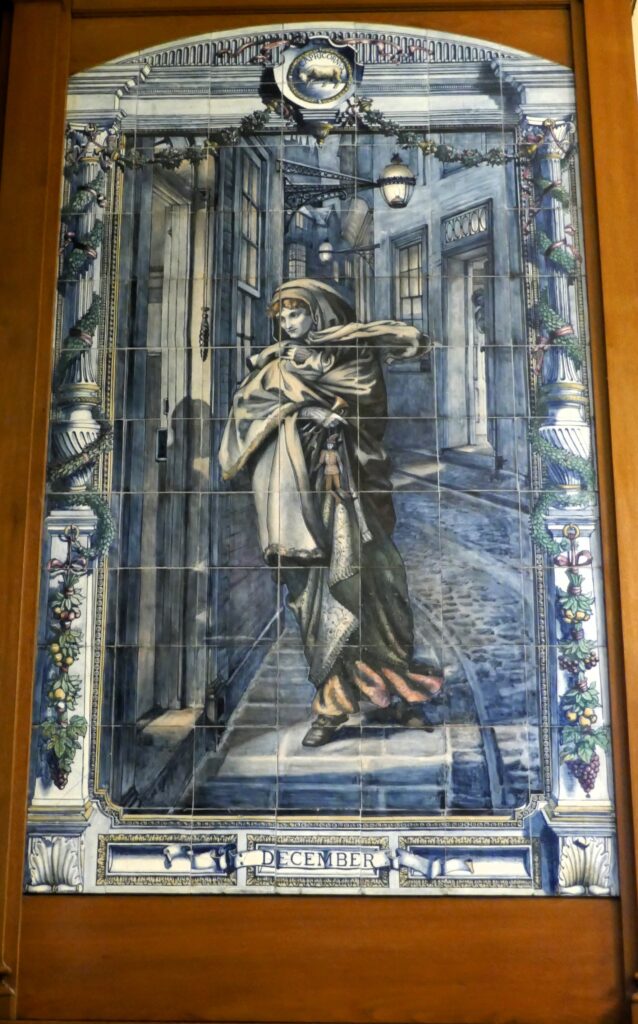
December tiles in Poynter Room
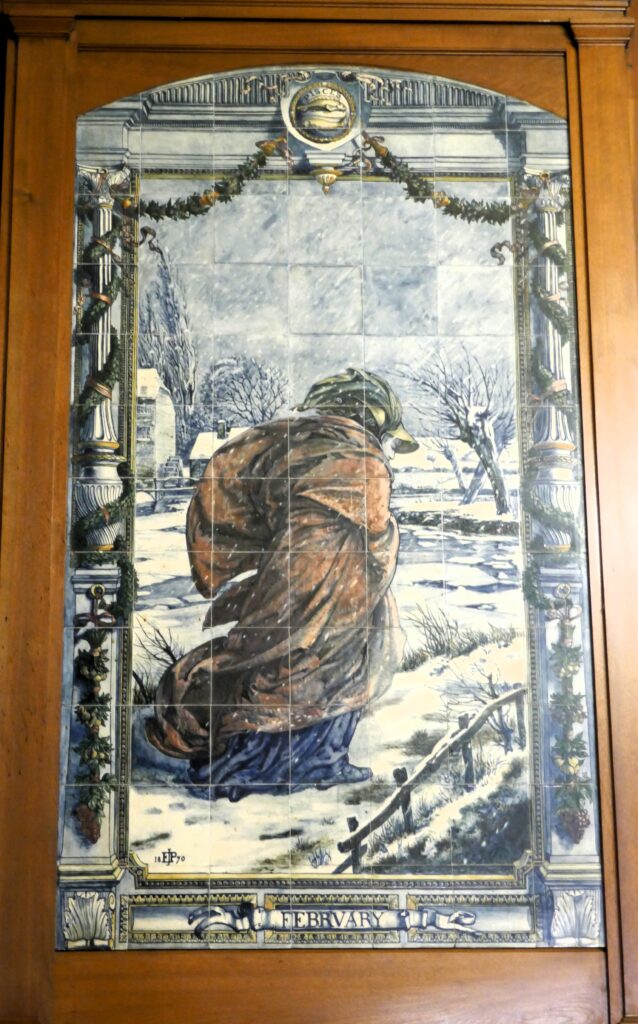
February, no wonder I want to hibernate
Memorial to Jim, on the wall of the garden court. He is buried somewhere in the garden
And at this time of year, I remember Henry Cole for something else, because in 1843 he designed and produced the first Christmas card. Depicting three generations his family raising a toast, with representations of charity and almsgiving around the margins, it is surely an image with which Dickens would have sympathised.
When I was a child our living room filled with cards at Christmas, for my grandparents came from the days of extended families and had a wide circle of friends. We strung the cards in loops across the chimney breast, and cascading down the walls. More jostled on the mantlepiece. Others surrounded and concealed the fruit bowl on the sideboard with its seasonal cargo of tangerines wrapped in tissue paper which when rolled into a cylinder and lit would float magically and weightlessly up to the ceiling. The post came twice a day: cards fell through the letterbox before I left for school, and a second pile arrived in the afternoon, saved for me to open when I came home.
Now there are fewer cards each Christmas, my grandparents long gone and my own contemporaries beginning to slip away. Moreover, the world has changed. Christmas greetings arrive by email. It is an easier way to communicate, quicker, more immediate, and very much cheaper. For in the 50s and 60s not only were boxes of Woolworths cards in the reach even of a child’s pocket money, but so were stamps. And if an envelope contained no other enclosure than a card, and if the flap were tucked in rather than sealed, then an even cheaper stamp would guarantee delivery. Today the annual purchase of books of stamps offers a sharp lesson in inflation, “How much?” we gasp in horror. Yet I cannot resist the pleasure of choosing and writing cards, and while it is nice to receive the emails, I am glad when friends still send those cheery, colourful, paper greetings which nudge each other on my bookshelves basking in the reflected lights of the tree.
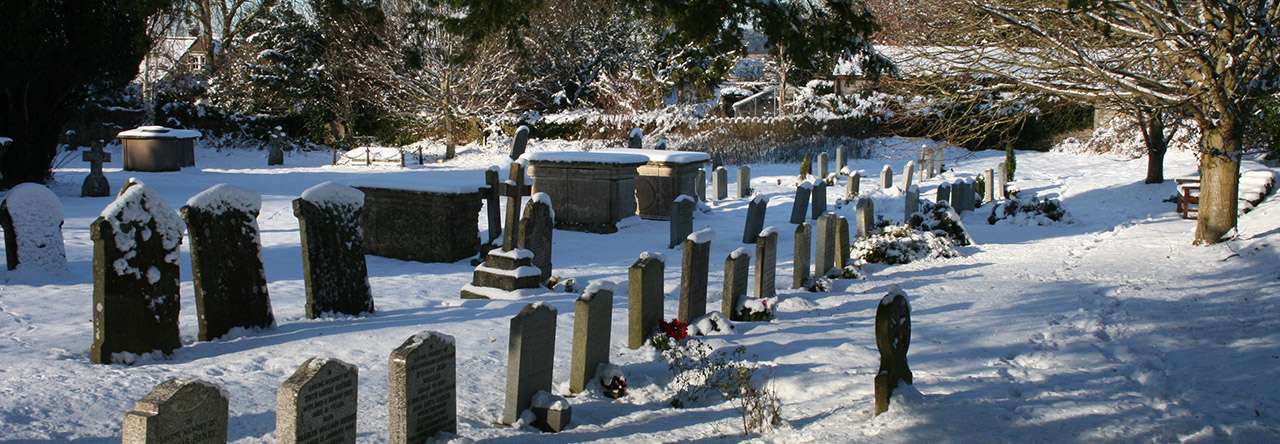
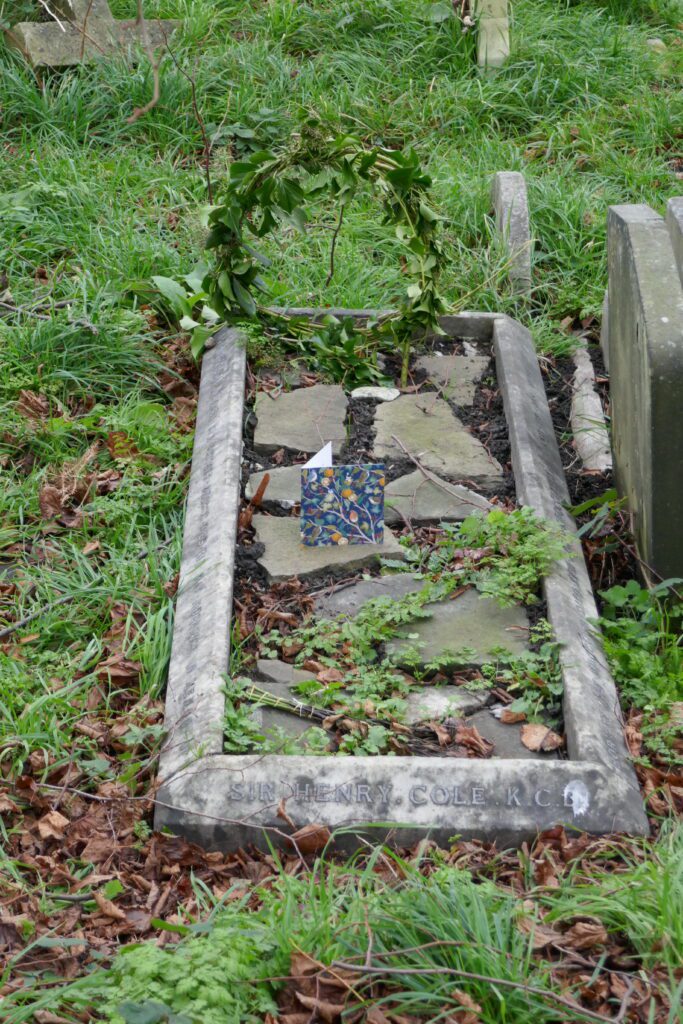
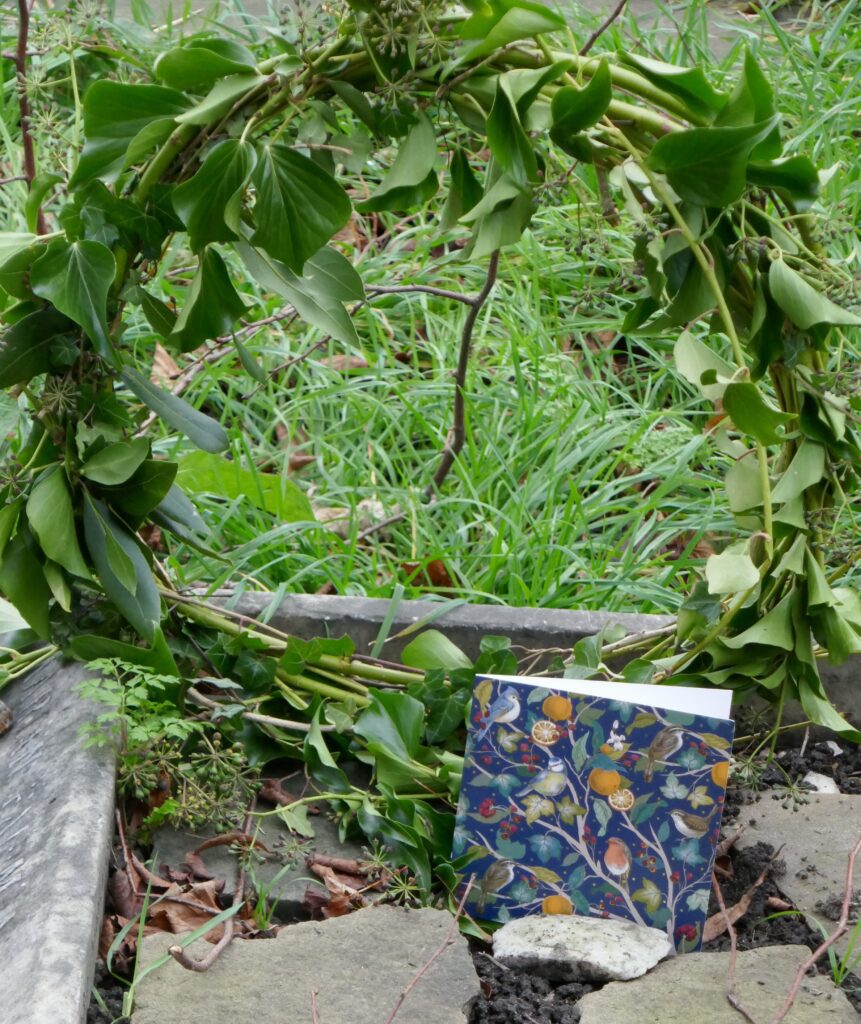
So, thank you Henry Cole for the Victoria and Albert, and for Christmas cards. When I first visited your grave in Brompton, it looked a little sad and neglected, but last week I was not your only visitor for someone had taken ivy and plaited a Christmas wreath for you. Merry Christmas, Henry Cole.