Thomas Gray’s Elegy Written in a Country Churchyard was an instant success when it was first published in 1751 and ensured his popularity throughout the latter half of the eighteenth century. Although he published only thirteen poems in English, he was offered, and turned down, the position of Poet Laureate in 1757.
He became known, along with Thomas Parnell, Robert Blair and Edward Young, as one of the Graveyard or Churchyard Poets. Their work, like the religious revival of the day, was essentially melancholy, characterised by meditations on mortality, lost innocence, disillusionment, fate. They were perfectly in tune with the Age of Sensibility, focusing on the transience of life, on emotions, nature, the individual, on loss, grief, and suffering. Even Gray’s Ode on the Spring quickly establishes itself as a memento mori, with the vibrant spring day he describes not a symbol of renewal but a reminder that life is short and soon succeeded by death.
If this sounds unduly bleak it is well to remember that life in the eighteenth century was precarious. Gray was the only one of twelve siblings to survive infancy. He had sent the Ode on Spring to his closest friend Richard West in a letter which was returned unopened for West had died at the age of only twenty-four.
Gray’s poetry is little read today although even in my parents’ generation primary school children still learned sections of the Elegy Written in a Country Churchyard by rote and quite surprising people could unexpectedly declaim its stanzas. Even today persons who may be entirely unfamiliar with the poem unknowingly reproduce it for many of Gray’s memorable aphorisms have passed into common parlance.
The poem opens with a lyrical evocation of the English countryside and rural life, the painterly detail and mellifluous tones conjuring a tranquil scene:
The curfew tolls the knell of parting day,
The lowing herd wind slowly o’er the lea,
The ploughman homeward plods his weary way,
And leaves the world to darkness and to me.
Gray then reflects on the people buried in the churchyard. Celebrating the lives and work of the unknown villagers, he reminds the rich and powerful of the transience of their achievements, that their end will be the same:
The paths of glory lead but to the grave.
Moreover, he reflects, given the opportunity the obscure villagers may have been capable of great things. He imagines
Some village Hampden, that, with dauntless breast,
The little tyrant of his fields withstood,
Some mute inglorious Milton here may rest,
Some Cromwell guiltless of his country’s blood.
But he ruefully acknowledges,
Full many a flower is born to blush unseen,
And waste its sweetness on the desert air.
Yet the very obscurity of the villagers also proscribed their crimes, for they were
Forbade to wade thro’ slaughter to a throne
but remained
Far from the madding crowd’s ignoble strife.
Contemplating the “frail memorial(s)” and “uncouth rhymes” on the rustic graves, Gray empathises with the universal yearning to be loved and remembered.
He imagines someone contemplating his own grave and inquiring about his life, and ends with his own epitaph, describing himself as an obscure and melancholy poet, hopeful of an afterlife. I find the epitaph less successful than the rest of the poem, and it did not exist in the earliest version which had instead reemphasised the inevitability of death, returning to the theme of its levelling influence, and advising resignation and stoicism:
But through the cool sequester’d vale of life
Pursue the silent tenour of thy doom.
Even for a graveyard enthusiast Gray can be overly morbid with his constant reminders that the legacy of day is night, and his emphasis on mortality and finality. Yet he did occasionally exhibit a lighter side. His tragi-comic Ode on the Death of a Favourite Cat Drowned in a Tub of Goldfishes, written on the request of Horace Walpole when his cat Selima died, is a witty description of the feline’s demise, a prey to unseemly desire:
A whisker first and then a claw,
With many an ardent wish,
She stretched in vain to reach the prize
What female heart can gold despise?
What cat’s averse to fish?
…
Again she stretch’d, again she bent
…
Eight times emerging from the flood
She mewed to every watery god,
Some speedy aid to send.
No dolphin came, no Nereid stirred
…
From hence, ye beauties, undeceived,
Know one false step is ne’er retrieved,
…
Not all that tempts your wandering eyes
And heedless hearts is lawful prize;
Nor all that glisters, gold.
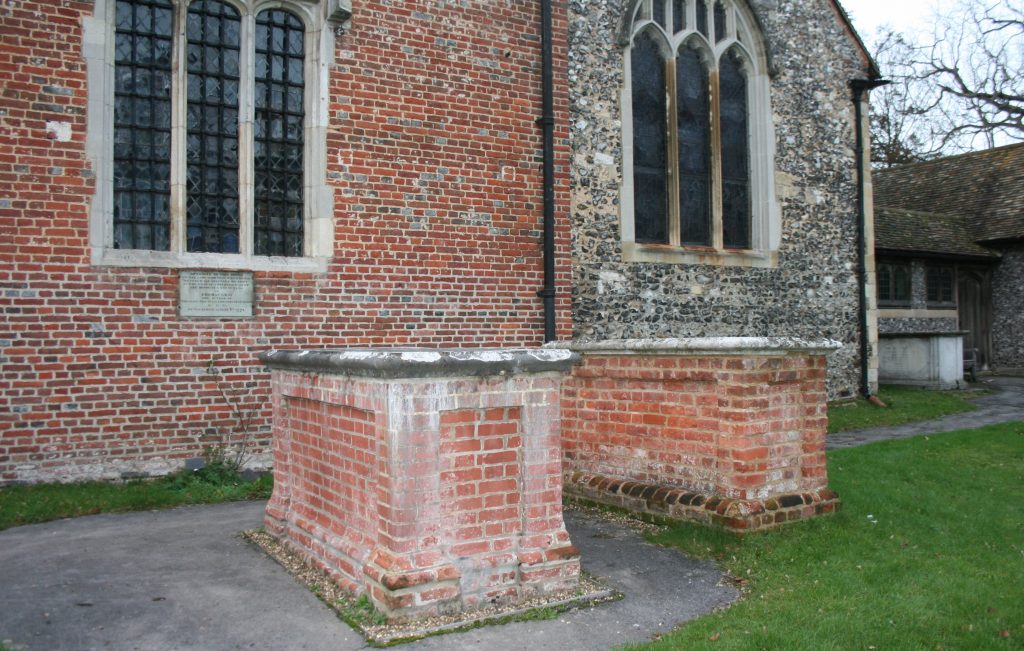
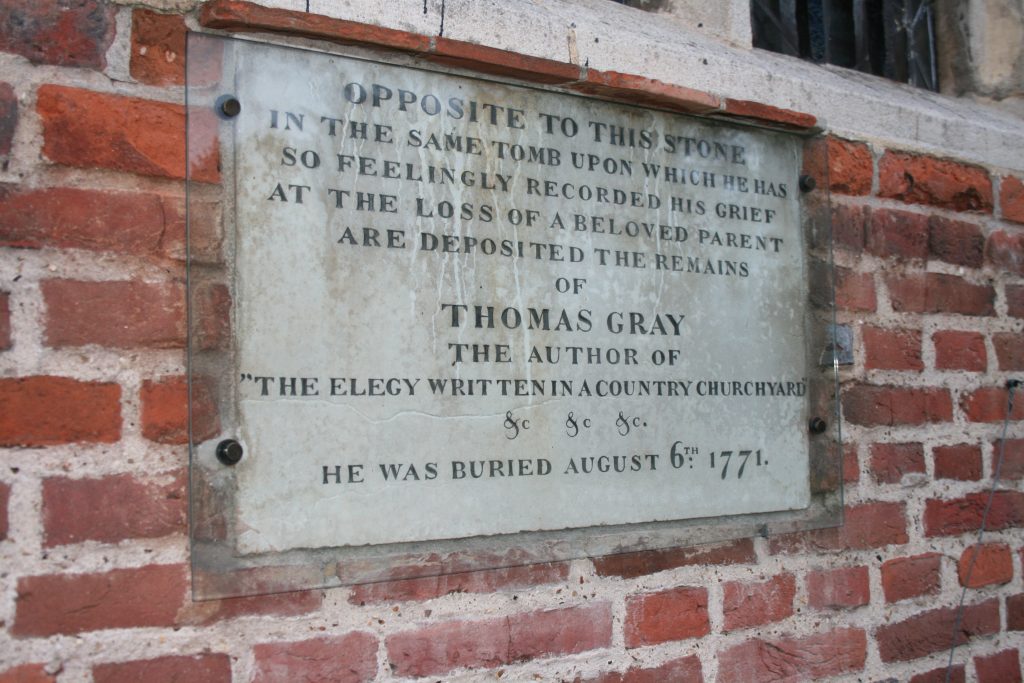
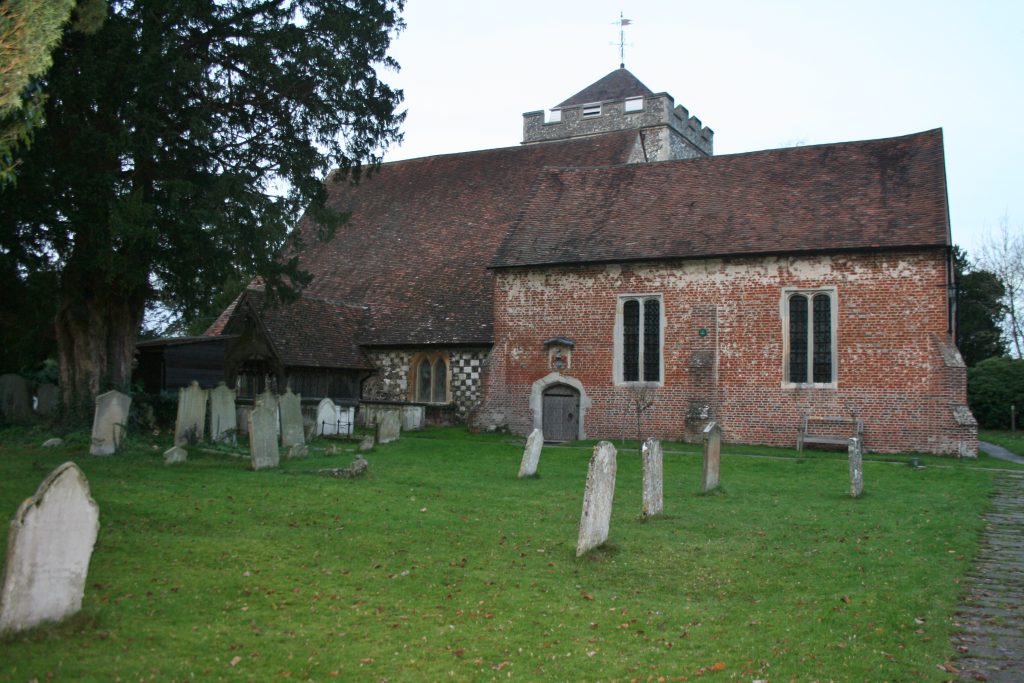
Following his own death Thomas Gray was buried alongside his mother at Saint Giles, Stoke Poges, Buckinghamshire, in the churchyard made famous by his poem.
Gray’s tomb
A plaque on the church wall advises of the location
Saint Giles church and churchyard
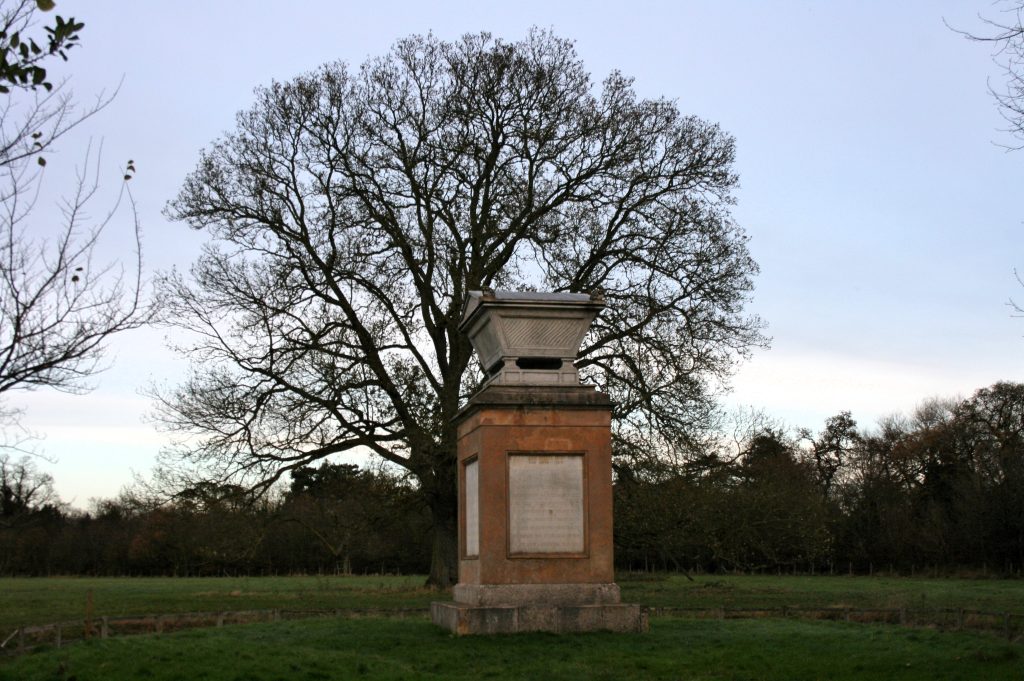
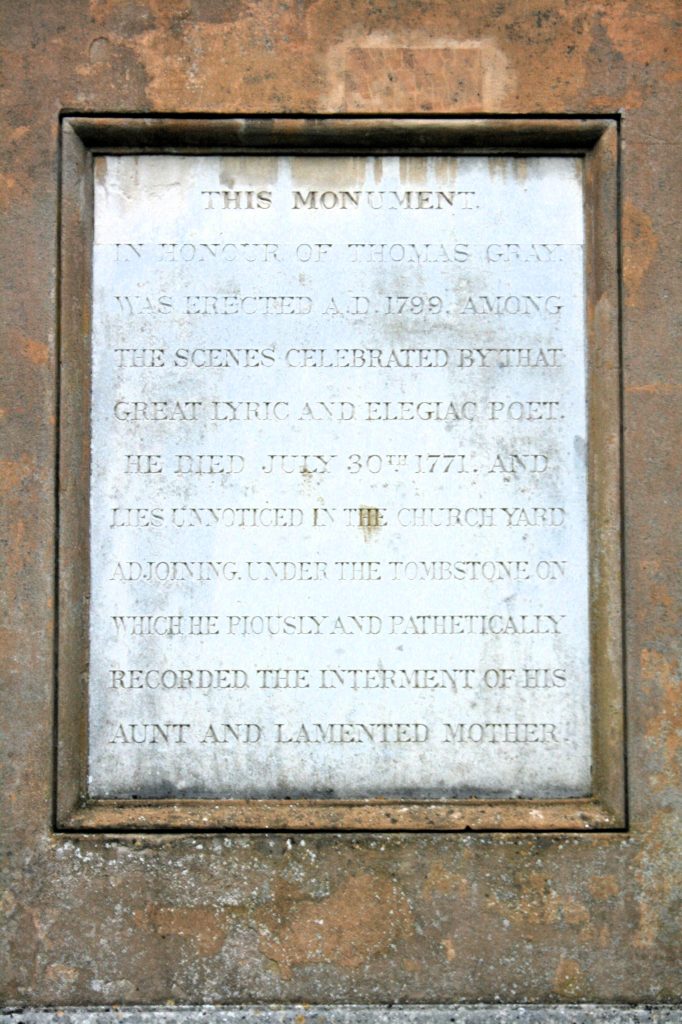
In 1799 a five metre high and monumentally ugly memorial was erected in a field adjoining the churchyard. John Penn commissioned it to form part of the vista from his new mansion at Stoke Park although he claimed it was erected to honour Thomas Gray.
Inscription on the monument. Other panels bear quotations from the poems.
There is also an extraordinarily bombastic memorial in Westminster Abbey which I can never pass without a cringe of embarrassment. The verse on it reads
No more the Grecian Muse unrivall’d reigns
To Britain let the Nations homage pay.
She felt a Homer’s fire in Milton’s strains.
A Pindar’s rapture in the Lyre of Gray.
Gray, I suspect, would have cared little for these grandiose memorials, preferring his own modest grave in the churchyard. He might even have been tempted to respond to the overblown language with a few satiric verses.
John Betjeman’s passions encompassed Victorian gothic architecture; steam trains; the English countryside and seaside; provincial towns and country churches; and the cosy, banal miscellany of buttered toast, Balkan Sobranie cigarettes, Liberty lampshades, and Hillman Imps. Often sentimental and nostalgic, his accessible verses guaranteed him a place in the pantheon of National Treasures. Academics and scholars could be dismissive: he was rejected for the position of Poet Laureate in 1967 on the basis that his work was “lightweight,” * and that he was a mere “mere songster of tennis lawns and cathedral closes.” ** And as a teenager in the 1960s, eager to embrace sophistication, I was a little ashamed of liking his poetry as much as I did.
But Betjeman was not just, as he is sometimes presented, a compound of cuddly whimsy and quirky charm. He cultivated fogeyism and winsomeness, but his work can be wry, mocking and satirical. Pathos jostles with a sardonic wit in his poems. He can be very funny; he engages with misfortune and adversity. He can also be a terrible snob and rather unkind. But neither his poetry nor his campaigning can be dismissed as “lightweight.”
Listen to a few extracts from a small selection of his poems:
For exuberant joyful absurdity nothing can equal A Subaltern’s Love Song:
Miss J. Hunter Dunn, Miss J. Hunter Dunn,
Furnish’d and burnish’d by Aldershot sun,
What strenuous singles we played after tea,
We in the tournament – you against me!
Love-thirty, love-forty, oh! weakness of joy,
The speed of a swallow, the grace of a boy
With carefullest carelessness, gaily you won,
I am weak from your loveliness, Joan Hunter Dunn…
But remember too the wistful and understated poignancy of In a Bath Teashop with its restrained economy of detail bearing a wealth of humanity and tenderness:
“Let us not speak, for the love we bear one another
Let us hold hands and look.”
She, such a very ordinary little woman;
He, such a thumping crook;
But both, for a moment, little lower than the angels
In the teashop’s inglenook.
The autobiographical blank verse poem Summoned by Bells captured the tragic brevity of childhood with a pithy:
Childhood is measured out by sounds and smells
And sights, before the dark of reason grows.
Betjeman allegedly regretted the publication of Slough, feeling that he had been unkind towards the town and its inhabitants, when it was uncontrolled industrialisation not the place itself which he abhorred:
Moreover, two years after he published those verses real bombs fell on England giving an unintended ugly twist to the poem.
In Westminster Abbey, written in 1940, for all its jaunty rhythm, Betjeman tackles darker themes of religious hypocrisy and racism:
Gracious Lord, oh bomb the Germans.
Spare their women for Thy Sake,
And if that it is not too easy
We will pardon Thy Mistake…
Keep our Empire undismembered
Guide our Forces by Thy Hand,
Gallant blacks from far Jamaica,
Honduras and Togoland;
Protect them Lord in all their fights,
And, even more, protect the whites.
Business Girls exhibits a tender empathy with the newly emancipated but poorly paid women of the mid twentieth century. And there is a hint that their independence came at too high a price, in part forced upon them by the carnage of the two World Wars:
From the geyser ventilators
Autumn winds are blowing down
On a thousand business women
Having baths in Camden Town…
Early nip of changeful autumn
Dahlias glimpsed through garden doors,
At the back precarious bathrooms
Jutting out from upper floors;
And behind their frail partitions
Business women lie and soak,
Seeing through the draughty skylight
Flying clouds and railway smoke.
Rest you there poor unbelov’d ones,
Lap your loneliness in heat.
All too soon the tiny breakfast,
Trolley-bus and windy street!
How to Get on in Society is a wonderful spoof on faux genteel manners and pretensions:
Phone for the fish-knives, Norman
As Cook is a little unnerved;
You kiddies have crumpled the serviettes
And I must have things daintily served.
Are the requisites all in the toilet?
The frills round the cutlet can wait
Till the girl has replenished the cruets
And switched on the logs in the grate…
(Pete Sarstedt’s 1969 hit Where do you go to my Lovely? which employed a similar technique, always reminded me of this poem. The song came out a mere fifteen years later but the list was very different, for lifestyle and societal ambitions had changed a great deal in that time.)
In 1973 Betjeman wrote and narrated Metroland, a television documentary focused on the suburbs of NW London. Between 1915 and 1933 the Metropolitan Railway had built houses adjacent to the line heading out of London through Middlesex, Hertfordshire and Buckinghamshire. They coined the slogan “Live in Metroland,” and produced a brochure promoting their Tudorbethan properties. The fulsome marketing language played on middle class aspirations, advertising spacious homes with gardens and garages in an idealised environment surrounded by trees and nature, but within easy commuting distance of the City.
Betjeman liked suburbia, and his commentary, delivered partly in verse and over an old black and white film shot from an MR train, sounds superficially like an unqualified homage to commuter towns, reflecting the MR’s own celebration of the comfortable suburban life of ladies who lunch, and their car washing, lawn mowing, golf playing husbands. But if there is affection in his portrait, it is tinged with regret, for Betjeman is conscious of the irony that in offering former city dwellers a quasi-rural retreat, the frenzy of construction destroyed the very countryside it promoted. When he looks out at the end of the MR line he reflects, “Grass triumphs. And I must say I am rather glad.”
Moreover, though Betjeman is broadly comfortable with semi-detached houses and golf courses, he cannot resist a snobbish aside worthy of Nancy Mitford when he describes Neasden as “The home of the gnome and the average citizen.” There was an acidity never far below the surface in Betjeman’s work; he had previously parodied the aspiring inhabitants of suburbia in Middlesex:
Gaily into Ruislip Gardens
Runs the red electric train,
With a thousand Ta’s and Pardon’s
Daintily alights Elaine…
National Treasure maybe, but Betjeman is neither lightweight nor cuddly. He is too self-consciously clever and sharp for that. Yet those very attributes make him a better poet than he is sometimes credited with being.
Then alongside Betjeman the poet is Betjeman the campaigner, and again his work is far from that of a good natured, bumbling dabbler.
A founding member of the Friends of Friendless Churches, he edited and wrote part of the Collins Guide to English Parish Churches. Simon Jenkins in his own England’s Thousand Best Churches recalls Betjeman’s tireless campaigns to save redundant churches, and reminds us of our debt to
Three ghosts (who) inhabit all English churches. They linger in every arcade, peep from every gallery and flit across every monument. They are those of John Betjeman, Alec Clifton-Taylor and Nikolaus Pevsner.
Betjeman’s enthusiasm extended to secular architecture. A railway enthusiast and champion of Victorian architecture when it was unfashionable, he led the unsuccessful fight to save the Euston Arch, the doric entrance to the station which was demolished in 1961.But his influence and determination were instrumental in saving the most spectacular of all the Victorian railway stations – St. Pancras and its adjacent Midland Grand Hotel.
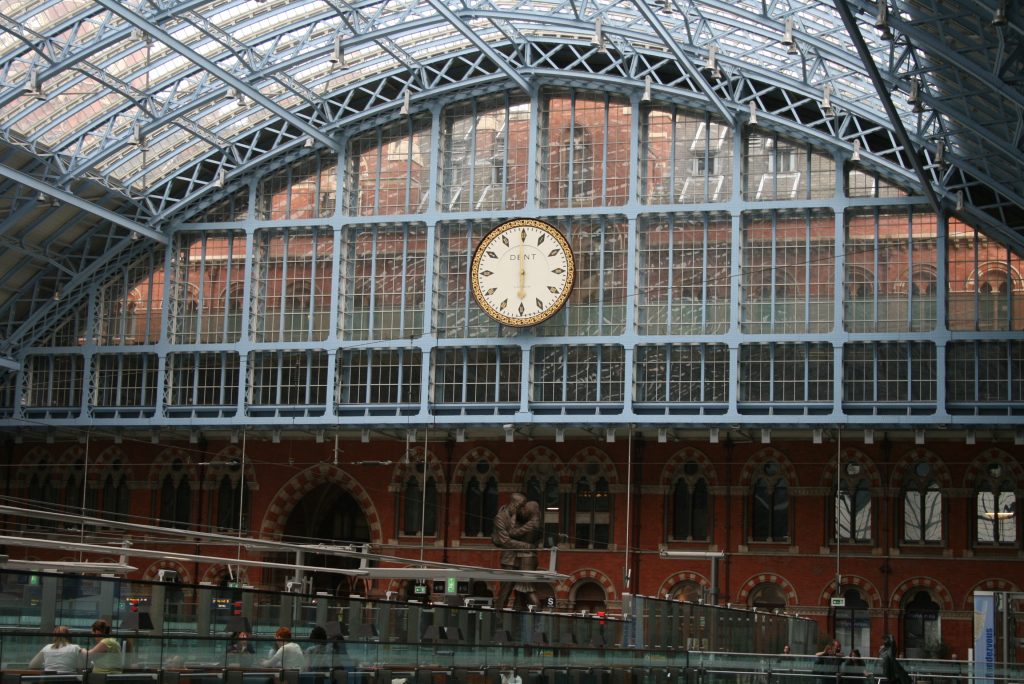
The work of George Gilbert Scott, 207 metres long and seventy metres wide, supported by 850 cast iron pillars and covered by an arched glass ceiling, the train shed at St. Pancras station is the acme of high Victorian secular architecture. When it opened in 1876 the hotel was the first to have electric lifts, “ascending chambers”, flushing lavatories, and revolving doors. In the 1890s the Ladies’ Drawing Room became the first Ladies’ Smoking Room in London. But when it closed in the 1930s it still had only five bathrooms for three hundred bedrooms. It became railway offices, then after bomb damage during the war it stood empty. In the 1960s both the station and the hotel were scheduled for demolition.
Their survival was ensured after Betjeman led the fight to prevent their destruction and they became grade 1 listed buildings in 1967.But the station was in decline as more of the north bound trains made Euston their terminus, and the hotel remained empty. In the 1990s English Heritage restored the exterior, and organised tours enabled us to see the magnificence which lay within beneath the layers of dust and dirt.
Salvation came in the form of Eurostar which since 2007 has operated out of St. Pancras. The station was renovated, and in 2011 the hotel reopened with 244 rooms – en suite – and sixty-eight apartments. The breathtaking grand stair once again curves up beneath the cerulean ceiling spangled with gold stars.
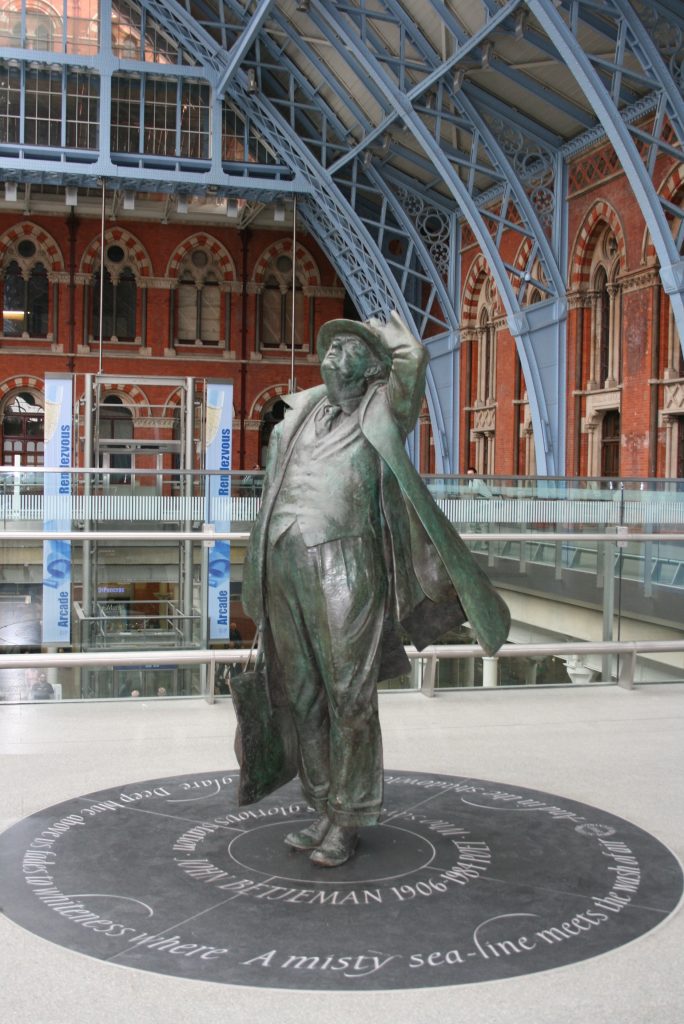
Betjeman died in 1984, too soon to see the magnificently restored station and hotel, but his statue stands, gazing up in delighted wonder at the glass ceiling of the train shed – and conveniently located for the champagne bar. Raise a glass to him when you travel this way; he saved something splendid for us all.
Statue of Betjeman gazing up at the glass ceiling of the train shed, Saint Pancras
Ceiling of the train shed, Saint Pancras
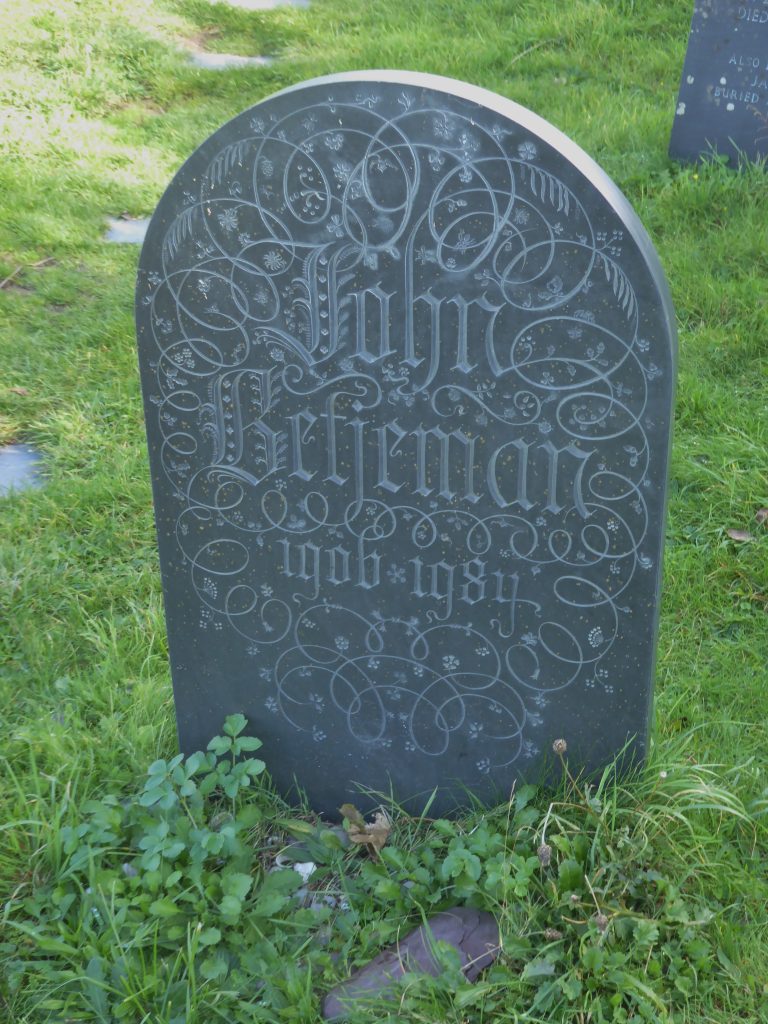
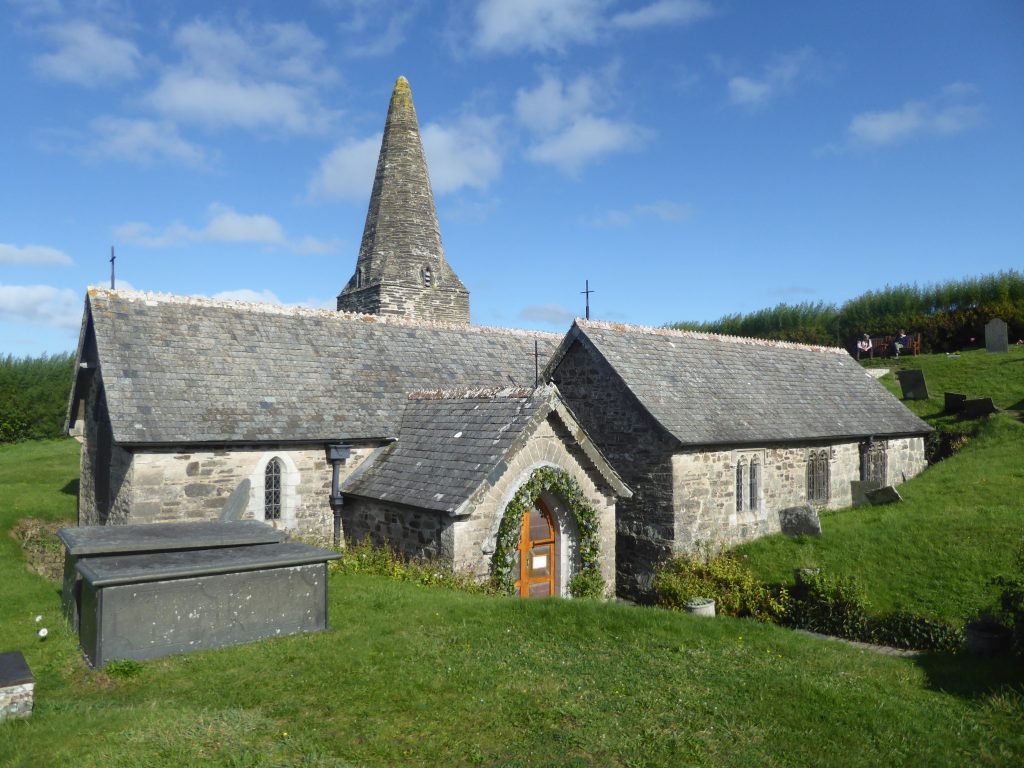
And you can visit his grave in Saint Enodoc’s churchyard in Trebetherick, Cornwall. Both St. Enodoc and Trebetherick, where he had spent childhood holidays, feature in his poems.
The fine lettering and decoration on the black slate are the work of the stone mason Simon Verity. In his introduction to English Parish Churches Betjeman praised the elegance of the stone carver’s craft, ubiquitous in graveyards until the middle of the nineteenth century, with letters and decoration deep cut into local stone. Sadly he contrasted it with the modern “machine made letters inserted into white Italian marble.”
John Betjeman’s grave, Saint Enodoc
Saint Enodoc’s church
It’s a beautiful location, near the sea, the old church partially sunk into the sand dunes, but… church and churchyard are surrounded by a hideous golf course. To reach them you must cross the sterile links, pass golfers in their pastel leisure-ware, and risk being hit by their flying balls. But Betjeman would not have minded; he loved golf and particularly liked to play on a seaside course.
*Helen Gardner, Merton Professor of English, Oxford
**Lord Goodman, Chairman of the Arts Council.
Betjeman was appointed Poet Laureate when the position fell vacant again in 1972.