Meet Bouboulina, a handsome woman, as befits a revolutionary heroine.
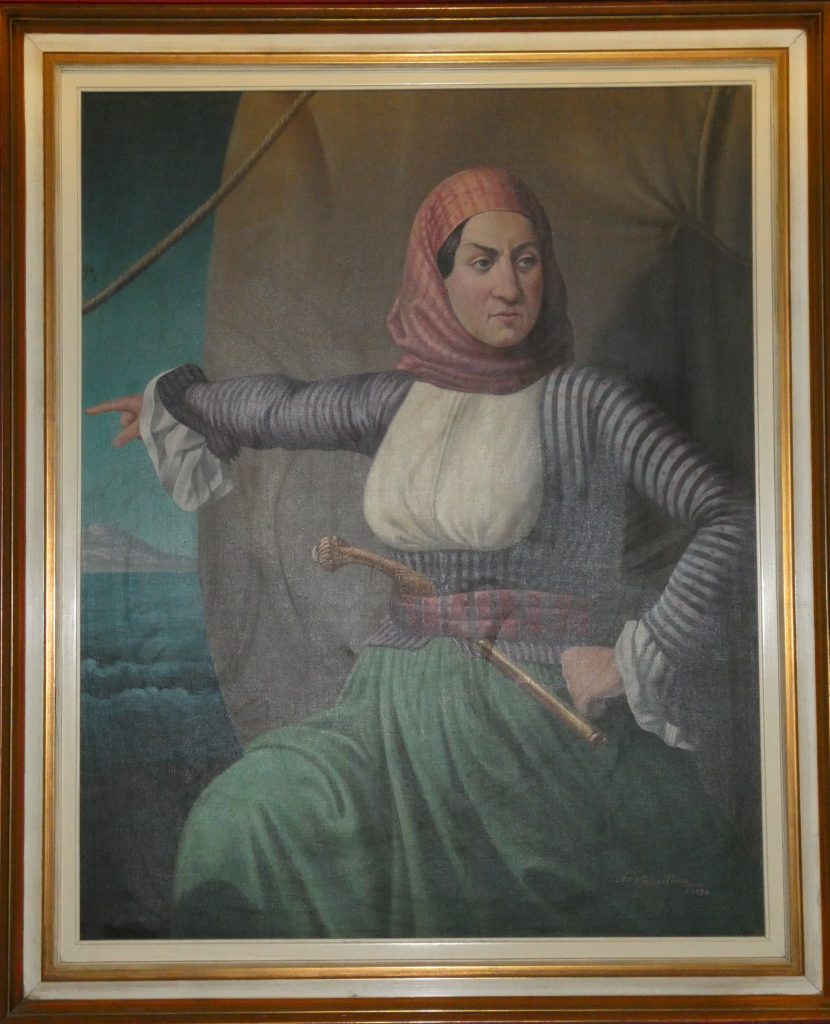
Commensurate with her position as a celebrated freedom fighter, Bouboulina has a colourful history.
She was born Laskarina Pinotsi, in a Constantinople prison where her mother was visiting her father. Stavrianos Pinotsis, an Arvanite (Greek of Albanian origin) sea captain from Hydra had been incarcerated by the Ottomans for his part in the abortive Orlov Revolt. He died soon after his daughter’s birth and her mother returned to Hydra, later moving to Spetses where she married another veteran of the Orlov Insurgency.
Bouboulina grew up in Spetses, enjoying a more physically active childhood – sailing, swimming and riding – than might have been expected for a girl of her times. She married first Dimitrios Yiannouzas in 1788, then Dimitrios Bouboulis in 1801. Both were sea captains and both drowned in battles against Algerian pirates. This left Bouboulina a very wealthy widow.
Unusually, but consistent with her position as a woman of Arvanite descent, Bouboulina took over her husbands’ fortunes, their businesses, and their ships. She acquired more land, cash, and vessels, building up her own merchant fleet.
Defending her capital required steely resolution. The Ottomans sought to confiscate her assets on the grounds that her husband had fought on the Russian side in the Russo-Turkish war. Bouboulina travelled to Constantinople to defend her rights. Enlisting the aid of another woman, the Valide Sultan (the Sultan’s mother) Natsidil Sultan, she retained her property.
In 1820 two of her stepsons, in a dispute over their inheritance, instigated her excommunication by the Patriarch Gregory V. If this was designed to intimidate her into surrendering control of her wealth it was unsuccessful.
Bouboulina supported the Filiki Etaireia, an underground organisation, modelled on Carbonarist and Masonic lines, preparing Greece for revolution against Ottoman rule. The organisation did not admit women but along with others, like Manto Mavrogenous and Marigo Zarafoupoulo, Bouboulina financed ships and smuggled weapons and ammunition to revolutionaries.
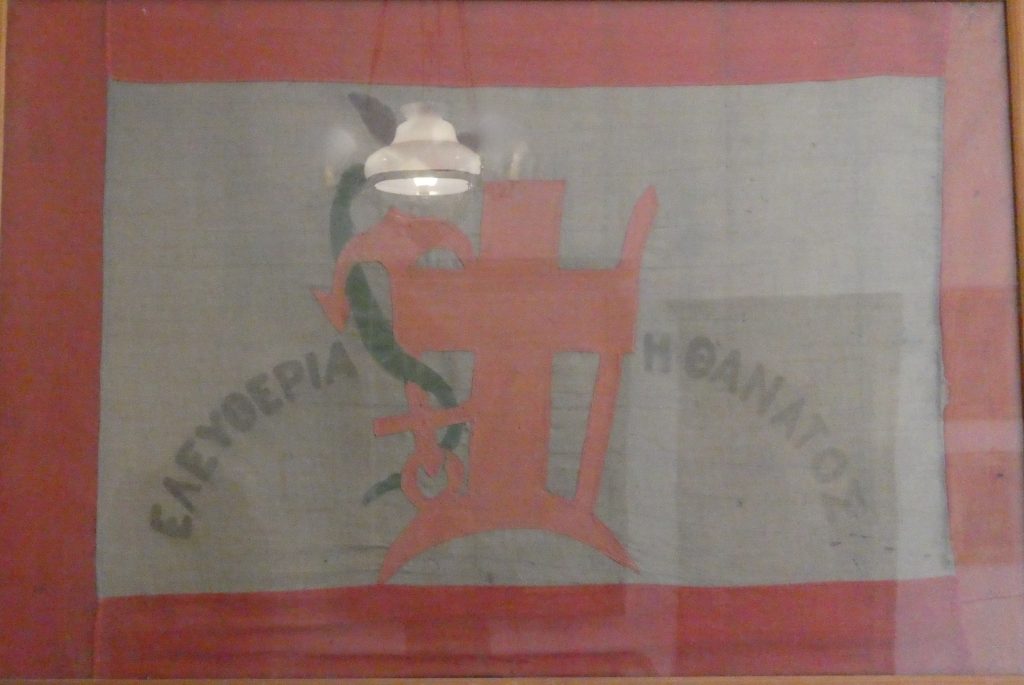
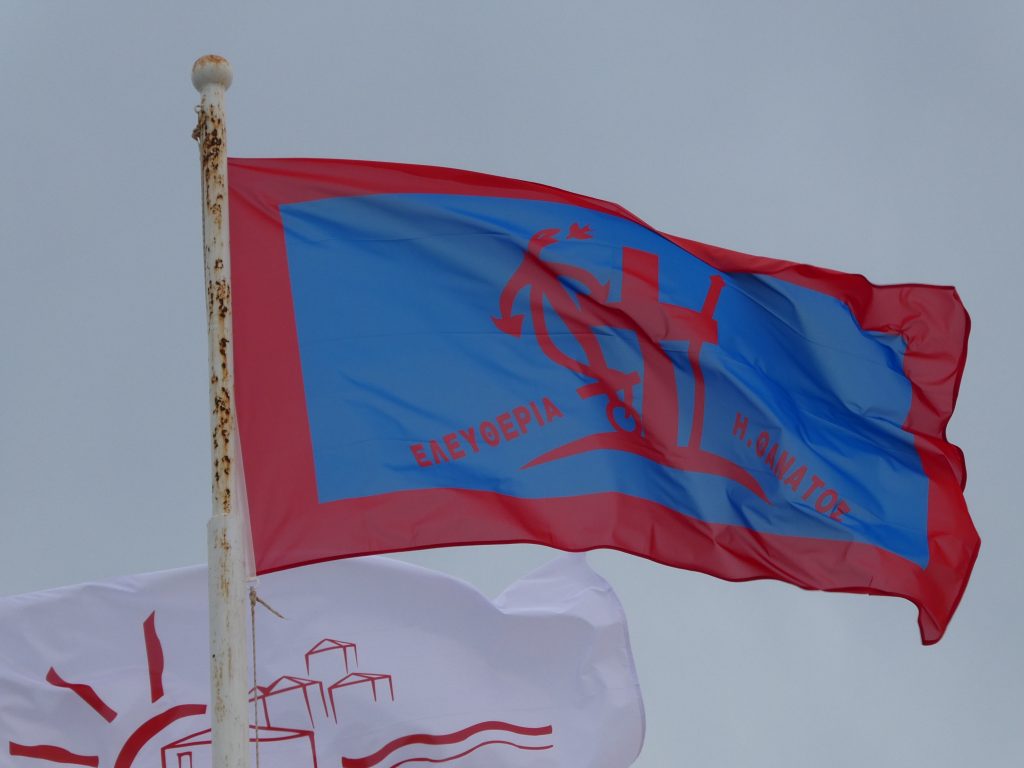
Against Ottoman regulations she ordered the construction of the Agamemnon, the first modern warship in Greece, bearing eighteen cannons. She bribed Turkish officials to register it as a smaller trade ship. On 3rd April 1821, twelve days before the Greek Revolution was officially declared, she raised the flag of the revolution on the mast of the Agamemnon. Spetses became the first island to fly a revolutionary flag.
Bouboulina gave command of the Agamemnon to her son Yiannis Yiannouzas. They sailed together with eight other ships from Spetses to take part in the naval blockade of Nafplion.
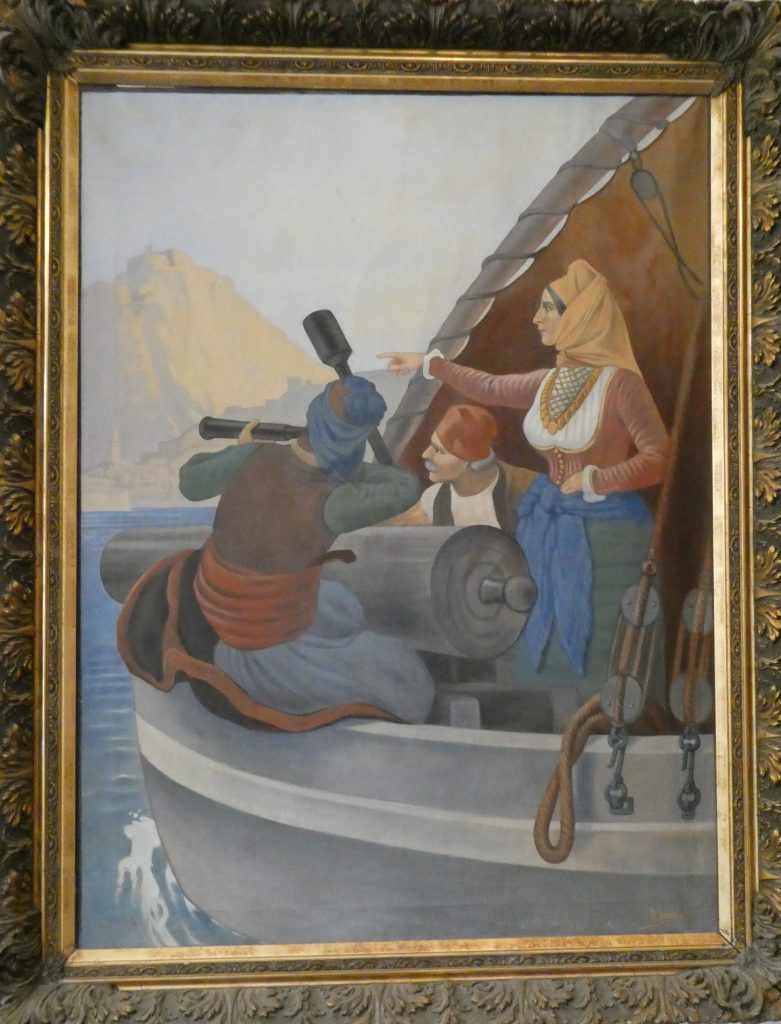
When Turkish forces hoping to raise the blockade rode towards Nafplion, the Greeks joined battle with them outside Argos. Yiannis Yiannouzas was killed and beheaded. Bouboulina collected her son’s remains, executed three Ottoman prisoners during the funeral ceremony, and sent back word to Spetses,
My son is dead, but Argos is ours.
In May, Bouboulina began a blockade of Monemvasia with the Agamemnon. The Turks surrendered in July.
In September with Tripolitsa about to fall to the Greek troops of Kolokotronis, she entered the city on a white horse. Remembering the assistance which the Valide Sultan had given her she was determined to save the lives of the women of the harem of Hourshid Pasha. Through her intervention and diplomacy, she negotiated a deal to exchange them for Greek ecclesiastical leaders. Drawing her own sword in defence of the women, she warned the disaffected Greek soldiers that they could take the women’s jewellery but not harm them: “whoever attempts to do so will have to pass first over my dead body.”
When the Ottomans surrendered Palamidi castle in Nafplion in November 1822, and the first Greek government was established there, Bouboulina moved into a house in the town. She continued to finance the revolution, spending most of her fortune providing weapons and support for the families of revolutionaries. She married her daughter, Eleni, to Kolokotronis’ son Panos.
When the civil war began in 1824, Bouboulina supported Kolokotronis and the old executive of the Provisional Administration against the new executive. As a result, this heroine of the revolution was arrested twice and briefly imprisoned accused of witchcraft and heresy. Her house was confiscated and she was expelled from Nafplion. She returned to Spetses.
Yet despite her support for Kolokotronis, when his son Panos was killed in the second civil war, she would not allow her ally to choose another husband for her daughter. Rather than let him organise another marriage for a strategic alliance she took her daughter home demanding the return of her dowry (unsuccessfully).
A final drama unfolded when Bouboulina’s son Georgis Yiannouzas eloped with Eugenia Koutsi, whose family had betrothed her to a man she disliked. Bouboulina’s sympathies lay with the couple, but the Koutsis family felt their honour had been compromised, or perhaps sought to avoid an alliance with a now impoverished family. Assuming the couple were at Bouboulina’s house the Koutsis family arrived there. Bouboulina confronted them and was shot in the forehead as she stood on the balcony of her house.
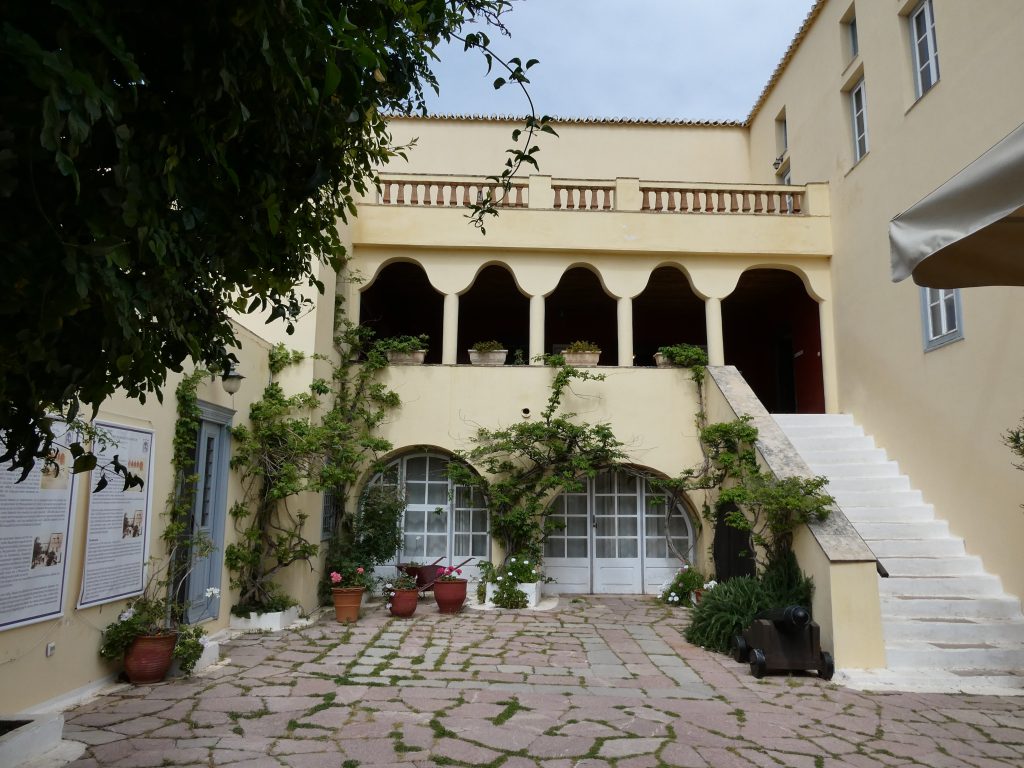
She was buried in the family vault in the church of Agios Ioannis, and in 1928 the casket with her bones was moved to the church of Agios Nikolaos. When the Spetses museum was established in 1939 the casket was moved again.
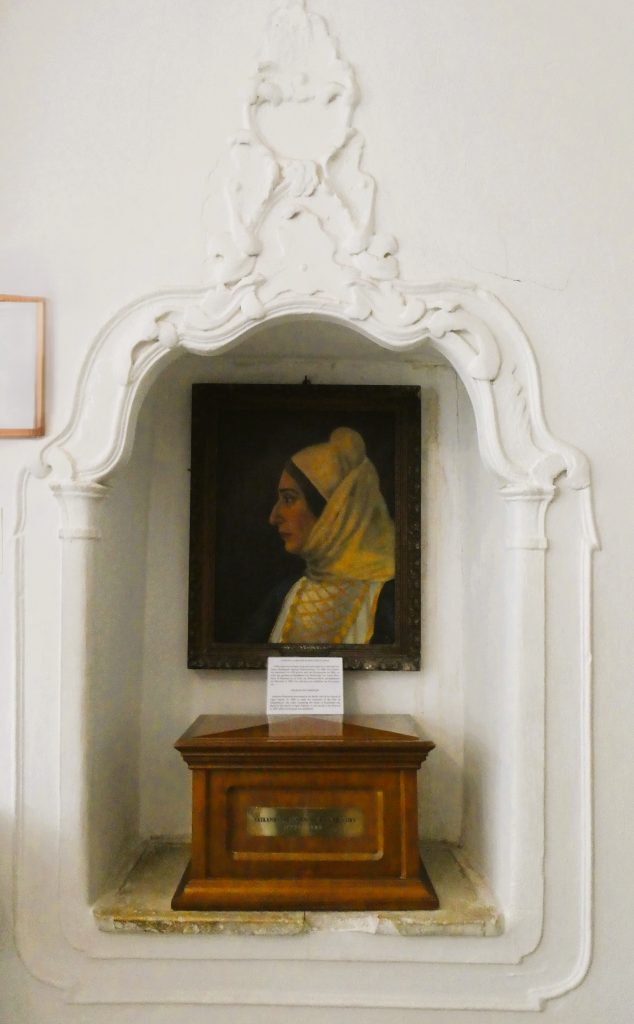
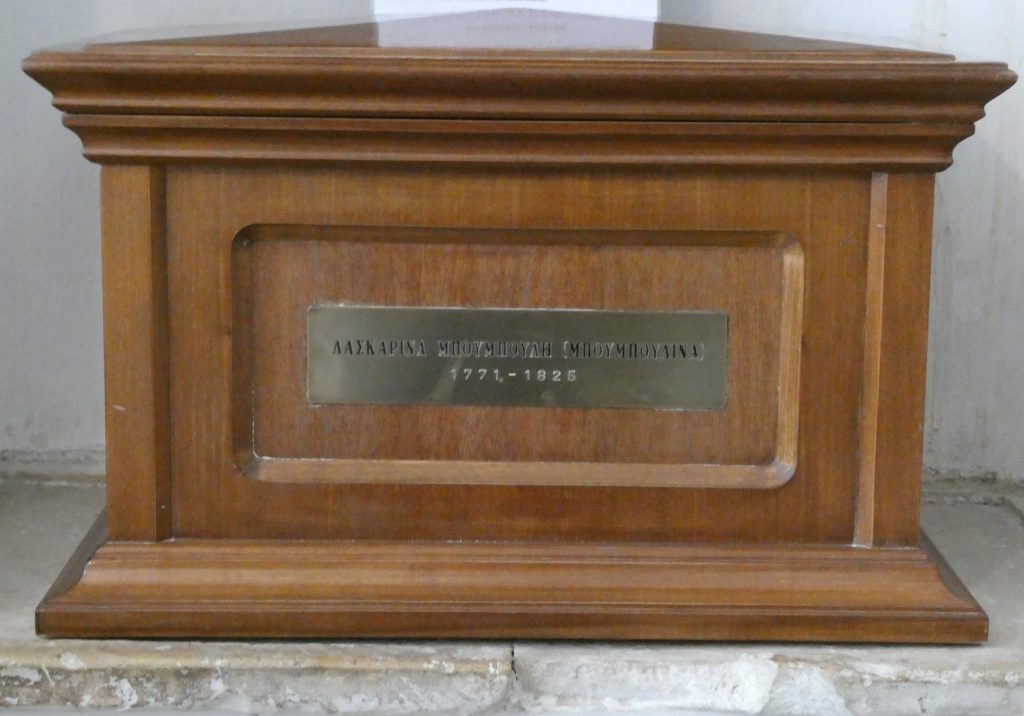
How accurate is this story of Bouboulina? Honestly, I have no idea. The accounts I read were contradictory even over minor details. And it is impossible not to wonder if the philhellenes, who published many of the early accounts, were impartial when they recorded the exploits of the woman whom they revered.
Did she save the women of the harem of Tripolitsa from compassion or did realpolitik dictate that they were worth more alive than dead? Elsewhere in the town there was butchery and looting. It was the norm on both sides, unlikely that Bouboulina was an exception. After the fall of Nafplion she may well have used her position on the commission charged with redistribution of property for personal gain. That too was a norm.
It was more than two hundred years ago, and I like the romantic story of Bouboulina in the same way that I like the story of another maritime national hero, Francis Drake. That is not to be blind to uncomfortable evidence, but this is a blog, not an academic treatise. And I am certain that for the courageous Bouboulina the words on the revolutionary flag – Freedom or Death – were no empty rhetoric.