For blog number one hundred, let me introduce you to John Pitt. When he died he was one hundred and one years old, and he had lived in three centuries. Admittedly this is a tenuous link. Moreover I know little else about him. I did however take some trouble to track him down in the churchyard of Saint Juthware and Saint Mary, in the village of Halstock in Dorset. The village has a population of only 420, is surrounded by working farms, and accessed by tortuous lanes. Following recent storms, the latter were flooded last week. Faced with small lakes of uncertain depth my normal, rational reaction would be to retreat, but since this would have meant reversing down long, narrow, winding tracks with the added possibility of running into a tractor or hedge trimmer, I took a deep breath, metaphorically closed my eyes, and ploughed on. I weathered the waters but would undoubtedly still be making futile circuits of the Dorset byroads were it not for the wonders of google maps and satellite navigation.
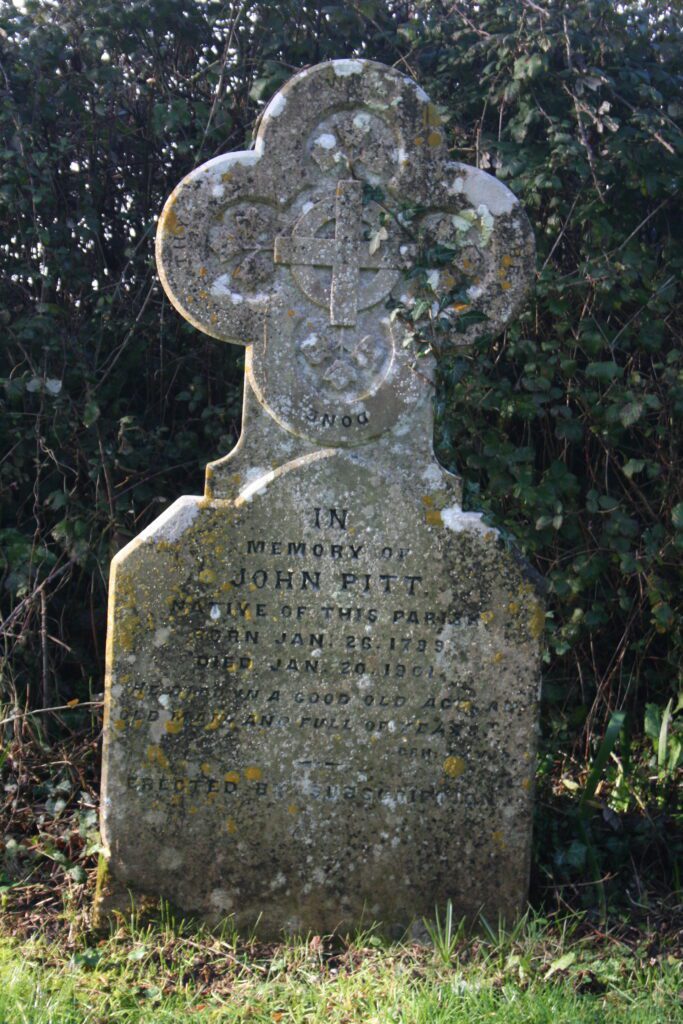
So here he is, John Pitt born in Halstock in 1799. He worked as a shoemaker. In 1823 he married Tryphena Garrett, and after her death married again to a widow, Mary Tucker, in 1865. He died in 1901 in Sherborne Workhouse, a cruel but still common destiny in the early twentieth century for those who outlasted their working lives. His gravestone was erected by public subscription, perhaps by parishioners impressed by his longevity.
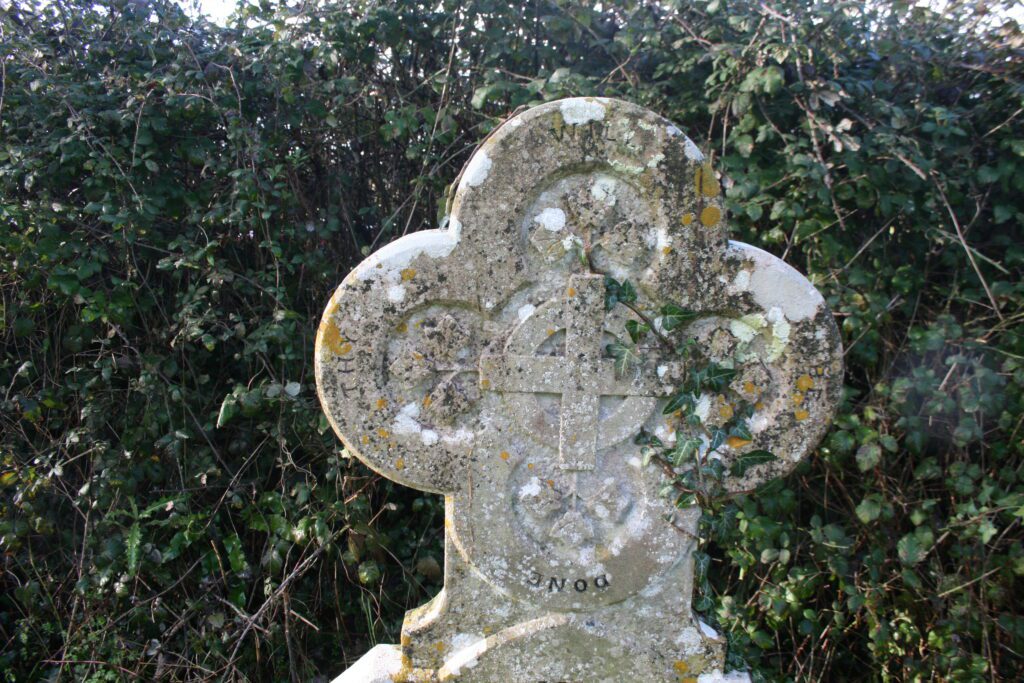
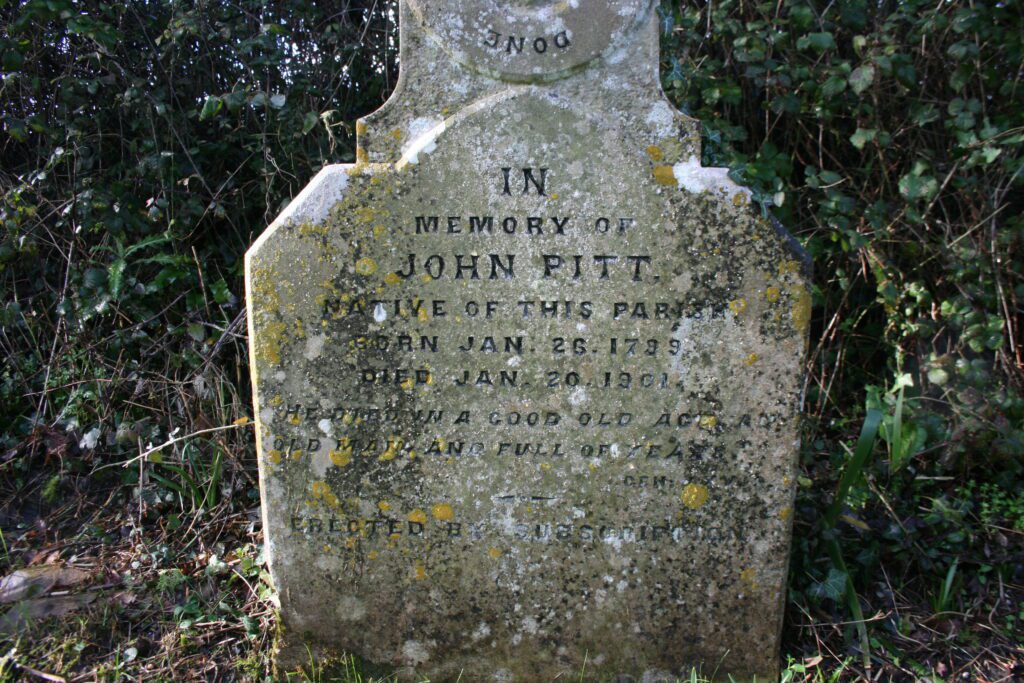
The carved ivy leaves found at each point of the cross on the upper part of the stone were a popular symbol of immortality. Today they are being superseded by the real thing, which I had to peel off to decipher the inscription on the base.
His epitaph reads:
IN MEMORY OF JOHN PITT NATIVE OF THIS PARISH BORN JAN. 26. 1799 DIED JAN. 20. 1901 HE DIED IN A GOOD OLD AGE, AN OLD MAN FULL OF YEARS
The quotation is from Genesis 25, 8. I looked it up. It refers to the death of Abraham, who, according to the previous verse, lived to be 175 years old, thus outclassing John Pitt, and embroiling biblical scholars in serpentine conjectures.
While paying my respects to John Pitt, I had become curious about the identity of the church’s titular saint, Juthware. The earliest records of her existence come from the fifteenth century Sherborne Missal and John Capgrave’s Nova Legenda Angliae, but they place her in the eighth century. Various retellings of her life mix grim fairy tale tropes with the prurient enthusiasm of Christian hagiography for virgin martyrs.
According to these stories, Juthware was a pious girl with a jealous stepmother. After the death of her father Juthware began to suffer chest pains due to her sorrow and the austerities to which she subjected herself with prayer and fasting. Seizing her chance, the wicked stepmother began to spread rumours, telling her son that his half-sister was a fallen woman bearing an illegitimate child. To make this convincing, she slaughtered a lamb, fed its carcass to the wolves in the woods, then led her son to the bloodied remains telling him that they were Juthware’s child.
Meanwhile she had feigned sympathy with her stepdaughter, advising her to apply a poultice of two soft cheeses to ease the pains in her breasts. As Juthware walked to church the cheeses melted and seeped through her clothing, enabling her stepmother to claim that it was breast milk.
Convinced by this calumny, her stepbrother beheaded Juthware outside the church. But milk rather than blood flowed from her wounds, and she picked up her head, walked into the church, and placed the head on the altar as an offering to god. A spring of pure water burst forth where the head had fallen.
Juthware’s relics were translated in the tenth century to Sherborne Abbey where they were venerated until they were destroyed at the Dissolution of the Monasteries. Today she is celebrated in the east window of the former abbey, now a parish church.
She was also remembered when around 1700 a public house opened in Halstock bearing the name Ye Quiet Woman, and with a painted sign of Juthware with her head tucked under her arm. Thomas Hardy took the name for his fictional public house in The Return of the Native.
The pub closed only in the 1990s after almost three hundred years. Although the name is offensive, I regret that I never saw it. But at least, with the aid of Hardy’s novels, I can imagine John Pitt in its dimly lit, smoky interior, sitting on a wooden bench near the fireplace, supping his ale amongst the reddlemen, furze cutters, shepherds, tranters, carriers, and charcoal burners who peopled the village.
It took me some time to cross the South Circular, a vicious road which hurtles from its junction with the North Circular and the M4 at Chiswick, across the Thames via Kew Bridge, and south through Kew and Putney, before veering on a wild course east through Clapham, Dulwich, and Lewisham, to end at the Woolwich ferry. In what was once the hamlet of Kew it severs Kew Green in two, leaving Saint Anne’s church, which originally sat in the centre of the green, stranded in the western half. Saint Anne’s was built in 1714 as a chapel of ease and has been extended several times, but my purpose in manoeuvring across the A205 was not to see the church but the raised churchyard which surrounds it on three sides, and in particular the graves of two eighteenth century painters: Gainsborough and Zoffany.
Thomas Gainsborough (1727-1788) and Johan Zoffany (1733-1810), both founder members of the Royal Academy, were phenomenally successful in their lifetimes. They had little else in common, apart from fortuitously ending up in the same burial ground: Gainsborough had requested burial there to be close to his friend and fellow artist Joshua Kirby, and Zoffany was resident in the parish, living on the opposite side of the river at Strand on the Green. In Britain Gainsborough’s star has never faded, but Zoffany’s reputation has been more inclined to fluctuation.
Grave of Gainsborough, St. Anne’s, Kew. It has been restored twice, in 1835 and 2012
With Gainsborough are his wife and nephew, Gainsborough Dupont, who was his sole assistant
Grave of Zoffany, St. Anne’s, Kew
“His Widow caused this Tomb to be erected as a Memorial of her Affection”
With Zoffany are his wife and grand daughter, Laura, who died at nine months: “This lovely bud so young so fair called hence by early doom. Just came to show how sweet a flower in Paradise would bloom.”
Born in Sudbury, in Suffolk, Gainsborough studied art in London. On his return to Ipswich, he enjoyed a very modest success with his landscapes and small head portraits of local merchants and squires. Only when he moved to Bath in 1759 did his fame and popularity grow, resulting in lucrative commissions from a stylish clientele in the fashionable spa town. His portraits became larger with life-size, full-length paintings of prominent social figures: actors, playwrights, musicians, and aristocrats.
Thomas Gainsborough, Mr. and Mrs. William Hallett, The Morning Walk. The National Gallery. Public Domain via Wikimedia Commons.
Thomas Gainsborough, Mrs. Mary Robinson (Perdita). The Wallace Collection. Public Domain via Wikimedia Commons
Thomas Gainsborough, Queen Charlotte. The Royal Collection. Public Domain via Wikimedia Commons
But Gainsborough was inclined to be cantankerous, and he was soon complaining that he was “sick of portraits” and yearned to indulge his real passion for “landskips.” (sic)
After settling in London in 1774, he began to integrate his sitters into landscapes. And gradually the figures shifted to the margins until, in his later years, the sitters disappeared entirely, and he returned to the pure landscapes which gave him most satisfaction. Oddly, unlike his youthful works, these were rarely painted from nature but completed at night by candlelight with model landscapes set up in his studio, using stones, twigs, leaves, and mirrors.
Thomas Gainsborough, Mr. and Mrs. Andrews. ( pushed to the edge of the landscape) The National Gallery Public Domain via Wikimedia Commons
Thomas Gainsborough, Landscape, Suffolk. Kunsthistorisches Museum, Vienna. Public Domain via Wikimedia Commons.
And in the Victoria and Albert museum is his strange “showbox”: sometimes Gainsborough painted landscapes with oils on glass, and backlit them with candles in the dark box to be viewed through a magnifying lens.
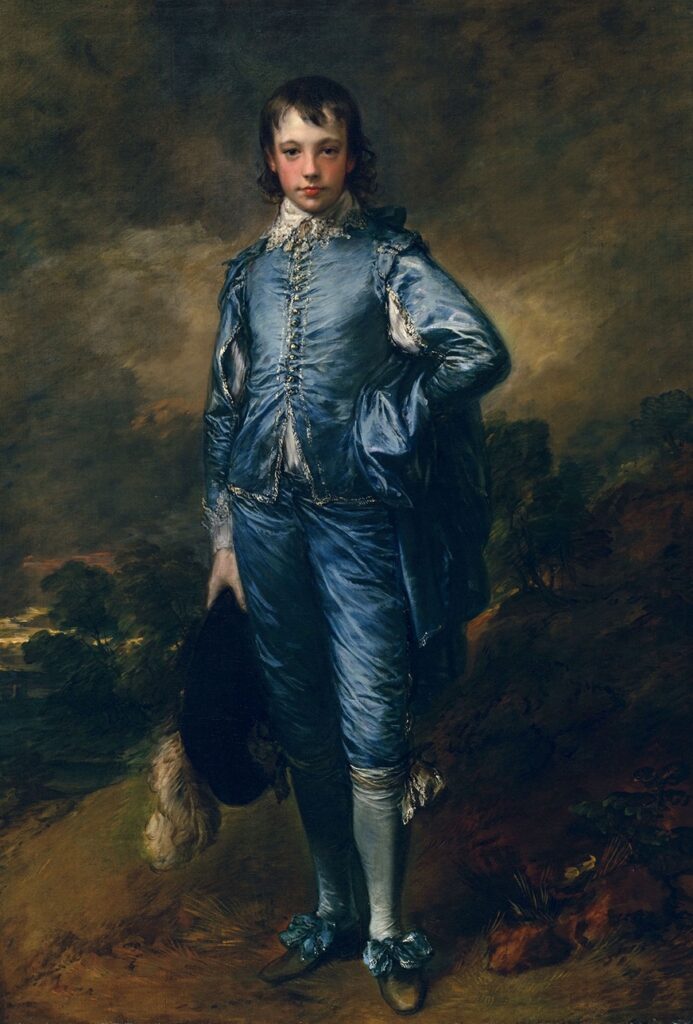
Gainsborough is credited as a founder member of the British landscape school, and, with Reynolds, as the dominant British portraitist of the late eighteenth century. But I have never been able to summon much enthusiasm for his work. Faced with grey powdered wigs, elaborate fussy hats and dresses, the stiff poses of his sitters, combined with the sludgy colours of the landscapes, I generally find the dogs the most attractive components of the portraits. And when, as with the famous Blue Boy, Gainsborough’s work reveals the influence of Van Dyck in both costume and technique, I find the effect positively weird.
Thomas Gainsborough, The Blue Boy. The Huntington, San Marino, California. Public Domain via Wikimedia Commons
Zoffany’s work is so much more fun: a merry-go-round of swirling colours; wry, risqué, full of satirical allusion. And his life was as flamboyant as his paintings. Of Hungarian and Bohemian origins, he was born in Frankfurt and when he was seventeen, he walked to Rome to study art. Ten years later he was in England where David Garrick became his first major patron. His depictions of Garrick both in his theatrical performances and with his family secured Zoffany’s fame. Like Gainsborough he was in demand for portraits of actors, musicians, scientists, and society. In 1764 he was taken up as a court painter, joining the expatriate German community around George III and Queen Charlotte.
Johan Zoffany, David Garrick as Jaffier in Venice Preserved. Holburne Museum. Public Domain via Wikimedia Commons
He combined the exuberance of his painting with a meticulous attention to detail. Commenting on the latter, the art critic Christopher Hussey described him as “the Jane Austen of English painting,” which is apposite only so long as it applies only to his representation of teacups and saucers.
Zoffany espoused the genre of conversation pieces, adapting it specifically to produce theatrical conversation pieces, filling his huge canvasses with large casts of instantly recognisable actors.
Similarly, in The Academicians of the Royal Academy, artists jostled with models and works of art. At the request of the Royal household, he worked for five years on the Tribuna of the Uffizi, but here he came to grief for the bigoted and prudish Charlotte was shocked to recognise two notorious “finger twirlers”, a derogatory term for homosexual men, in the crowded gallery. There were no more Commissions from Charlotte.
Johan Zoffany, The Academicians of The Royal Academy. Royal Collection. Public domain via Wikimedia Commons. The two women members of the Royal Academy, Mary Moser and Angelica Kauffman, appear only as portraits on the wall; women were barred from life classes on the grounds of “propriety.”
Johan Zoffany, The Tribuna of the Uffizi. Royal Collection, Windsor Castle Public domain via Wikimedia Commons
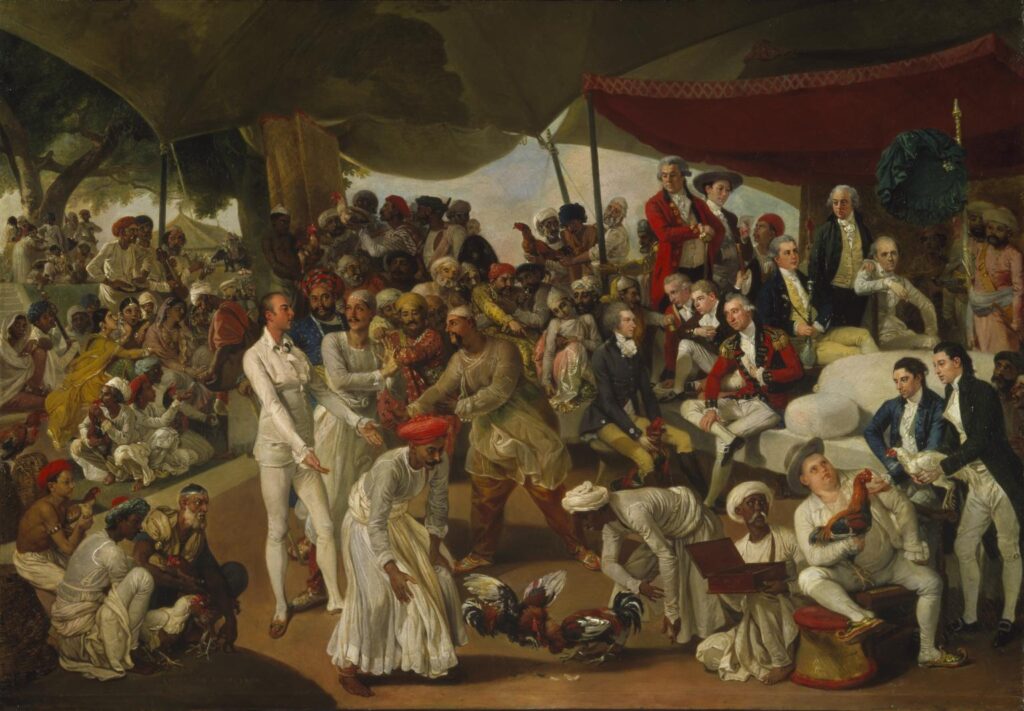
Unperturbed Zoffany set out for India, the paintings he produced there providing a wonderful insight into what William Dalrymple has described as the intermixing and mingling of people, culture and ideas in eighteenth century India before racial prejudices, arrogant imperial policies, and an ugly desire for British control swept all this away in the nineteenth century. Dalrymple uses a detail from Zoffany’s General William Palmer and Family for the cover of his book White Mughals; in the painting Palmer and his wife, the Mughal Princess, Bibi Faiz Bakhsh appear with their children and her sisters. In Colonel Mordaunt’s Cock Match, Zoffany portrays a fight between the prize cockerel of the royal family of Awadh and that owned by East India Company men, a painting in which he and his friends also featured.
Johan Zoffany, Colonel Mordaunt’s Cock Match. Tate Britain Public Domain via Wikimedia Commons
He painted an altar piece of the Last Supper for Saint John’s church in Kolkata, using local merchants as models for the apostles, a Greek Orthodox priest as a model for Jesus and, more controversially, the Police Magistrate Blaquiere for Saint John. Blaquiere who had feminine good looks and enjoyed cross dressing, had frequently used female disguise in successfully apprehending bandits, but he was unpopular with some Europeans because of his indifference to Christianity and his sympathy for local religions and customs. It was however Zoffany’s modelling of Judas on William Tulloh, an auctioneer with whom he had fallen out, which landed him with a lawsuit.
As he sailed back to England, Zoffany was shipwrecked off the Andaman Islands. Dalrymple comments drily,
Lots having been drawn among the starving survivors, a young sailor was duly eaten. Zoffany may thus be said with some confidence to have been the first and last Royal Academician to become a cannibal. *
Back in England Zoffany produced a second notorious altarpiece featuring the Last Supper, this a commission from Saint Anne’s at Kew. He used fishermen from Strand on the Green as models for the disciples, modelled Peter on himself and John on his wife. Again, it was Judas who landed him in trouble; he had modelled the latter on his lawyer, who was also a churchwarden at Saint Anne’s. The church authorities refused to pay for the finished work, and he donated it instead to Saint George’s church in Brentford.
In search of the altarpiece, I crossed Kew Bridge and made for Brentford High Street, but Saint George’s had closed, being converted first into a music museum in 1963, and then, after a period of dereliction, and a delay owing to the discovery of graves under the nave, into “an exciting new gated development” with “upscale serviced apartments” in 2017. The altarpiece had been moved to Saint Paul’s, also in Brentford, where it has been relegated to a position high on the wall of a side chapel. And although I am amused by the story of its provenance, I have to admit that it is a very disappointing work. Sadly, I too would have consigned it to a dark corner.
Zoffany’s Last Supper altarpiece, St. Paul’s, Brentford
Detail: the red headed Judas on the right of the picture was modelled on Zoffany’s lawyer
But I found consolation in an excellent coffee and cake in the very welcoming Spire Café in Saint Paul’s church. Highly recommended should you find yourself in Brentford.