Come with me into the graveyard, all human life is here

Month: August 2025

Myles Hobart, Parliamentarian: a Moment of Glory eclipsed by a Runaway Coach

Myles Hobart was the Member of Parliament for Marlow in Buckinghamshire for a very short time:1628-29.

I love seventeenth century history, not least because at this time the English language reached its apogee, so that every Act of Parliament, every Petition and Protest, is couched in the most eloquent and elegant English, as much a work of lucid literature, as a dry document. But in the seventeenth century the business of Parliament never was dull or mundane. On the contrary, acts of high drama were leading slowly but inexorably to the demise of absolute monarchy and the genesis of a Parliamentary democracy. Myles Hobart had a walk on part in one such drama.

Charles I, like his father, had an elevated view of his status as God’s chosen appointee. He ran an extravagant household, had a bloated army…and expected other people to pay for his amusements. In 1626 Parliament refused to grant the taxes he sought. Charles promptly dissolved Parliament and raised money through forced loans, imprisoning without trial those who refused him. Billeting his soldiers in private homes, he obliged people to feed, clothe and accommodate them.

But as increasing numbers of people faced prison rather than “lending” him money, he was compelled to call another Parliament in 1628. The Members were ready for him. Edward Coke had drawn up the Petition of Right confirming that there should be no taxation without Parliamentary consent, no imprisonment without trial, and no forced quartering of soldiers in private houses. As a condition of their voting taxes Parliament demanded the King’s formal assent to the Petition.

Charles attempted to fob them off with a verbal consent. The Parliamentarians were not impressed; they sought written guarantees:

Not that I distrust the King but that I cannot take his trust but in a Parliamentary way,

observed Edward Coke wryly.

Charles then tried to add a proviso stating that the terms of the Petition prevailed through his grace, and not as of right, hoping through this expedient that in future disputes the Petition would have no force of law. But Parliament was packed with men who had legal training, they knew the power of words, and they stood firm. Reluctantly Charles gave his formal assent to the Petition in June 1628.

But he then prorogued parliament, and had the Petition of Right rewritten so that it could only be enforced “according to the laws and customs of the realm,” a loose phrase which he could interpret to suit himself. He proceeded to collect the indirect taxes of Tunnage and Poundage* without seeking authorisation and to prosecute merchants who refused to pay.

When Parliament reconvened in January 1629 and took issue with this illegal levy, the Members anticipated that another adjournment would presage a dissolution. As they expected, in March, on instructions from the King, the Speaker rose to announce an adjournment. Immediately Denzil Holles and Benjamin Valentine pushed him back into his chair and held him down ** while a furious debate ensued as angry members defied the king and his supporters in the House. John Eliot thundered,

Mr. Speaker there never was the like of this done in the House…It is the fundamental liberty of this House that we have ever used to adjourn ourselves.

When the King sent his messenger, the ludicrously named Gentleman Usher of the Black Rod, to order Parliament to disperse, Myles Hobart had his moment of glory: he locked the door and pocketed the key leaving an impotent Black Rod standing outside. John Eliot then read out the declaration which he had prepared. After condemning Charles’ actions, he sought and secured assent for the Three Resolutions anathematising anyone levying or paying Tonnage and Poundage without the consent of Parliament, or promoting Popery or Arminianism (the religious groups supporting the king). Anyone breaching the Resolutions was declared

a capital enemy of the Kingdom and Commonwealth…betrayer of the liberties of England and an enemy of the state.

In short, such people would be guilty of treason. Having completed their business, the Members then voted for their own adjournment.

Charles’ response was swift. Nine of the leading protagonists, including John Eliot and Myles Hobart were arrested and imprisoned in the Tower.

Some few vipers that did cast the mist of undutifulness over most of their eyes,

spat Charles, inaccurately, for a majority in the House were firmly behind Eliot. As the MPs had foreseen Charles then dissolved Parliament. He ruled as an autocratic, absolute ruler for eleven years raising money by royal prerogative…but he was to get his comeuppance in 1649.

Meanwhile Eliot died in prison. Myles Hobart was released in 1631 but was fatally injured a year later when his carriage overturned on Holborn Hill.

He was buried in All Saints Parish Church, Marlow, where a monument, situated too high up for comfortable viewing, features a bust of Hobart resting on a cushion. An admonitory homily references his youth; he was only thirty-four when he died,

Wryte not a daye this spectacle thee charms,

Death from thy byrth doth claspe thee in her armes.

Youthful as he, thou mayest be, yet he’s gonne

And thou must followe, no man knows how soone

Learn this of hym, prepared thou be to dye

Then shalt thou lyve, though through mortality.”

Memorial, Myles Hobart, All Saints Parish Church, Marlow
An admonitory homily

The cause of his death is not spelled out but illustrated by the charming carving of a runaway coach.

The runaway coach

I was disappointed that despite the monument having been erected by vote of Parliament in 1647 there was no reference to the day Hobart locked Black Rod out of the Commons. But I sent him a silent word of thanks for his theatrical contribution to the long fight for Parliamentary democracy.

*****************************************************************

*If you have forgotten your school history, Tunnage and Poundage were respectively the indirect taxes charged on each tun of wine imported and on other goods imported or exported as determined by weight.

**There is a wonderful painting of the incident by Andrew Garrick Gow in the Parliamentary Art Collection see https://artuk.org >discover>artworks>House of Commons 1628-29, Speaker Finch held by Holles and Valentine.

Bishop Ken: Uncanonically Deprived but hoping for a Perfect Consummation of Blisse

Against the east side of the church of Saint John in Frome, where bushes encroach onto the graveyard, I noticed a strange, shabby, neglected tomb. It was covered by a stone canopy abutting the church wall, and visible only through windows cut into two sides the stone. Even this view was partially obscured by iron bars painted the functional shade of blue favoured by municipal authorities in the vicinity of public swimming baths and water features. Peering through I discerned cracked tiles crudely decorated with bishops’ mitres. More thick iron bars straddled the tiles like a cage, marking the shape of the tomb beneath. On top of the cage lay a bishop’s crozier and mitre, also of metal, crudely fabricated and coated with peeling paint. Soil debris, bird droppings, and weeds growing through the tiles completed the picture of decrepitude.

A stone canopy abutting the church wall
Iron bars a functional shade of blue
More bars mark the shape of the tomb beneath
A mitre and a crozier
Decrepitude

The remains of Anglican bishops are generally cosseted in their cathedrals, so this scruffy outlier came as a surprise.

On the far side of the tomb, I found an inscription:

May the here interred Thomas, Bp of Bath and Wells,

and uncanonically deprived for not transferring

his allegiance, have a perfect consummation of blisse

both of body and soul

-of which God keep me always mindful.

(Bishop Ken’s epitaph ordered by himself.)

I liked the rolling language of his phrases although the conflation looked grammatically suspect. Even more, I was intrigued by the resentment which Bishop Ken carried to his scruffy grave, as he recalled an unforgiven slight arising from his own principled stand. I hoped for an amusing tale of strife and discordancy amongst the episcopacy, perhaps a scandal or a schism.

In the Bishops’ Palace beside Wells Cathedral there was little sign that there had ever been any drama. In the long gallery Bishop Ken’s sizeable portrait occupied a prominent position amongst others who had held office in Bath and Wells.

Bishop Ken’s portrait in the long gallery of the Bishops’ Palace, Wells

 The written guides described the occupant of the diocese from 1685-1688 in anodyne language: a Bishop of simple lifestyle, a supporter of unspecified worthy causes, showing compassion for the needy by regularly inviting twelve poor parishioners to share his Sunday lunch,* and an enthusiastic hymn writer.**

His first brush with authority had come in 1687 when James II issued The Declaration of Indulgence. The Declaration suspended laws enforcing conformity to the Church of England: it allowed people to worship as they saw fit and ended the requirement to take communion in the Anglican Church in order to obtain public office. Seven bishops, including Ken, refused to proclaim The Declaration. They were sent to the Tower and charged with seditious libel. Marches and riots in the City made it clear that they enjoyed widespread support. They were subsequently acquitted.

The Declaration, ostensibly proclaiming religious tolerance, was a crude political tactic. James had no interest in religious pluralism. Since he had succeeded his brother in 1685, he had pursued a policy of promoting Catholics, from whom his chief supporters were drawn. The inclusion of Dissenters in the Declaration was a transparent attempt to win their support in a political alliance against Anglican Parliamentarians.

For James had shown no compunction in persecuting Dissenters. The Presbyterian Covenanters in Scotland had refused to take the Oath of Supremacy reasoning that no mortal king but only Jesus Christ could be head of the church. They refused to pray for the king or attend their parish churches. Instead, they held open air meetings at field conventicles. For this they had been excluded from all public offices and fined. On coming to power James had instigated new penal laws passed by the Scottish Parliament under pressure from him, subjecting both Covenanter preachers and their hearers to the death penalty and the subsequent confiscation of their property. Suspects were brutally tortured to extract confessions.

The Declaration of Indulgence was just the latest in a series of attempts by James to re-establish a monarchy unchecked by Parliament. To this end he had been appointing his own supporters to the highest offices at court, in the church, and in the universities. Lords Lieutenant vetted potential members of Parliament to pack the chamber with loyalists. Local government was purged to produce a docile electoral machinery. James enlarged the standing army using his dispensing power to appoint his Catholic supporters to command regiments. He demanded that Parliament vote large sums of money to maintain these forces. When the members refused, he prorogued Parliament.

James had embarked on an arbitrary rule, suspending Habeas Corpus, introducing a centralised, autocratic, militarised state. He sought a ruling from the law courts that he had the power to dispense with Acts of Parliament, and when judges questioned this undermining of the rule of law, they were dismissed.

It was clear then that the Declaration of Indulgence was a cynical ploy to wrest power from any future Parliament by packing it with the King’s own supporters, facilitating his exercise of absolute power, reviving the Divine Right of Kings as God’s appointees to rule as they saw fit. Any tolerance would be dependent on the King’s capricious decision making. It was ascendancy, not toleration which James sought.

But it was not any legitimate objection to autocratic power and arbitrary rule which motivated Ken and his fellow bishops; indeed, Ken upheld the Divine Right and had backed the King against Monmouth’s rebellion in 1685. Far more likely it was the well-founded fear that their own privileges would be eroded which prompted their opposition.

Neither side emerges with credit from this spat, both struggling to ensure that in their own interests their preferred religious faction had control of the government. And certainly, neither the bishops nor the king questioned the dubious legitimacy of any theocratic influence on the legislature.

But this crude attempt to buy the support of the Dissenters irrevocably undermined any remaining credibility which James may have had. On the very day that the Bishops were acquitted, the Immortal Seven (six nobles and a bishop) wrote to William of Orange inviting him to England and suggesting that he bring a small army with him. As William landed at Torbay, James fled, throwing the Great Seal, used by monarchs to signify assent to state documents, into the Thames as he went.

If he thought that disposing of the latter would incapacitate any alternative government, James was wrong. He was considered to have abdicated and Parliament invited William and Mary to take the throne. The Glorious Revolution of 1688 was imminent.

And it was at this point that Bishop Ken had his second altercation with the establishment. Since he believed in the Divine Right of Kings and had sworn allegiance to James, Ken reasoned that it would be breaking his oath if he swore allegiance to William while James was still alive. So, he became one of six Bishops, known as the non-jurors, who refused to swear allegiance to the new king and were subsequently removed from office. Once again, I suspect, he may have been influenced by a desire to protect his Anglican privileges, this time against a Calvinist threat.

Ken’s friend Lord Weymouth provided him with a home and an annuity at Longleat- whose grandeur eclipses that of any Bishops’ Palace – for the next twenty years. In 1703 Queen Anne invited Ken to resume his bishopric; but even though both James and William were now dead he refused, though he did accept the £200 pension which Anne offered.

Longleat, whose grandeur eclipses that of any Bishops’ Palace

Before his own death in 1711 he had requested to be buried in the nearest parish church “within my diocese,” and written his epitaph. So, there he is in St. John’s churchyard, Frome: a man of integrity and principle, or a conservative with narrow views and a petulant, querulous disposition, depending on your point of view.

And the Glorious Revolution? There was no overthrow of the status quo, no fundamental change in the class system. William himself had an ulterior motive, seeking an alliance against French expansion which he considered a threat to the independence of the Netherlands. Certainly, the subsequent Bill of Rights (1689) heralded a degree of Parliamentary democracy, with the powers of a constitutional monarch limited by Parliamentary sovereignty. Absolute monarchy and any concept of the Divine Right of Kings was superseded by the notion of a social contract between rulers and ruled. It became illegal for any monarch to suspend the law or to make royal appointments, to levy taxes or to maintain a standing army in time of peace without the consent of Parliament. Elections were to be free, the life of Parliaments and the interval between Parliaments to be limited. An independent judiciary, freedom of press and speech, and greater religious toleration were written into law. At the very least it was an improvement, and no one had to die for it. Further steps towards democracy followed slowly over the centuries, and sometimes people did die for them. Yet well into the twenty-first century we still tolerate the anomaly of an unelected head of state and an unelected second chamber where twenty-six Anglican bishops still have an automatic right to sit and vote.***

**********

*He shared his lunch with the poor but unlike Dom Helder Camara he never questioned the origins of their poverty. “When I gave food to the poor they called me a saint. When I asked why the poor have no food, they called me a Communist,” Dom Helder Camara, Brazilian Prelate, in Essential Writings edited by McDonough, 2009.

**Those of us who attended school in the sixties when a provision of the 1944 Education Act still made a daily act of worship mandatory can recall Awake My soul and with the Sun and Praise God from whom all Blessings Flow from morning assemblies.

***Republic is committed to the abolition of the monarchy, its replacement with an elected head of state, and a more democratic political system. For details of activities and events see https://www.republic.org.uk

Robert Owen: Capitalist, Political Philosopher, Social Reformer.

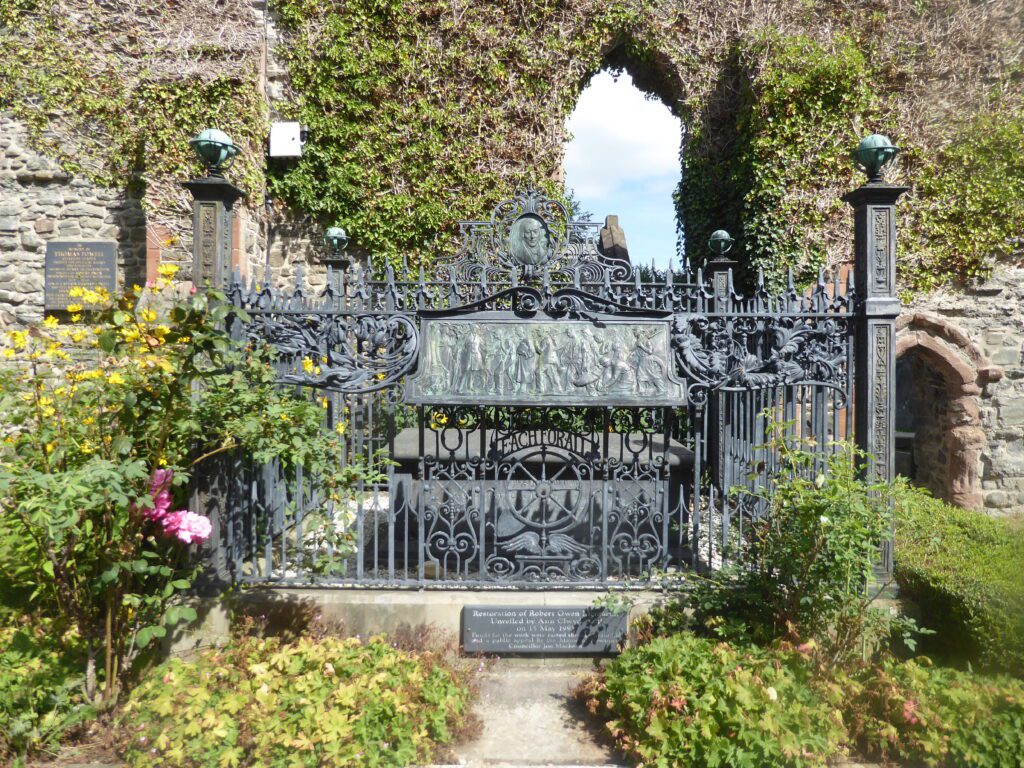
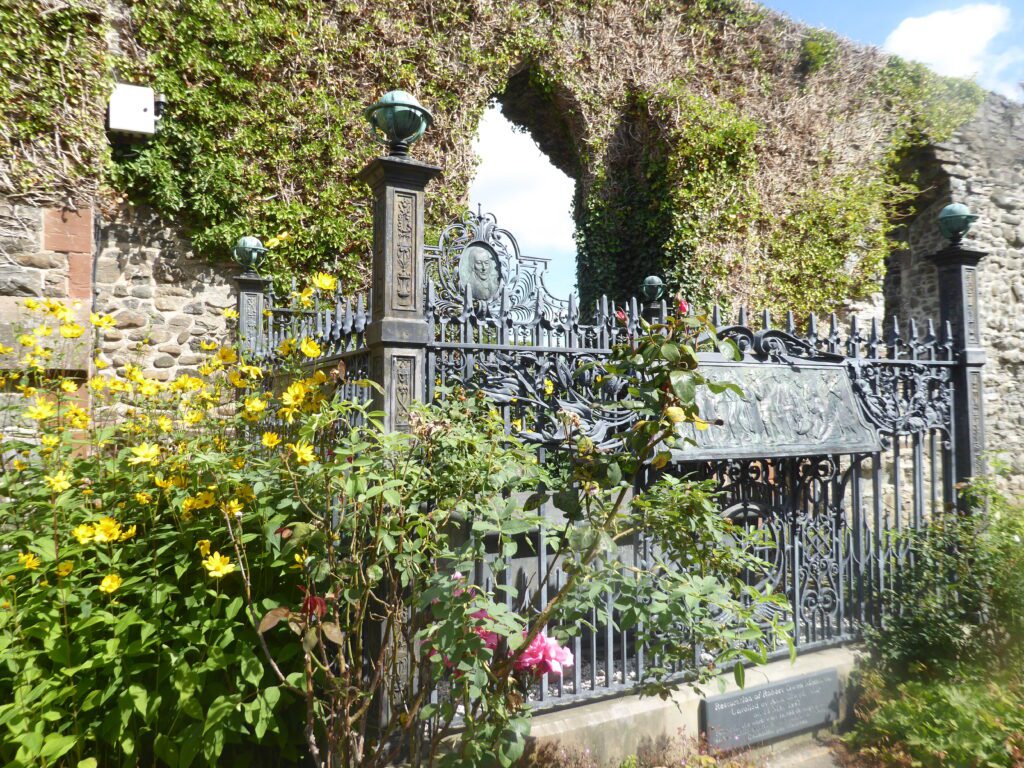
1960s planning law led to the expansion of Newtown in Powys, formerly Montgomeryshire, but the heart of the stolid little market town remains huddled in a bend of the river Severn, impervious to the late twentieth century developments which stretch beyond it. The main street is a cheerful jumble of Victorian redbrick and arts and crafts timbers; there are three museums, a contemporary art gallery, and a theatre. And outside the ruined church of St. Mary on the south bank of the river I found a jewel. For there, against a backdrop of ivy-draped stone walls, sat a splendid contrivance of wrought iron swirls and twists, as though an exotic Parisian fantasy from the Belle Epoque had been dropped into the unpretentious Welsh town.

It is the grave of Robert Owen (1771-1858), variously acclaimed as The Father of British Socialism, a Capitalist Paternalist, and the Inspiration of the Co-operative Movement.

Owen was born in Newtown, leaving school at ten years old to become an apprentice draper in Lincolnshire. After working in London and Manchester he opened and managed his own mill. In 1799 he bought the New Lanark Mill in Scotland. There 2,000 people, five hundred of them children, were employed in cotton spinning.

Conditions in cotton mills were harsh: workers, including children, worked twelve to fourteen hours a day, the machinery was dangerous, discipline brutal, and wages low. Orphans and young children from poor families were often not paid at all, receiving only basic food and a place to sleep. By this exploitation of labour mill owners accrued substantial profits and accumulated great wealth.

Owen’s approach was different. He and his partners, who included Jeremy Bentham, chose to limit themselves to a 5% return on their capital. Owen transformed the factory, introducing the eight-hour day, and campaigning for its introduction elsewhere under the slogan

 Eight Hours Labour, Eight Hours Recreation, Eight Hours Rest.

Setting an example in his own mill, Owen campaigned for the introduction of child labour laws, outlawing the employment of children under ten years old. He increased wages, improved working conditions and housing, and reformed the truck system. Under the latter workers had received their pay in tokens which could only be used in the owners’ truck shops where high prices were charged for shoddy goods. Owen did not abolish the system, but his shops sold quality goods at just above wholesale price, passing on savings from bulk purchases. With the profits returned to the community, Owen’s shops were the forerunners of the Co-operative Movement later established by the Rochdale Pioneers.

Espousing the philosophy that character is not inherent, but formed by environment, Owen sought to provide a sound physical, moral, and social background for the children of his workers. At New Lanark he funded schools, including the first nursery schools in Britain for four- to six-year-olds, with a curriculum which included dancing and music.

For Owen’s workers there was the opportunity for adult education, with lectures and concerts. There was recreation on the allotments and free health care.

New Lanark was not perfect: Owen was an autocrat, his workers constantly subjected to his scrutiny, he even inspected their houses for cleanliness; the work was still hard, monotonous, and dangerous; and the Silent Monitor was an alienating presence located above each machinist. The monitor was Owen’s own invention, a four-sided block with each side painted a different colour, it was turned to represent the quality and quantity of the worker’s output.

Nonetheless New Lanark flourished, more efficient than other factories, the output reflected the better working conditions, and it achieved an international reputation. It was a reputation which Owen hoped would appeal to the self-interest of other capitalists, illustrating to them that if they extended the same care to their workers as they did to their machines they might be rewarded with greater productivity.

By the 1820s Owen had embraced the more radical ideals of Utopian Socialism. Moving to the United States, he expended his by now considerable fortune to buy up an existing town of 180 buildings and several thousand acres in Indiana. He renamed the town, previously owned by a religious group which had relocated, New Harmony. In this experimental socialist Utopia, he pursued his belief that a clean, safe environment founded on moral values and equal opportunities would foster mutual respect in a prosperous society. To this end, he poured money into schools and libraries, established communal kitchens and dining rooms, promoted scientific research and the arts.

Yet New Harmony was as spectacular a failure as New Lanark had been a success, and after two years the community was dissolved.

Accounts for the failure vary. There were disagreements within the community and suggestions that some of its members were parasitic upon others, exploiting goodwill to their own selfish advantage. In common with other self-contained communities of the time New Harmony foundered in the absence of members with practical skills. Josiah Warren, the American Philosophical Anarchist who had joined Owen at New Harmony, later rejected Owenism suggesting that self-preservation and the desire for personal property would always prove stronger instincts than commitment to the common good.

Marx, while agreeing that the working class were creating the wealth from which they were not benefitting, did not share Owen’s view that a Socialist utopia within existing society would prove its superiority over time. He reasoned that it was not possible to circumvent international capitalism with small scale communes. The overthrow of the capitalist system could only come via a revolutionary party independent of all capitalist influence.

Owen returned to London with his fortune dissipated, but his beliefs untarnished. No longer wealthy, but increasingly radical, he dedicated the rest of his life to political propaganda in support of trades unionism, the Co-operative Movement, better housing for workers, legislation to improve wages and working conditions, the abolition of child labour, aid for the unemployed, free co-educational schools, the abolition of corporal punishment, equal opportunities, the establishment of libraries and museums, and secularism. He spoke tirelessly at public meetings, churned out pamphlets and periodicals… and died penniless.

Towards the end of his life, he had returned to Newtown seeking to be buried near his parents. There were protests at the prospect of such a dangerous radical and avowedly non-Christian individual being buried in sacred ground. But by good fortune the thirteenth century church of St. Mary, having served five hundred years as the parish church of Newtown, had been abandoned two years previously after repeated flooding when the winter Severn burst its banks. With his congregation relocated to the new St. David’s, the rector proved amenable to Owen’s burial beneath the south wall outside the nave of the old church.

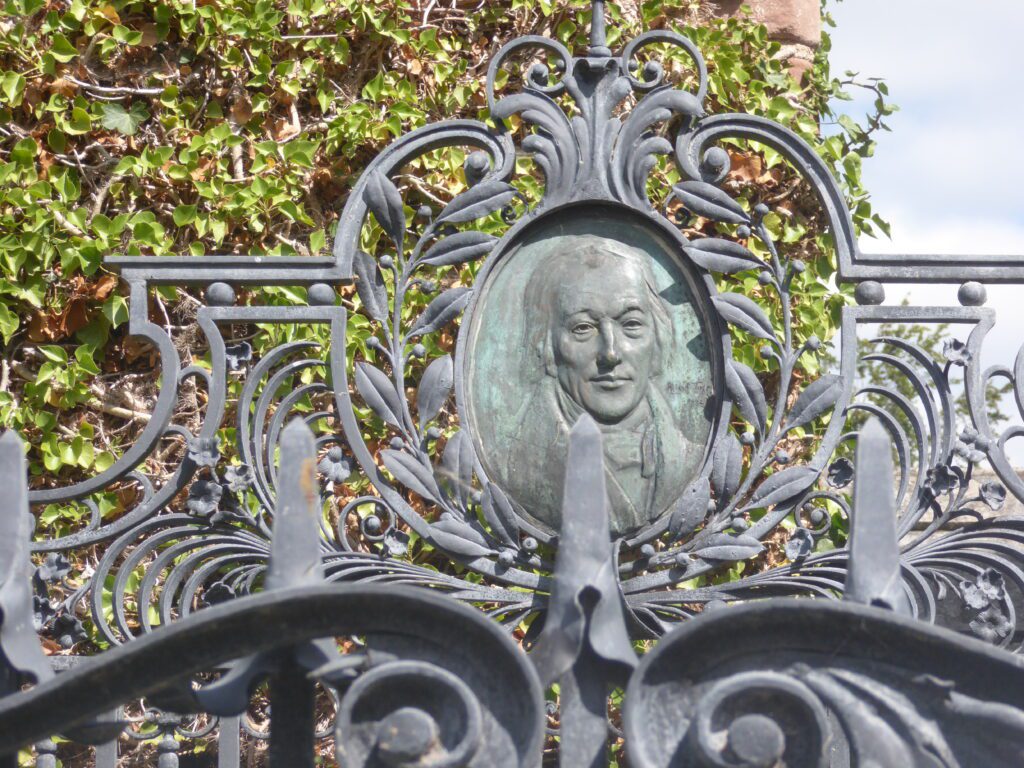
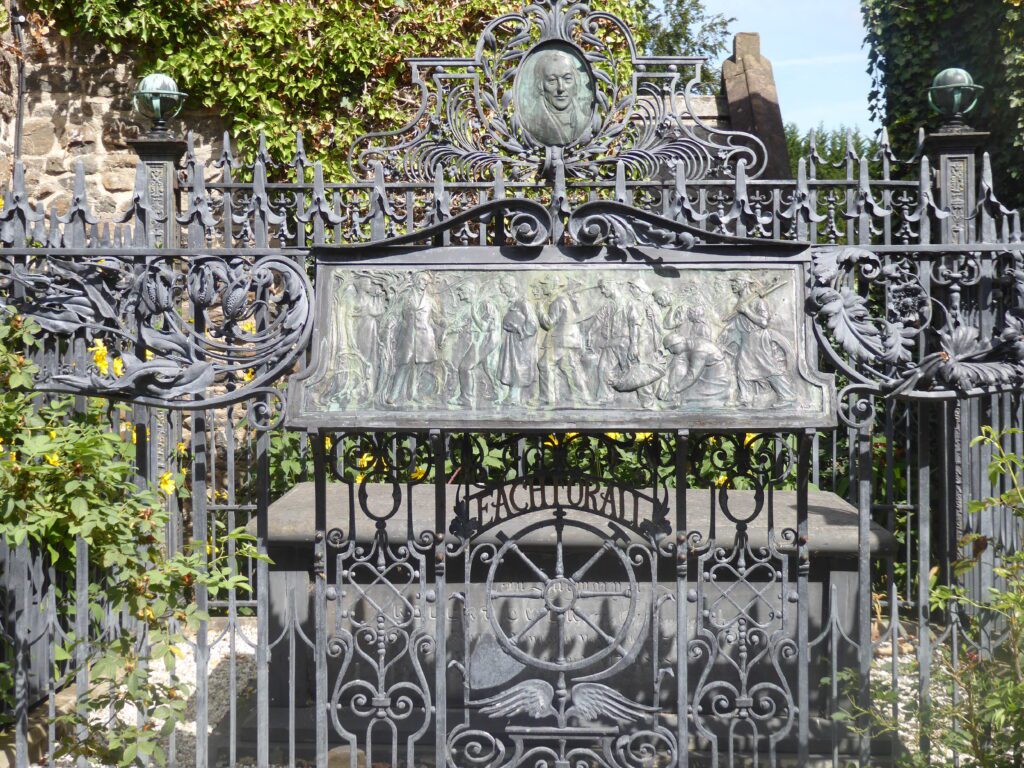
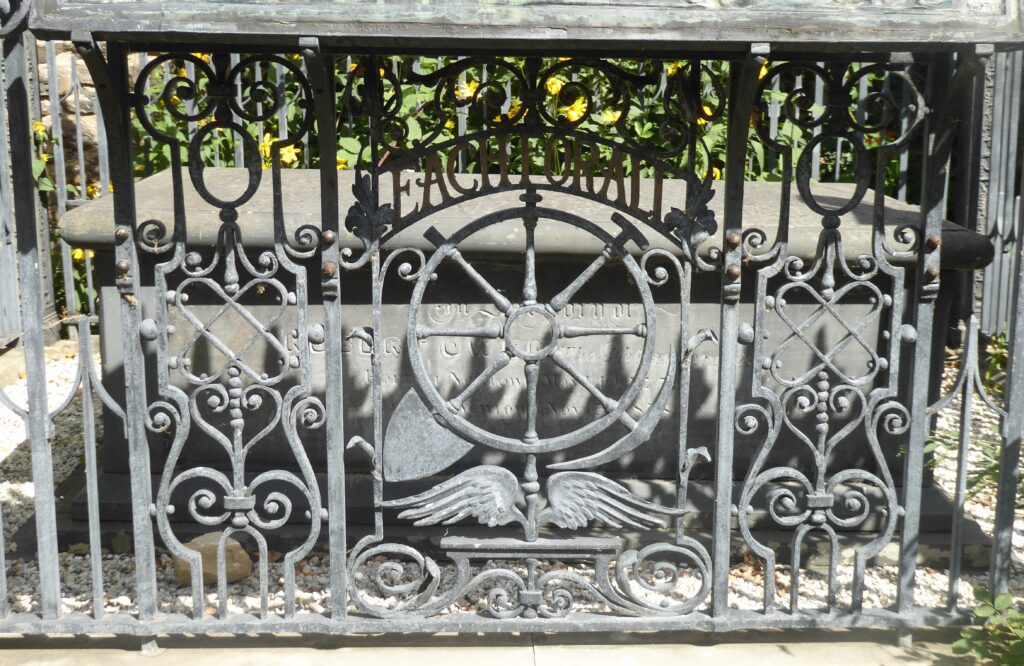
Forty years later Owen’s friend and fellow reformer, George Jacob Holyoake, revisited the grave to find it neglected and decaying. He exerted his influence on the Co-operative Union to restore the tabletop slate tomb and erect the ornate Art Nouveau iron railings, awash with foliage and neo-classical symbols, around it. The tomb bears the Co-op motto

Each for All, and All for Each

and a quotation from Owen himself

It is the one great and universal interest of the human race to be cordially united and to aid each other to the full extent of their capabilities.

At the dedication ceremony in 1902 Holyoake reminded the assembled trade unionists that

Due to Owen – Knowledge is Greater; Life is Longer; Health is Surer; Disease is Limited; Towns are Sweeter; Hours of Labour are Shorter; Men are Stronger; Women are Fairer; Children are Happier.

No mean achievement.

Today a public garden has been created. It runs from the riverbank, through the now roofless church whose walls are lined with old gravestones, surrounds Owen’s tomb, and spills on towards the town in a summer riot of grasses and flowers.

Powered by WordPress & Theme by Anders Norén