Come with me into the graveyard, all human life is here

Category: Political Theorists, Philosophers and Economists

Robert Owen: Capitalist, Political Philosopher, Social Reformer.

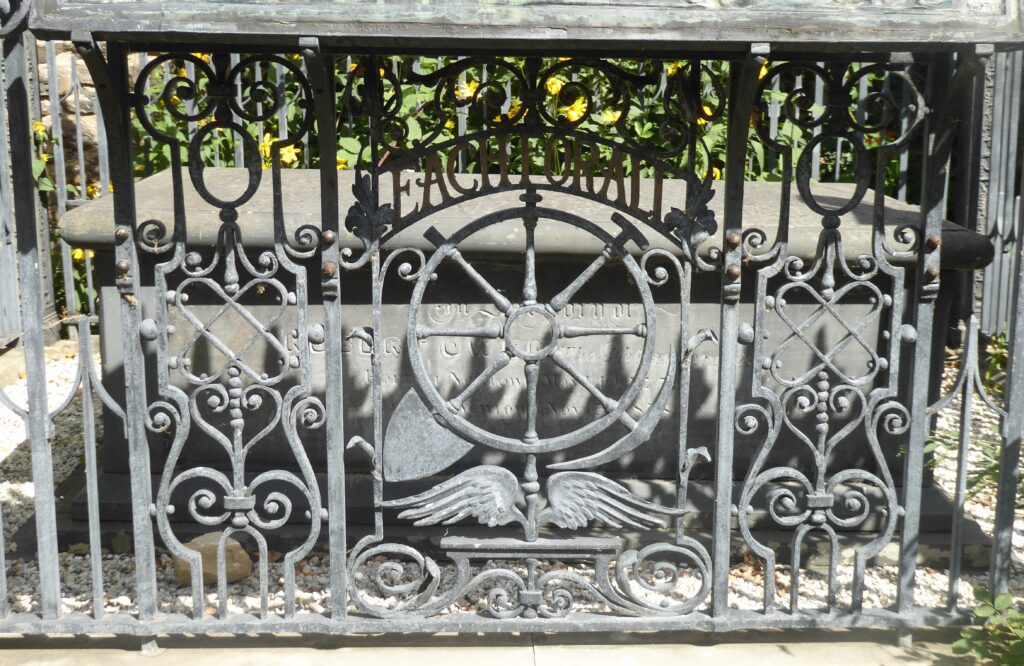
1960s planning law led to the expansion of Newtown in Powys, formerly Montgomeryshire, but the heart of the stolid little market town remains huddled in a bend of the river Severn, impervious to the late twentieth century developments which stretch beyond it. The main street is a cheerful jumble of Victorian redbrick and arts and crafts timbers; there are three museums, a contemporary art gallery, and a theatre. And outside the ruined church of St. Mary on the south bank of the river I found a jewel. For there, against a backdrop of ivy-draped stone walls, sat a splendid contrivance of wrought iron swirls and twists, as though an exotic Parisian fantasy from the Belle Epoque had been dropped into the unpretentious Welsh town.
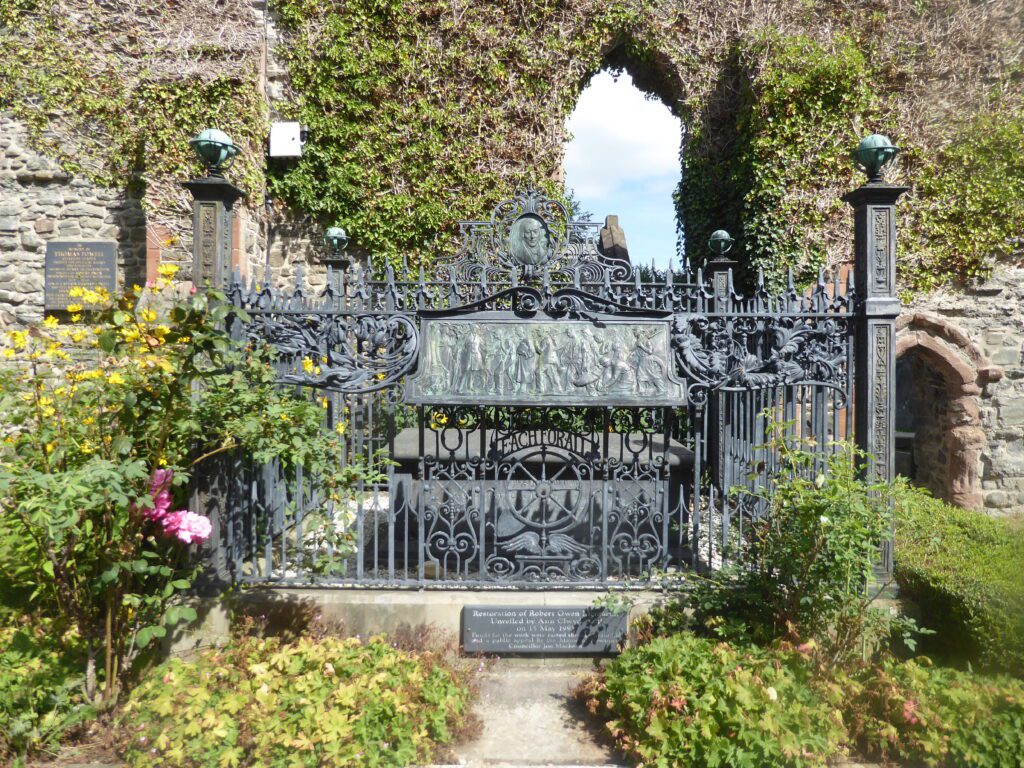
It is the grave of Robert Owen (1771-1858), variously acclaimed as The Father of British Socialism, a Capitalist Paternalist, and the Inspiration of the Co-operative Movement.
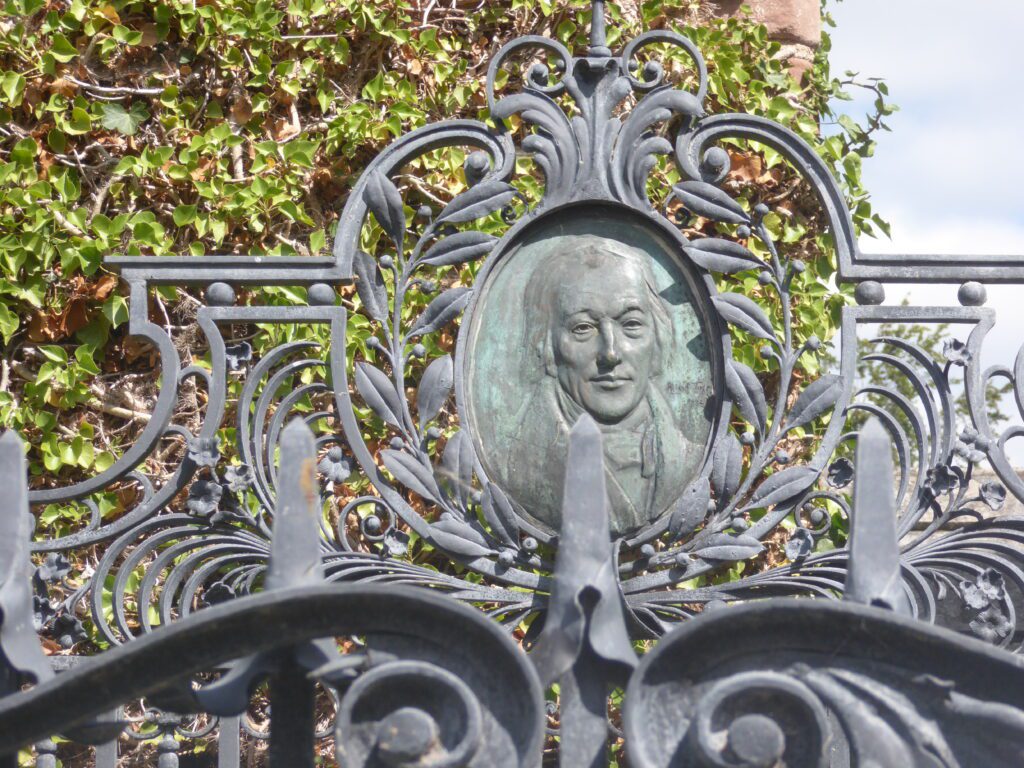
Owen was born in Newtown, leaving school at ten years old to become an apprentice draper in Lincolnshire. After working in London and Manchester he opened and managed his own mill. In 1799 he bought the New Lanark Mill in Scotland. There 2,000 people, five hundred of them children, were employed in cotton spinning.

Conditions in cotton mills were harsh: workers, including children, worked twelve to fourteen hours a day, the machinery was dangerous, discipline brutal, and wages low. Orphans and young children from poor families were often not paid at all, receiving only basic food and a place to sleep. By this exploitation of labour mill owners accrued substantial profits and accumulated great wealth.

Owen’s approach was different. He and his partners, who included Jeremy Bentham, chose to limit themselves to a 5% return on their capital. Owen transformed the factory, introducing the eight-hour day, and campaigning for its introduction elsewhere under the slogan

 Eight Hours Labour, Eight Hours Recreation, Eight Hours Rest.

Setting an example in his own mill, Owen campaigned for the introduction of child labour laws, outlawing the employment of children under ten years old. He increased wages, improved working conditions and housing, and reformed the truck system. Under the latter workers had received their pay in tokens which could only be used in the owners’ truck shops where high prices were charged for shoddy goods. Owen did not abolish the system, but his shops sold quality goods at just above wholesale price, passing on savings from bulk purchases. With the profits returned to the community, Owen’s shops were the forerunners of the Co-operative Movement later established by the Rochdale Pioneers.

Espousing the philosophy that character is not inherent, but formed by environment, Owen sought to provide a sound physical, moral, and social background for the children of his workers. At New Lanark he funded schools, including the first nursery schools in Britain for four- to six-year-olds, with a curriculum which included dancing and music.

For Owen’s workers there was the opportunity for adult education, with lectures and concerts. There was recreation on the allotments and free health care.

New Lanark was not perfect: Owen was an autocrat, his workers constantly subjected to his scrutiny, he even inspected their houses for cleanliness; the work was still hard, monotonous, and dangerous; and the Silent Monitor was an alienating presence located above each machinist. The monitor was Owen’s own invention, a four-sided block with each side painted a different colour, it was turned to represent the quality and quantity of the worker’s output.

Nonetheless New Lanark flourished, more efficient than other factories, the output reflected the better working conditions, and it achieved an international reputation. It was a reputation which Owen hoped would appeal to the self-interest of other capitalists, illustrating to them that if they extended the same care to their workers as they did to their machines they might be rewarded with greater productivity.

By the 1820s Owen had embraced the more radical ideals of Utopian Socialism. Moving to the United States, he expended his by now considerable fortune to buy up an existing town of 180 buildings and several thousand acres in Indiana. He renamed the town, previously owned by a religious group which had relocated, New Harmony. In this experimental socialist Utopia, he pursued his belief that a clean, safe environment founded on moral values and equal opportunities would foster mutual respect in a prosperous society. To this end, he poured money into schools and libraries, established communal kitchens and dining rooms, promoted scientific research and the arts.

Yet New Harmony was as spectacular a failure as New Lanark had been a success, and after two years the community was dissolved.

Accounts for the failure vary. There were disagreements within the community and suggestions that some of its members were parasitic upon others, exploiting goodwill to their own selfish advantage. In common with other self-contained communities of the time New Harmony foundered in the absence of members with practical skills. Josiah Warren, the American Philosophical Anarchist who had joined Owen at New Harmony, later rejected Owenism suggesting that self-preservation and the desire for personal property would always prove stronger instincts than commitment to the common good.

Marx, while agreeing that the working class were creating the wealth from which they were not benefitting, did not share Owen’s view that a Socialist utopia within existing society would prove its superiority over time. He reasoned that it was not possible to circumvent international capitalism with small scale communes. The overthrow of the capitalist system could only come via a revolutionary party independent of all capitalist influence.

Owen returned to London with his fortune dissipated, but his beliefs untarnished. No longer wealthy, but increasingly radical, he dedicated the rest of his life to political propaganda in support of trades unionism, the Co-operative Movement, better housing for workers, legislation to improve wages and working conditions, the abolition of child labour, aid for the unemployed, free co-educational schools, the abolition of corporal punishment, equal opportunities, the establishment of libraries and museums, and secularism. He spoke tirelessly at public meetings, churned out pamphlets and periodicals… and died penniless.

Towards the end of his life, he had returned to Newtown seeking to be buried near his parents. There were protests at the prospect of such a dangerous radical and avowedly non-Christian individual being buried in sacred ground. But by good fortune the thirteenth century church of St. Mary, having served five hundred years as the parish church of Newtown, had been abandoned two years previously after repeated flooding when the winter Severn burst its banks. With his congregation relocated to the new St. David’s, the rector proved amenable to Owen’s burial beneath the south wall outside the nave of the old church.

Forty years later Owen’s friend and fellow reformer, George Jacob Holyoake, revisited the grave to find it neglected and decaying. He exerted his influence on the Co-operative Union to restore the tabletop slate tomb and erect the ornate Art Nouveau iron railings, awash with foliage and neo-classical symbols, around it. The tomb bears the Co-op motto

Each for All, and All for Each

and a quotation from Owen himself

It is the one great and universal interest of the human race to be cordially united and to aid each other to the full extent of their capabilities.

At the dedication ceremony in 1902 Holyoake reminded the assembled trade unionists that

Due to Owen – Knowledge is Greater; Life is Longer; Health is Surer; Disease is Limited; Towns are Sweeter; Hours of Labour are Shorter; Men are Stronger; Women are Fairer; Children are Happier.

No mean achievement.
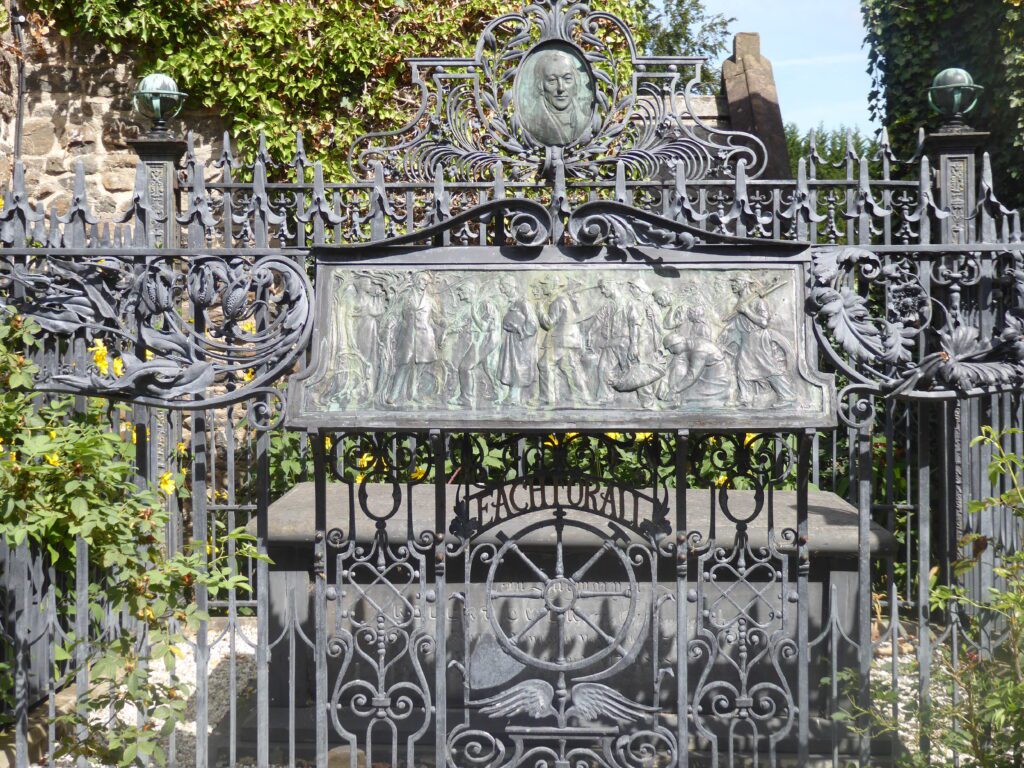
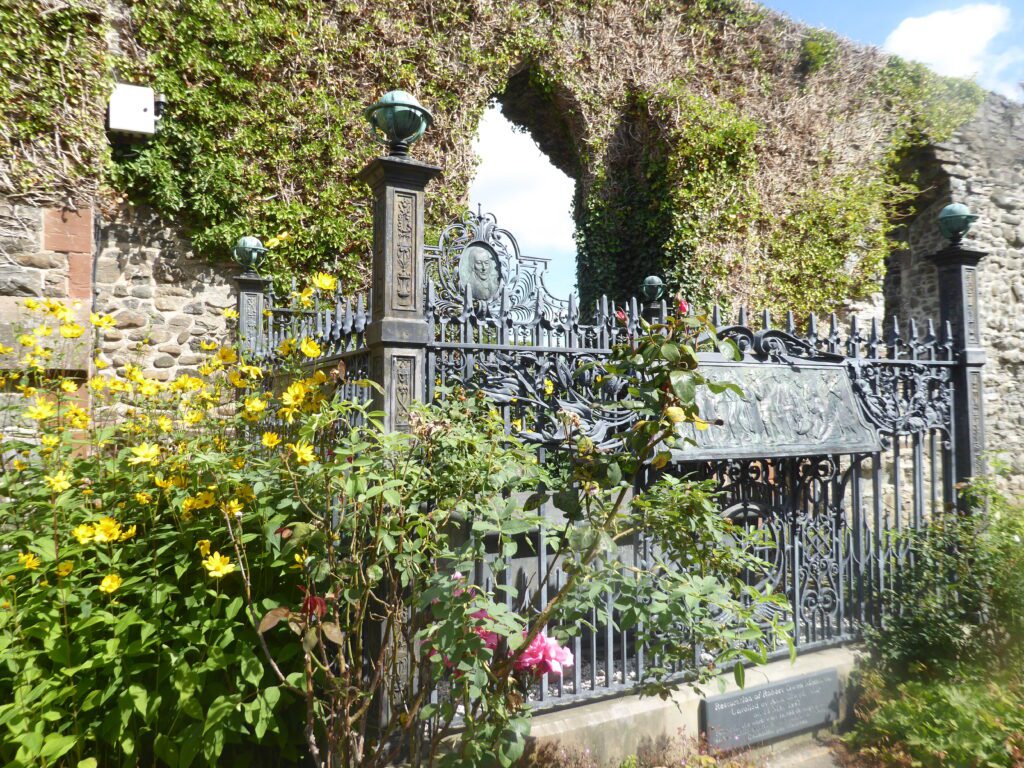
Today a public garden has been created. It runs from the riverbank, through the now roofless church whose walls are lined with old gravestones, surrounds Owen’s tomb, and spills on towards the town in a summer riot of grasses and flowers.
Thank You Mary, for My Education and My Rights

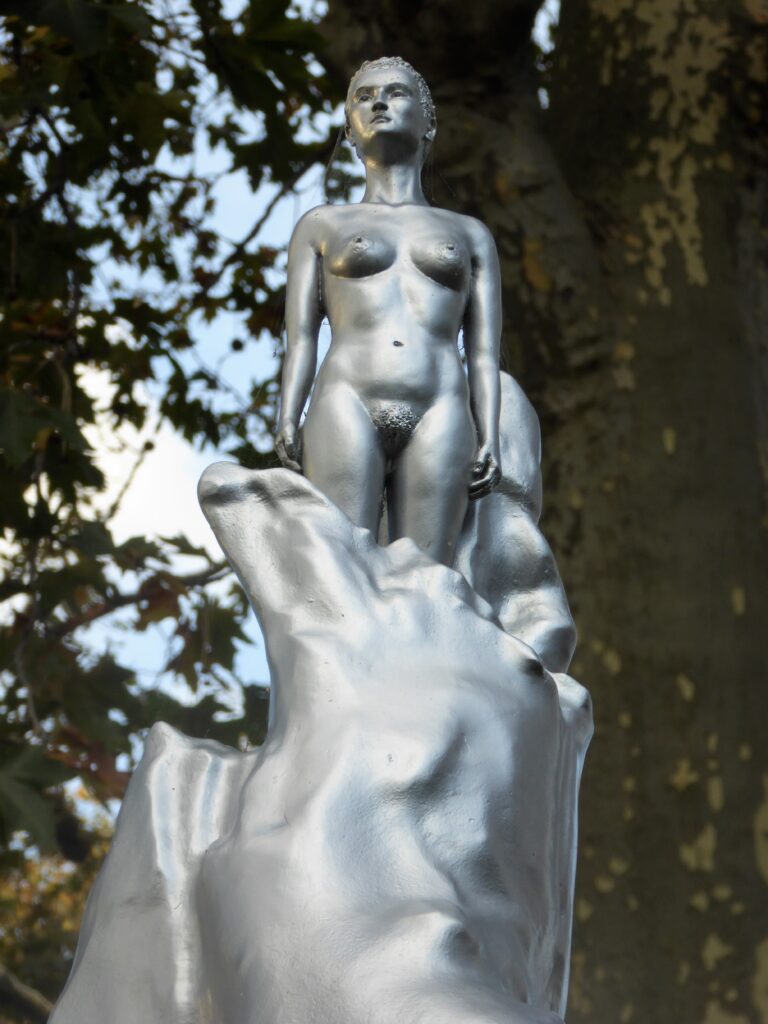
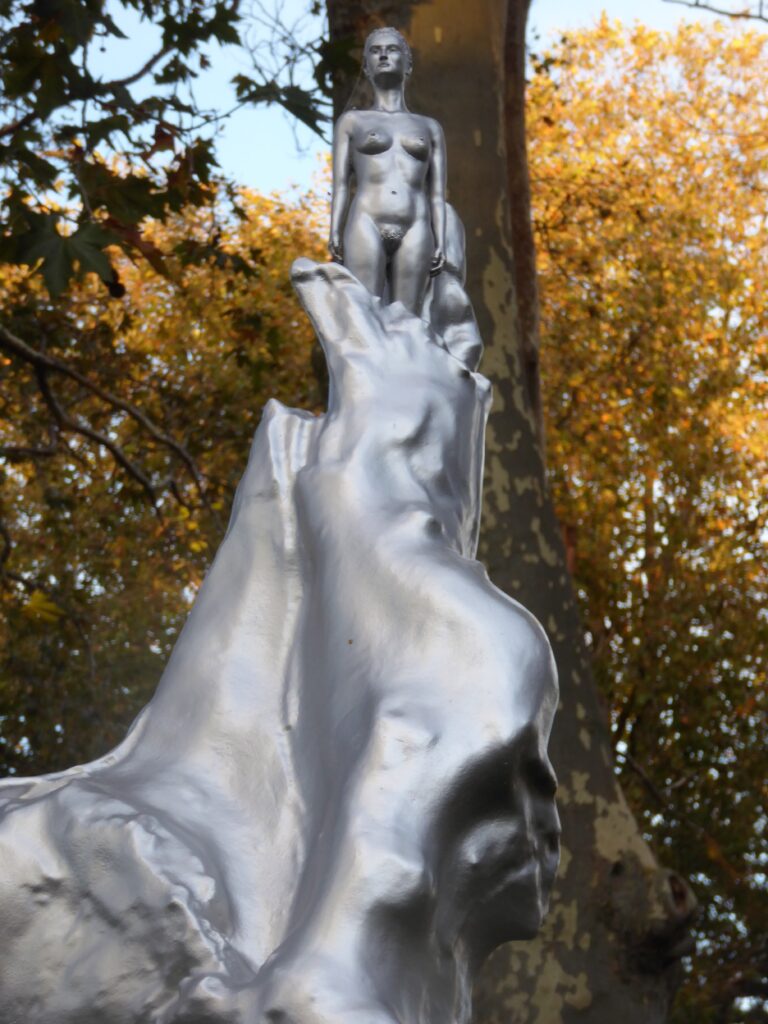
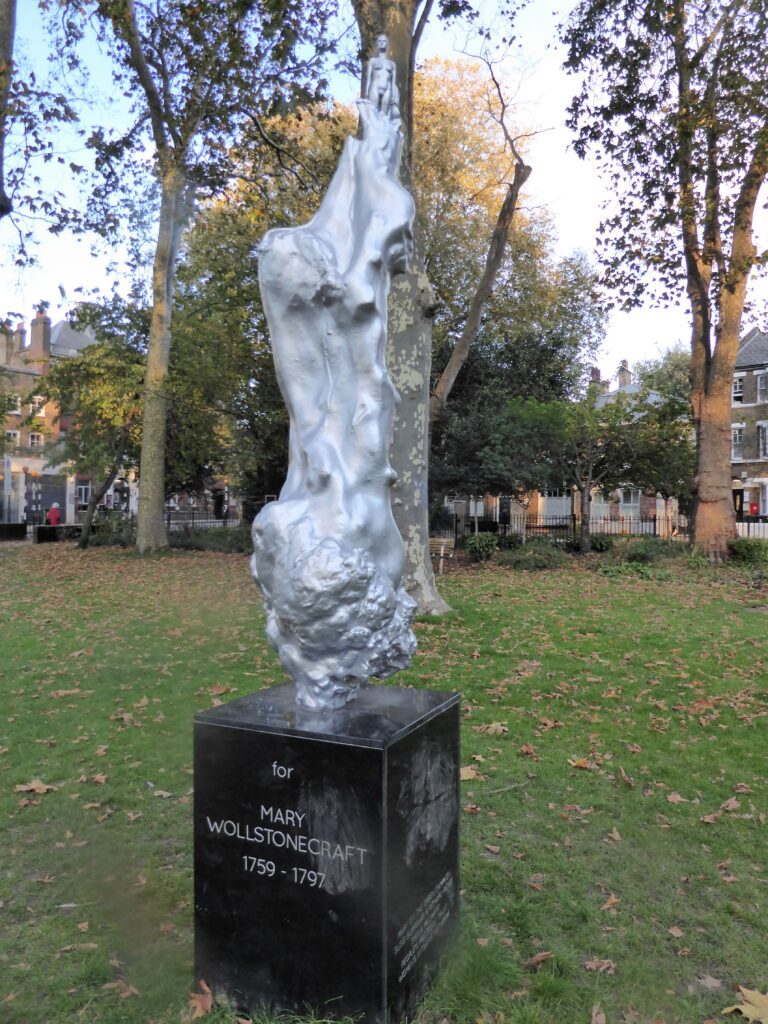
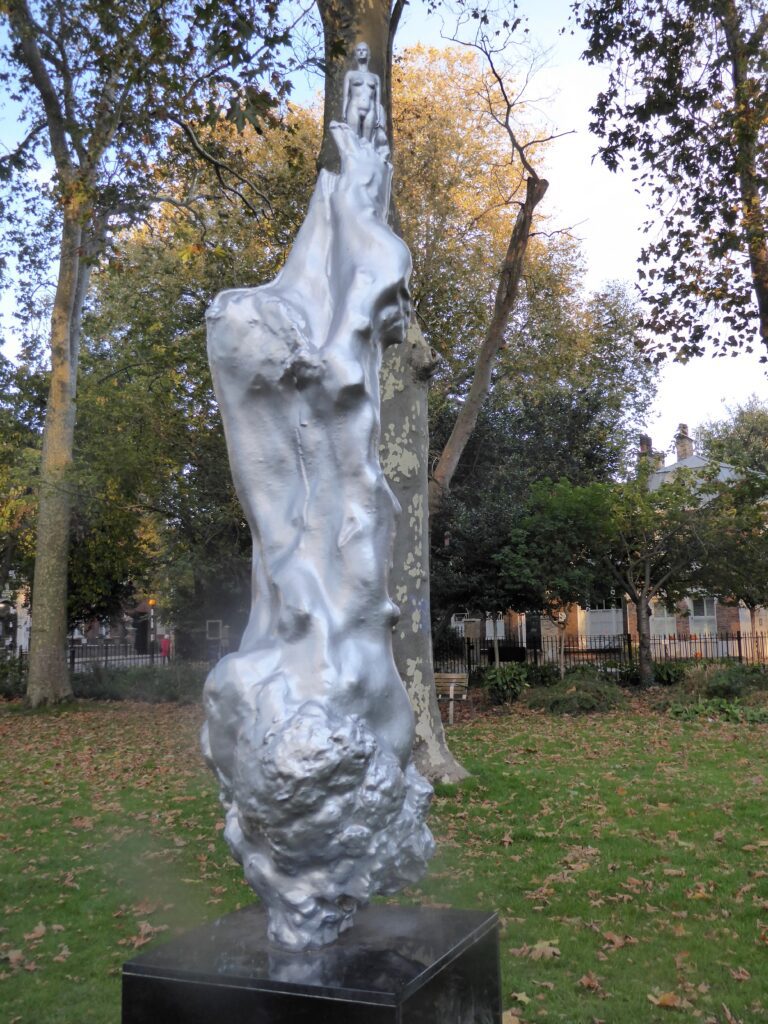
I stood on a muddy patch of grass on  Newington Green looking up at Maggi Hambling’s  memorial to Mary Wollstonecraft, a small naked silver figure emerging above a swirl of organic matter, gleaming and glittering like a fish in the pale autumn sunlight. It was my first visit to London since the pandemic, in  that strange time when the full wrath of Covid had passed but we still moved in and out of changing restrictions, alternating between nervous caution and an impatient desire to re-engage with the world.

After a few moments other women joined me: some still wore masks and we all kept a discreet distance from one another, but the air was heavy with unspoken thoughts. Eventually someone broke the hesitant silence: “I’m not quite sure that I understand it.” Empathetic murmurs preceded a burst of speech as we shared knowledge: “I read that she is arising out of female forms to show that she is supported by her predecessors.” “Hambling says it represents everywoman and the birth of the feminist movement rather than Wollstonecraft herself.” “She said that she made it in deliberate opposition to traditional male heroic statuary.” “She made her naked so that she would be relevant for all time, not bound to a certain era by her clothes.”

We were silent again for a few moments, then: “The most important thing is that it is here.” “And that it was made by a female artist.” “Anything new and different is always a bit challenging.” “It would have been inappropriate just to put up a conventional statue.” “I expect it will grow on us.” We parted agreeing that we would revisit the statue.

Two years on and I greet it as a familiar friend and a fitting tribute to Wollstonecraft, for as it says on the plinth, the statue is “for Mary Wollstonecraft,” not of her.

Mary Wollstonecraft memorial on Newington Green
Gleaming and glittering in the autumn sunlight
for MARY WOLLSTONECRAFT

Mary Wollstonecraft (1759-1797) was a writer, philosopher, and advocate of women’s rights. She had variously earned her own living as a lady’s companion, teaching in a school which she founded with her sisters and friend in Newington Green, as a governess, and as a translator before focusing on her own writing.

Her output was prolific, but two books stand out like especially bright stars. Critical of aristocracy, monarchy, church and military hierarchies, all hereditary privilege and advocating Republicanism, Wollstonecraft celebrated the  revolutionary events in France. In A Vindication of the Rights of Men (1790) she countered Edmund Burkes’s conservative critique of the French Revolution. When a group of angry women had  marched the royal family from Versailles to Paris, Burke had praised Marie Antoinette describing her surrounded by “furies from hell, in the abused shape of the vilest of women.” Mary responded angrily that they were working women angry at the lack of bread to feed their families. Though deeply saddened and depressed by the Jacobin terror and the executions of the Girondin leaders, and offended by the Jacobins’ treatment of women to whom they refused to grant equal rights, nonetheless Wollstonecraft continued to believe in the ideals of the revolution and remained true to her conviction that it represented a great achievement.

At the heart of all her work lay a conviction in the importance of education for women. In  A Vindication of the Rights of Woman, (1792), she argued that while women were not inherently inferior to men they often appeared to be because of their lack of education which made them seem silly and superficial, frivolous and incapable, leading to excessive sensibility at the expense of rationality. It precipitated them, unable to support themselves independently, into patriarchal marriages based on economic necessity. They became the mere ornaments and property of men,helpless adornments of their households. Such marriages infantilised them, made them poor companions for their husbands and poor mothers for their children, poor citizens, and poor human beings. Only with education could they achieve independence, support themselves, blossom as individuals with the same rights as men, and realise relationships based love and affection.

Mary had begun an affair with the philosopher William Godwin and when she became pregnant they had married so that society would consider the child legitimate, but Mary died of septicaemia eleven days after her daughter was born.

Godwin’s memoir of his wife, though motivated by his love, compassion, and sense of loss,  destroyed her reputation for many years. For he wrote candidly of her personal life as well as her writings, and her love affairs, illegitimate child, and suicide attempts shocked nineteenth and early twentieth century society. She had sought unsuccessfully to live with her married lover, Henri Fuseli and his wife. She had an illegitimate daughter, Fanny, by Gilbert Imlay. She made two suicide attempts when Imlay rejected her, the first by laudanum and the second by trying to drown herself in the Thames. The opprobrium which these actions engendered meant that only in the 1960s did her star begin to rise again when attention refocused on her work.

Godwin buried Mary in the churchyard of Old Saint Pancras Church where they had married, and when she was a small child he took their daughter, also a Mary, on visits to her. When Godwin remarried, the child, unhappy with that second marriage, continued her visits alone. There she would read her mother’s works, and later meet in secret with one of her father’s political followers, the poet Shelley. An unsubstantiated tradition has it that there beside the grave she lost her virginity to him. I choose to believe it.

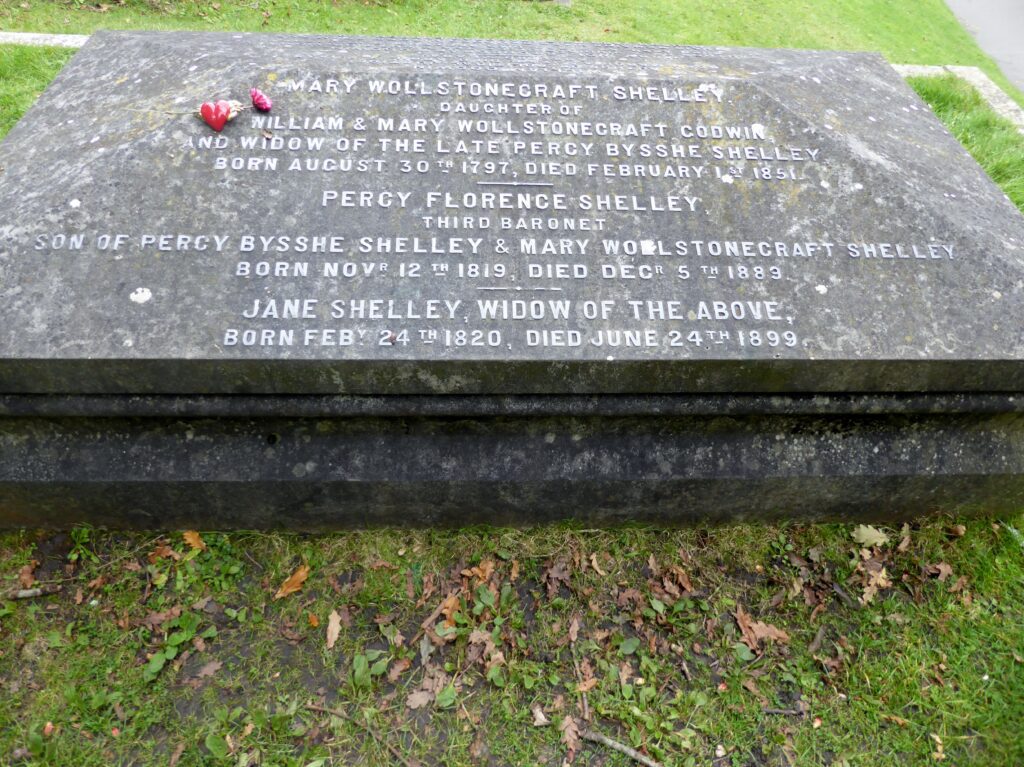
Like her mother, Mary led a turbulent and unconventional life, eloping with Shelley in the face of her father’s disapproval, facing ostracism and debt. She had four children with Shelley, whom she married after the suicide of his  first wife Harriet, but only one of them, Percy Florence Shelley survived. Mary supported herself through her writing producing travelogues, historical fiction, short stories, biographies, and novels, most famously Frankenstein: or, The Modern Prometheus. After Shelley drowned in 1822 while sailing from Livorno to Lerici she devoted herself to promoting and editing his work and  ensuring the education of their son.

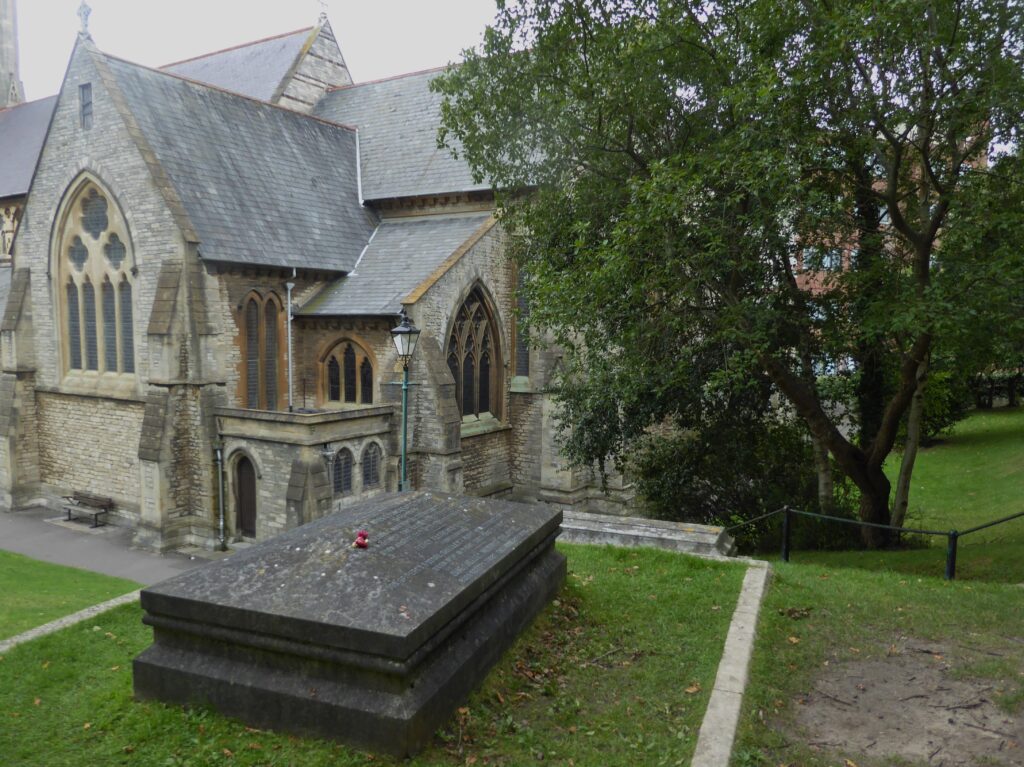
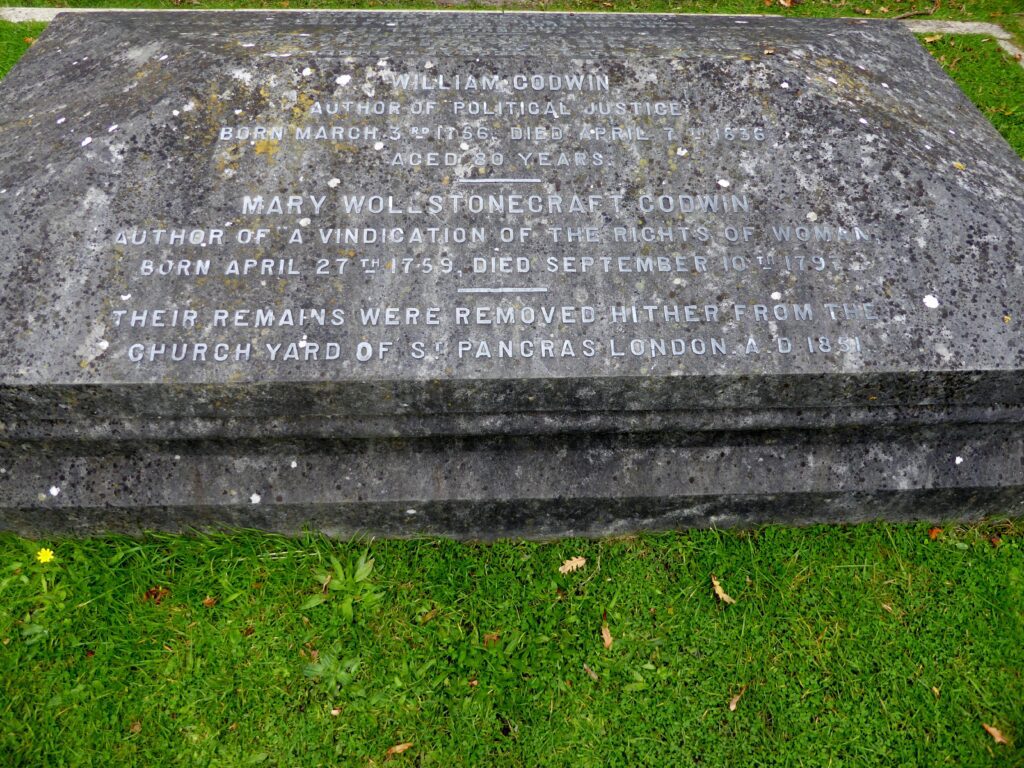
Mary Shelley had asked her son and his wife Jane to bury her with her parents in Old Saint Pancras, but when she died in 1851 they thought the old graveyard a “dreadful” place. Indeed a local resident had written to The Times in 1850 complaining that, “More than 25 corpses have been deposited every week for the last twenty years in an already overcrowded space: and at this very time they are burying in it nearly twice that rate…teeth, bones, fragments of coffin wood are seen lying in large quantities around these pits.” A few years later it featured in Charles Dickens’ Tale of two Cities as a site of body snatching. Moreover, the arrival of the railway brought further disruption and  the railway company supervised the excavation of over 10,000 graves to make way for the new London train terminus at St. Pancras. So they buried her in the churchyard of St. Peter in Bournemouth near their own home and to fulfil her wishes disinterred  her parents and reburied them with her.

Later in her desk they found a box containing a human organ wrapped in the preface to Shelley’s poem Adonais, an elegy on the death of his friends Keats. They thought it was Shelley’s heart, for in accordance with quarantine regulations his friends had  cremated Shelley on the beach where his body had been borne by the tide, but Trelawny had rescued the slow burning heart and given it to Mary. When Mary Shelley’s son died, both he and the heart joined his mother and grandparents.

At least one modern medical speculation however has suggested that this organ may have been Shelley’s liver rather than his heart, for the liver is a denser and more solid mass and more likely to have resisted the heat. I choose to believe it was the heart; keeping a liver, even one wrapped in poetry, in a desk drawer for thirty years lacks romance.

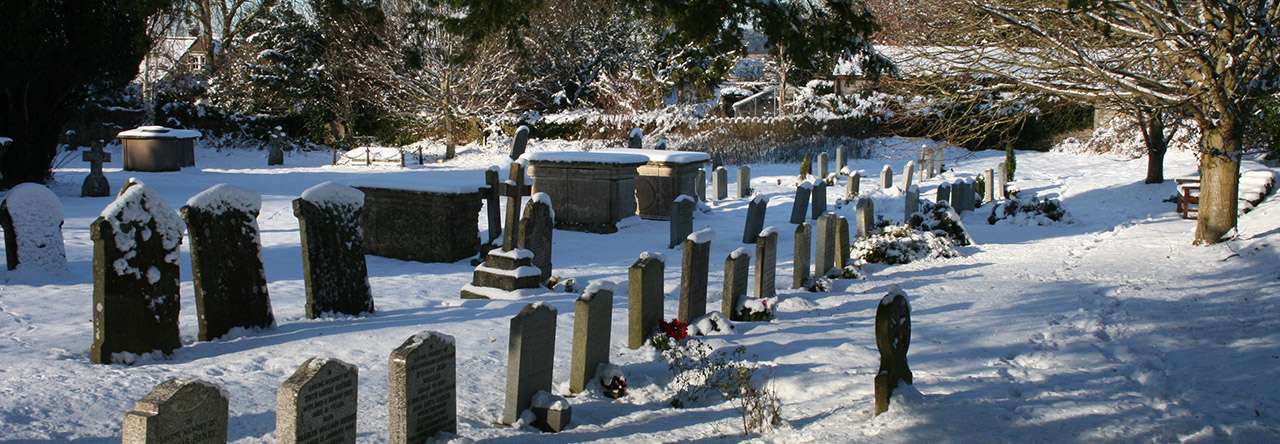
St. Peter, Bournemouth and the Wollstonecraft/Godwin/Shelley grave
William Godwin and Mary Wollstonecraft Godwin, removed from St.Pancras, London to St. Peter, Bournemouth
Mary Wollstonecraft Shelley, her son and his wife

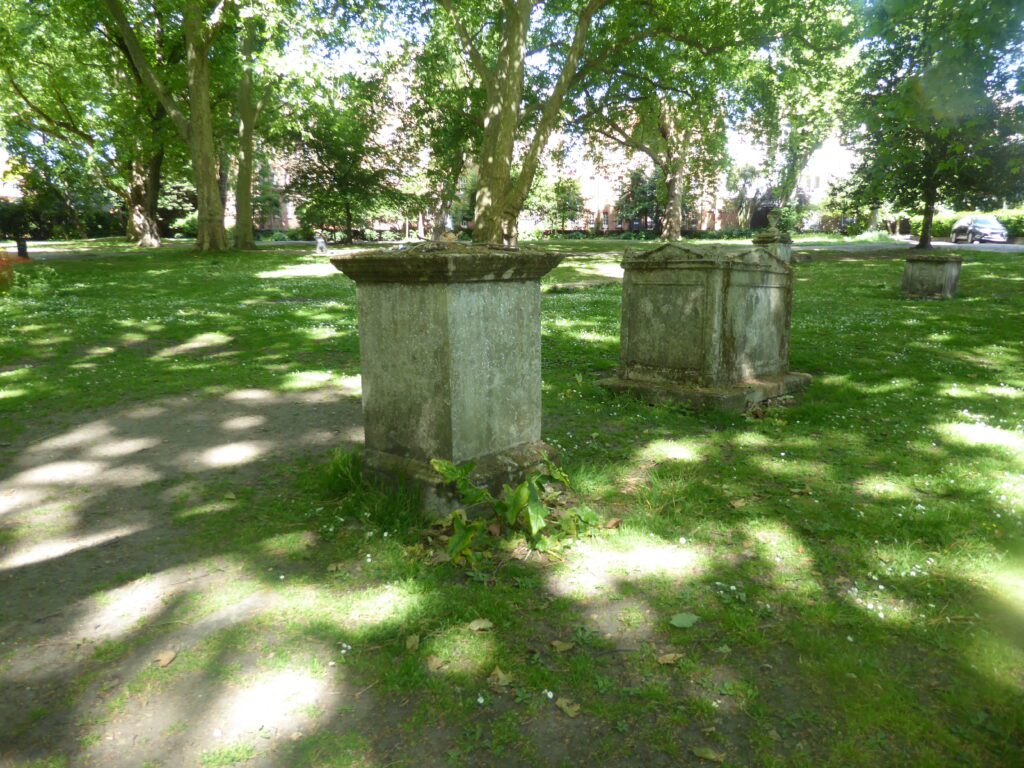
Today the Bournemouth grave despite its famed collection of inhabitants is little visited, the churchyard and the grey Victorian church a little bleak, while ironically the church and graveyard of Old Saint Pancras have a new vitality. The redevelopment of the surrounding area, the restoration of  King’s Cross and St. Pancras stations along with the magnificent old Midland Grand  Hotel, and the opening of the Crick Institute, have transformed the neighbourhood. The metamorphosis of Coal Drops Yard has seen designer outlets, an abundance of cafes and restaurants, fountains, and gardens  replace the dereliction  which previously blighted the area with disused railway sidings and warehouses. Ingenious designs have slotted clever apartments into old gasometers. The Central School of Art  has located in an old granary. Bright river craft dawdle along the Regent’s canal. And across the road from this vibrant area the graveyard offers a  tranquil green space, with its paths and gates recently repaired, shaded seats beneath the mature plane trees and neatly trimmed grass around the tombs. The pretty church is open daily hosting concerts and community groups as well as religious services.

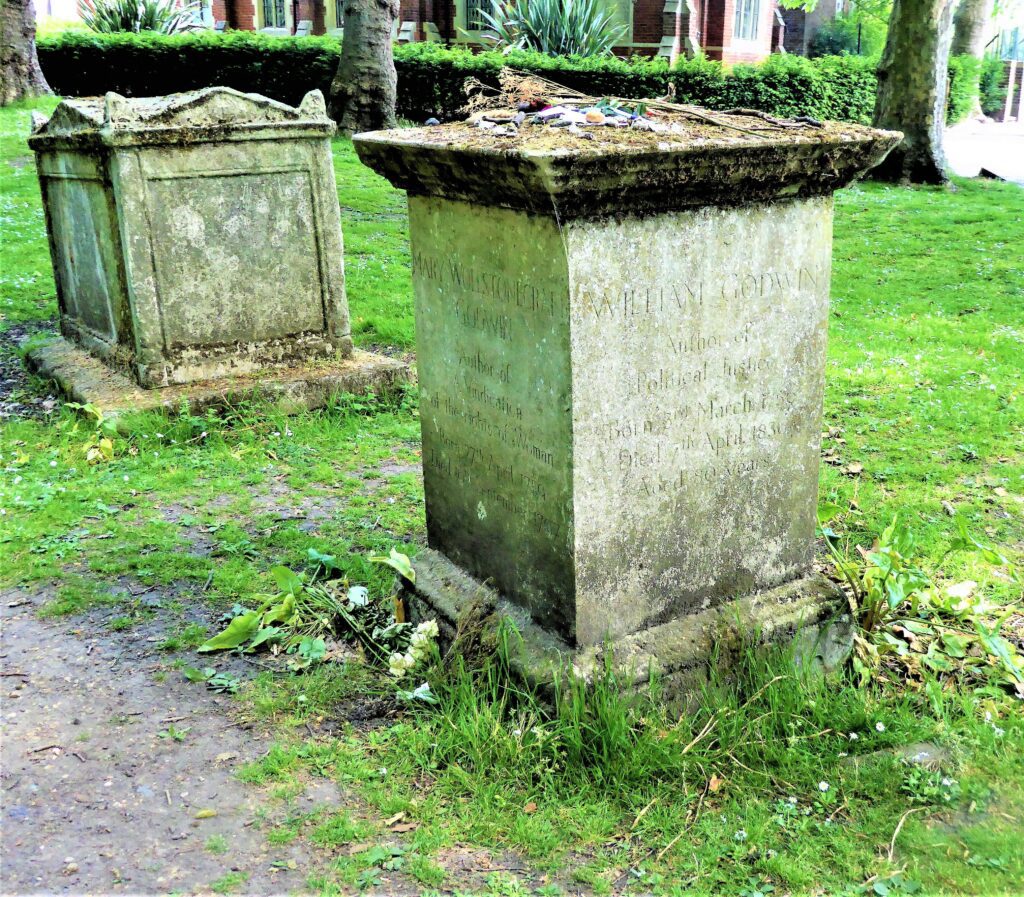
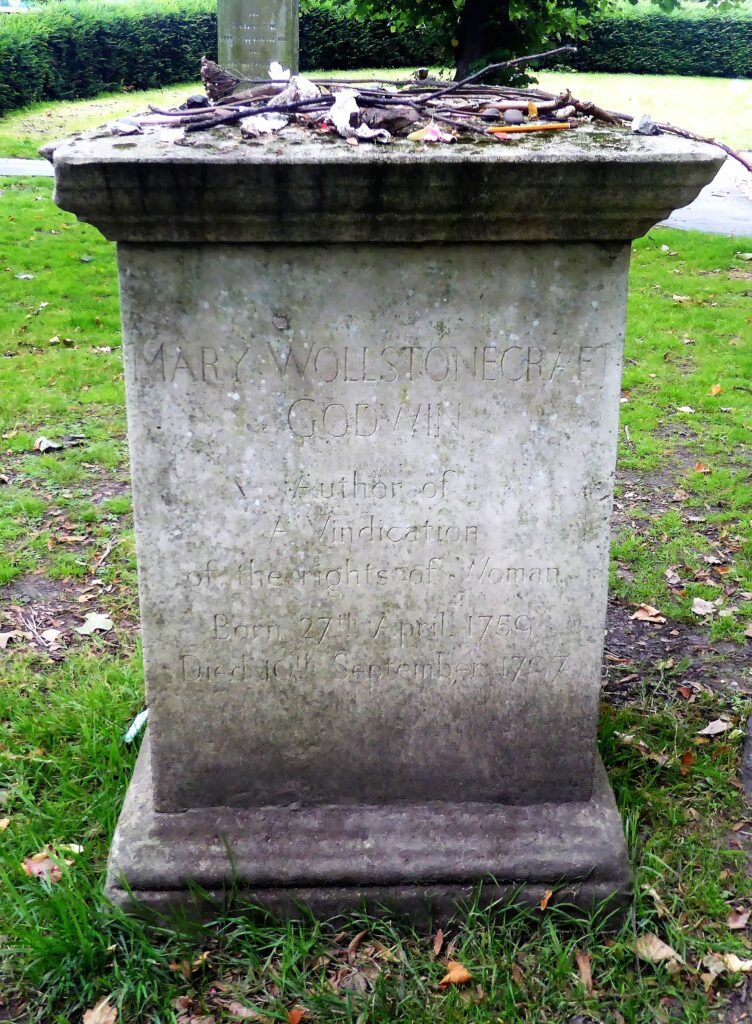
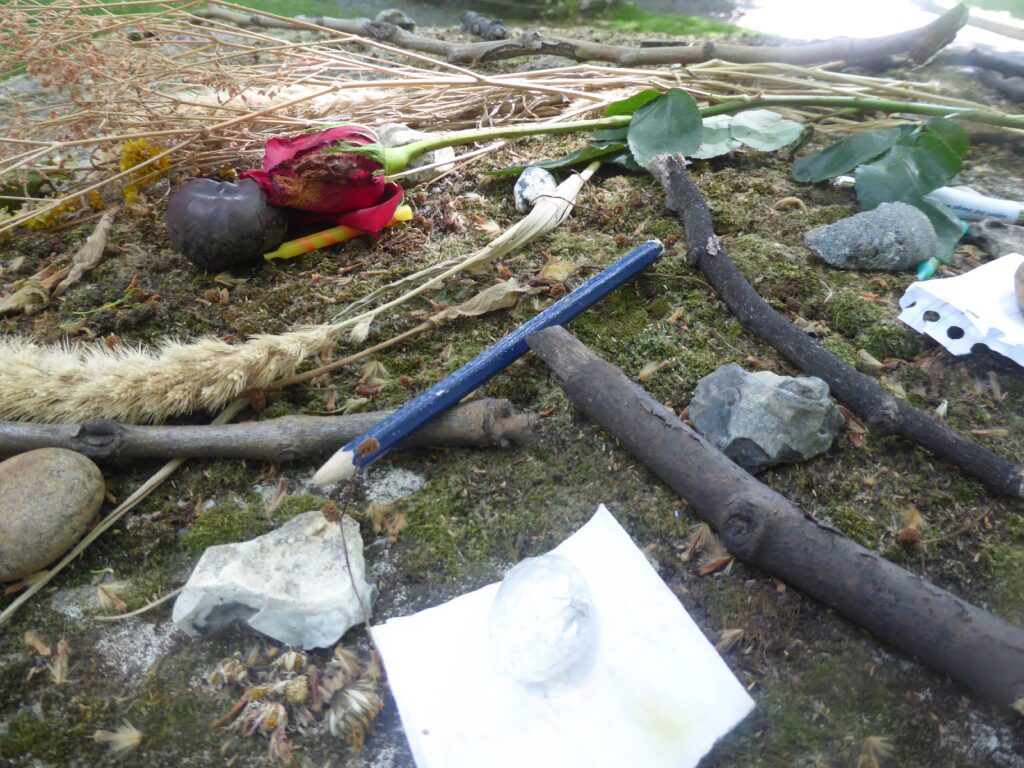
It is Mary Wollstonecraft’s original grave marker which draws her admirers today though neither she nor Godwin lie beneath it. Nonetheless devotees leave tributes to Mary, the tomb chest always bearing an array of pens, pencils, flowers, stones and ribbons  There are notes too; like medieval pilgrims visitors seek Mary’s help with exams, relationships, careers, and sometimes they just tell her about their lives, their joys and sorrows, successes and failures, hopes and fears.

I lifted a crystal holding down a sheet of paper torn from a small notebook: “Thank you Mary,” it read “for my education and my rights.”

The original Wollstonecraft Godwin tomb at Old Saint Pancras
Mary Wollstonecraft and William Godwin
Mary Wollstonecraft Godwin
Tributes laid on top of Mary’s tomb

To find out more about Mary Wollstonecraft read Claire Tomalin, The Life and Death of Mary Wollstonecraft.

Powered by WordPress & Theme by Anders Norén