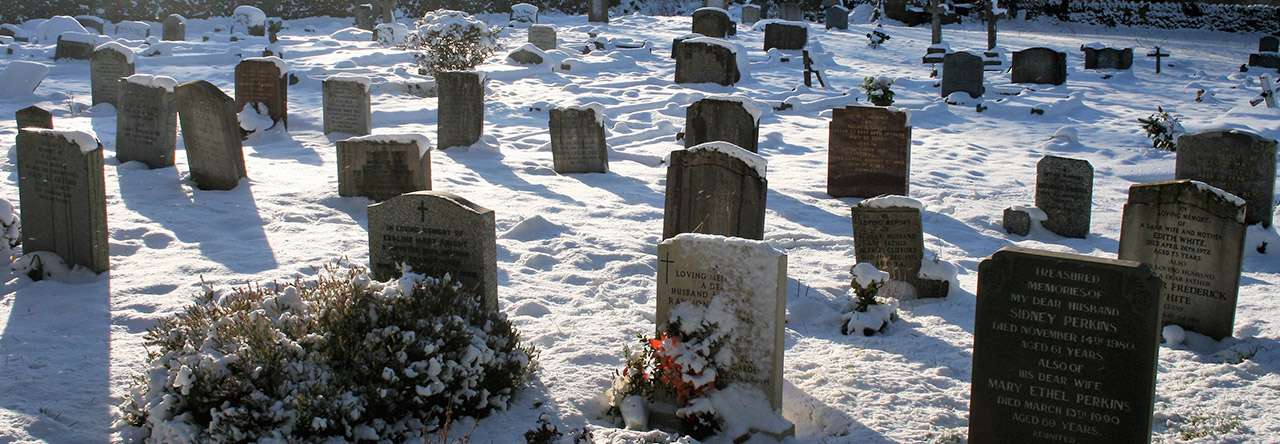
For blog number one hundred, let me introduce you to John Pitt. When he died he was one hundred and one years old, and he had lived in three centuries. Admittedly this is a tenuous link. Moreover I know little else about him. I did however take some trouble to track him down in the churchyard of Saint Juthware and Saint Mary, in the village of Halstock in Dorset. The village has a population of only 420, is surrounded by working farms, and accessed by tortuous lanes. Following recent storms, the latter were flooded last week. Faced with small lakes of uncertain depth my normal, rational reaction would be to retreat, but since this would have meant reversing down long, narrow, winding tracks with the added possibility of running into a tractor or hedge trimmer, I took a deep breath, metaphorically closed my eyes, and ploughed on. I weathered the waters but would undoubtedly still be making futile circuits of the Dorset byroads were it not for the wonders of google maps and satellite navigation.
So here he is, John Pitt born in Halstock in 1799. He worked as a shoemaker. In 1823 he married Tryphena Garrett, and after her death married again to a widow, Mary Tucker, in 1865. He died in 1901 in Sherborne Workhouse, a cruel but still common destiny in the early twentieth century for those who outlasted their working lives. His gravestone was erected by public subscription, perhaps by parishioners impressed by his longevity.
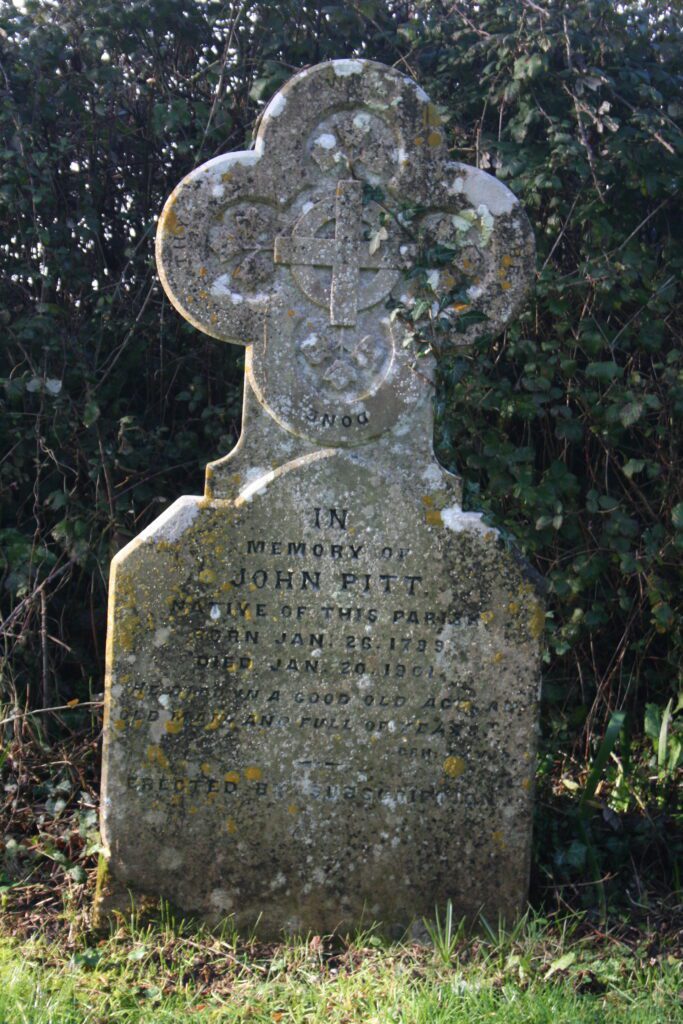
The carved ivy leaves found at each point of the cross on the upper part of the stone were a popular symbol of immortality. Today they are being superseded by the real thing, which I had to peel off to decipher the inscription on the base.
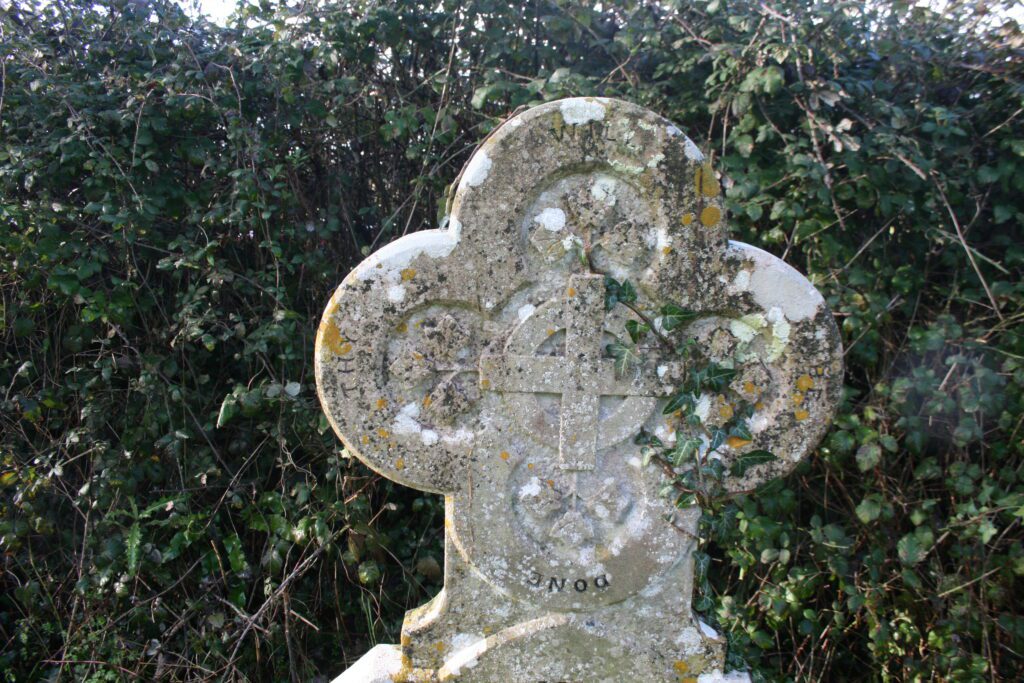
His epitaph reads:
IN
MEMORY OF
JOHN PITT
NATIVE OF THIS PARISH
BORN JAN. 26. 1799
DIED JAN. 20. 1901
HE DIED IN A GOOD OLD AGE, AN
OLD MAN FULL OF YEARS
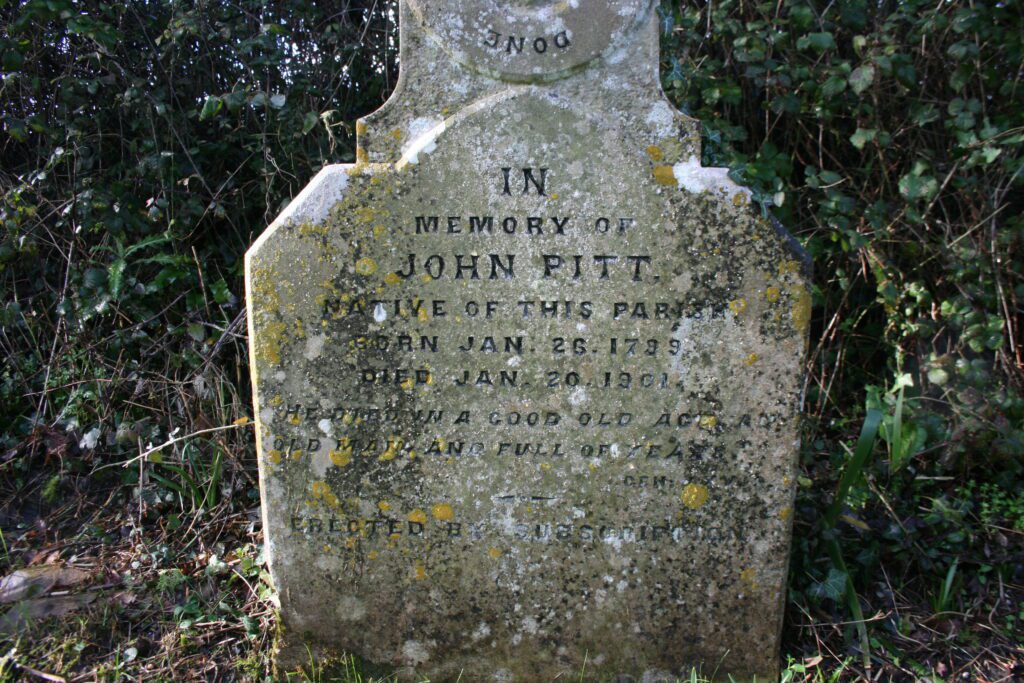
The quotation is from Genesis 25, 8. I looked it up. It refers to the death of Abraham, who, according to the previous verse, lived to be 175 years old, thus outclassing John Pitt, and embroiling biblical scholars in serpentine conjectures.
While paying my respects to John Pitt, I had become curious about the identity of the church’s titular saint, Juthware. The earliest records of her existence come from the fifteenth century Sherborne Missal and John Capgrave’s Nova Legenda Angliae, but they place her in the eighth century. Various retellings of her life mix grim fairy tale tropes with the prurient enthusiasm of Christian hagiography for virgin martyrs.
According to these stories, Juthware was a pious girl with a jealous stepmother. After the death of her father Juthware began to suffer chest pains due to her sorrow and the austerities to which she subjected herself with prayer and fasting. Seizing her chance, the wicked stepmother began to spread rumours, telling her son that his half-sister was a fallen woman bearing an illegitimate child. To make this convincing, she slaughtered a lamb, fed its carcass to the wolves in the woods, then led her son to the bloodied remains telling him that they were Juthware’s child.
Meanwhile she had feigned sympathy with her stepdaughter, advising her to apply a poultice of two soft cheeses to ease the pains in her breasts. As Juthware walked to church the cheeses melted and seeped through her clothing, enabling her stepmother to claim that it was breast milk.
Convinced by this calumny, her stepbrother beheaded Juthware outside the church. But milk rather than blood flowed from her wounds, and she picked up her head, walked into the church, and placed the head on the altar as an offering to god. A spring of pure water burst forth where the head had fallen.
Juthware’s relics were translated in the tenth century to Sherborne Abbey where they were venerated until they were destroyed at the Dissolution of the Monasteries. Today she is celebrated in the east window of the former abbey, now a parish church.
She was also remembered when around 1700 a public house opened in Halstock bearing the name Ye Quiet Woman, and with a painted sign of Juthware with her head tucked under her arm. Thomas Hardy took the name for his fictional public house in The Return of the Native.
The pub closed only in the 1990s after almost three hundred years. Although the name is offensive, I regret that I never saw it. But at least, with the aid of Hardy’s novels, I can imagine John Pitt in its dimly lit, smoky interior, sitting on a wooden bench near the fireplace, supping his ale amongst the reddlemen, furze cutters, shepherds, tranters, carriers, and charcoal burners who peopled the village.