Sussex was the first county that I ever visited in the south of England. In the mid-sixties the south was still a quite different place from the north. True, we did not think of ourselves as northerners in my home county of Cheshire. Surrounded though we were by The North, The Midlands, Wales, and Liverpool, we perceived Cheshire as a misplaced bit of the home counties. Heavy industry, serious pollution, abandoned bombsites, and slum dwellings were the preserve of other, more stereotypically northern counties. Cheshire was dairy farming, the determined gentility of Knutsford and Wilmslow, and well-heeled housewives shopping in the Chester Rows.
Nonetheless a singular difference was apparent to me on that first trip south. Everything was cleaner and smarter, lighter and brighter, the air was fresher, the people were better dressed, the shops more elegant. There was an air of confidence, a swagger of prosperity and modernity. It was as though the sun had come out at the end of a bleak winter or a light had been switched on in a dark room.
In Chichester, the white limestone of the Cathedral contrasted with the dark red sandstone of the Chester I knew. There was an exciting scattering of coffee shops with real coffee; at home, the height of sophistication was a frothy coffee in a Perspex cup at a Wimpy bar. In Brighton, The Lanes burst with colour: greengrocers with Mediterranean fruits and vegetables which had not yet reached us in the north, vied with clothes shops with outrageously coloured and styled fashions.
Today the contrast is less apparent, and conceivably my memory exaggerates the erstwhile difference. I was doubtless influenced by an unusually sunny August, and by meetings with poised and stylish French children on English home holidays.
Nonetheless I still have a great affection for Sussex, not only for memories of a youthful, golden summer, but because it really is a very pretty county. I am particularly fond of Bosham with its the elegant houses, magnificent harbour, spectacular tidal range, and picturesque Anglo-Saxon church.
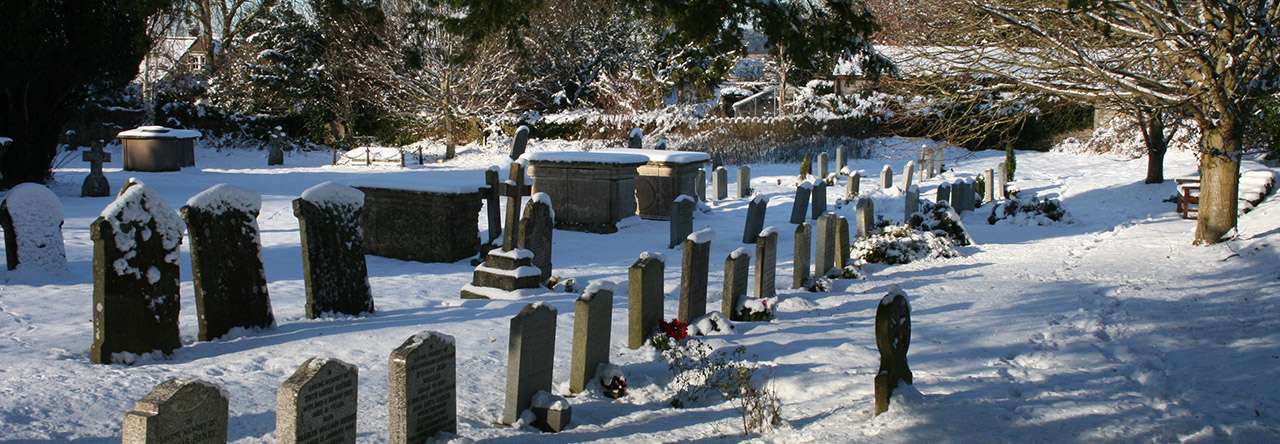
Of course, Holy Trinity church is surrounded by a picture book perfect churchyard, a gentle paradise of flowers, birdsong, and ancient stones. And there, despite the unhappy story attached to it, rests one of my favourite graves. Although the grave dates from 1759, the carved script, in a charming mixture of calligraphy, is still clear. Perhaps that lack of pollution and the milder southern climate which I noted on my first visit, combined with high quality engraving, has ensured its longevity.
The stone bears witness to the memory of Thomas Barrow, who was master of a sloop called the Two Brothers. It records his tragic misfortune:
In Memory of
Thomas, Son of Richard and Ann
Barrow, Master of the sloop Two
Brothers who by the Breaking of the
Horse fell into the Sea and Drown’d.
October the 13th 1759 Aged 23 years

Having little knowledge of things maritime, the reference to the horse confused me until I discovered that a horse is an additional footrope hung at the extreme end of the yardarm where the main rope is too tight to stand on. The shorter rope hangs down low enough for sailors to stand on while they are furling the outermost edges of the sails. It is usually thinner and more unstable than the other ropes, and as it is necessary to step off the main footrope to get on to it, it is usually the preserve of more experienced sailors like Thomas. *
Above a rough sea and pounded by storms from the north, the horse broke, and poor Thomas fell to his death. A bittersweet little carving illustrates the tragedy. In the centre is the sloop, below the rumbustious waves, and above a winged putti with distended cheeks representing the north wind. A tiny figure is clearly visible falling from the broken horse.

Below a dramatic yet poignant verse proclaims,
Tho Boreas’s Storms and Neptune’s waves
have toss’d me to and fro
Yet I at length by God’s decree
am harboured here below
Where at an Anchor here I lay
with many of our Fleet
Yet once again I shall set Sail
my saviour Christ to meet.”

And who reading his story could fail to wish that Thomas might “once again set sail”?

*****************************************************************
*If this is as unclear to you as it was to me, search for “Flemish horse(rigging)” on https://en.wikipedia.org where there is not only a helpful photograph and a diagram, but an explanation that all footropes were once known as “horses”, with this, the most dangerous one, known as a Flemish horse because the latter were considered the most unruly of equines.