According to local tradition, the first cuckoo to return from Africa will sing from the Celtic Cross in Saint Brynach’s churchyard at Nevern in Pembrokeshire every 7 April. Its song, on the feast day of Saint Brynach, heralds the arrival of Spring.
Brynach was an evangelist from Ireland who, in the sixth century, made the Peregrinatio Pro Amore Christi, travelling the coasts of England and Wales establishing small Celtic monasteries. By the time the Celtic Cross was erected in the tenth century thousands of pilgrims were visiting Nevern on the Pilgrim Way to St. David’s, and numbers increased when in the twelfth century Pope Calixtus II declared three pilgrimages to St. David’s the equivalent of one to Jerusalem. But a fallow period was to follow at the Reformation when the monastery and its church fell into disrepair. The church was restored during the Methodist Revival of the 1730s.
The Celtic Cross, Saint Brynach’s Church, Nevern
But while my friends were examining the knotwork and ringwork carvings on the cross, I was more interested in the seven-hundred-year-old yew trees which line the path to the church, and especially in the bleeding yew. For one of the trees produces a blood-red sticky resin. Thin legends have grown up around this phenomenon: the tree will bleed until Nevern Castle, abandoned in 1179, is again occupied by a Welshman; a monk, hanged from the tree for a crime he did not commit, vowed that it would bleed for eternity. More prosaically the release of sap is normal if a yew has been damaged and usually it will heal itself. But this sap is a very red and blood like sap, and the tree shows no sign of healing.
Many explanations have been offered for the common occurrence of ancient yews in the churchyards of England and Wales. My favourite comes from the seventeenth century astrologer, botanist and translator of mystic texts, Robert Turner, who claimed they were planted to protect and purify the dead, absorbing the gases from decomposing corpses. Their branches
draw and imbibe… the gross and oleaginous vapours exhaled out of the grave by the setting sun.
and their roots
suck nourishment from the dead. *
From this it is only a step to imagine vampire-yews sucking blood as well.
The Bleeding Yew… definitely a vampire
As I wandered the graveyard embroidering this ghoulish fantasy, I was distracted by an old gravestone now fixed high on the wall of the churchyard and overhung with ivy. The stone records the deaths in infancy of Anna Letitia and George, the children of David Griffith, vicar of Nevern between 1782 and 1834. Infant mortality was high in those years, and while the deaths did not surprise me, I was taken aback by the strangely jaunty verse which commemorated them:
They tasted of life’s bitter cup.
Refused to drink the potion up
But turned their little heads aside
Disgusted with the taste – and died.
Old gravestone, now affixed high on the wall of the churchyard
ANNA LETITIA and GEORGE, children of Rev. DAVID GRIFFITH,VICAR of this parish, who died in their infancy,A.D.1794
Strangely jaunty verse
It sounded horribly callous and cold-hearted. Could anyone record the death of their children in such insensitive terms? Was it meant to be humorous?
But the jocularity was not entirely unfamiliar: a commemorative brass in Southwark Cathedral begins conventionally enough:
Susanna Barford departed this life the 20th of
August 1652 aged 10 yeares 13 weekes, the non-
-Such of the world for piety and virtue
In soe tender years.
And death and envye both must say twas fitt
Her memory should thus in brasse bee writ.
Here lyes interr’d within this bed of dust
A virgin pure not stained by carnal lust;
Such grace the king of kings bestowed upon her
That now she lives with him a maid of honour.
Her stage was short, her thread was quickly spun
Drawne out and cut, gott heaven, her worke was done.
But the final couplet has a chirpy insouciance like that on the Griffith grave:
This world to her was but a traged play
Shee came and sawt dislikt and passed away.
Brass commemorating a child death in Southwark cathedral
The origin of this and similar couplets may lie in a poem written by Henry Wotton in 1626;recalling the death of his nephew’s widow shortly after that of her husband, it ends:
Hee first deceased; Shee for a little Tryd
To live without him, likd it not, and dyd.
The lines were certainly adapted on the stone of Margaret and John Whiting, found in Saint Bartholomew the Great, when John died a year after his wife in 1681,
Shee first deceased; Hee for a little Tryd
To live without her, likd it not and dyd.
On an adult grave, and where the epitaph also records that the couple had,
“lived lovingly together … 40 yeares and upward…having had issue 12 children”.
the humour sounds gentle and not out of place. But on the child graves the seeming emotional detachment is disturbingly unfeeling and unsympathetic.
Lawrence Stone** has advanced the chilling suggestion that the high infant mortality rate in earlier centuries led parents to make only a limited emotional investment in their children, but I think it is more credible that an age of greater faith may have rendered even child death less traumatic than it is today.
Pat Jalland*** reasons that the evangelical movement of the late eighteenth and early nineteenth century engendered a view of death as an escape from an unhappy world of pain and suffering. As angels in heaven the children would watch over those left below, who should anticipate a joyful reunion, certain of a future life in a happier world. She warns against judging the emotions of an earlier age from our own standpoint where there is reduced prevalence of religious belief.
Certainly, Reverend David Griffith was both a product and a part of the Methodist Revival which espoused these evangelical views. Nonetheless I find the epitaph he chose for the grave of his young children, with its apparent bland and untroubled acceptance, deeply disquieting.
*Quoted in Richard Mabey, Flora Britannica, (1996) p.29.
**Lawrence Stone, The Family, Sex and Marriage in England 1500-1800, (1977) pp651-2.
***Pat Jalland, Death in the Victorian Family, (1996) chapters 1 and 6.
In 1853 the Ottoman Empire was in decline and Russian expansion threatened the balance of power. British and French armies united with the Turks fighting the Russians in Crimea. WH Russell’s journalism, Roger Fenton’s photography, Tennyson’s poetry, and the paintings of Elizabeth Butler, Robert Gibb and Harry Payne fostered a jingoistic enthusiasm for the war in Britain such that Alma, Balaklava, and Inkerman still feature as street names today.
Against this background Florence Nightingale emerged as a national heroine, venerated by Victorians as The Lady with the Lamp.
Nightingale (1820-1910) was born into a wealthy British family. She believed, as significant numbers of Victorians did, that she was called by god to serve others. Her decision to realise this through nursing was strongly, and unsurprisingly, opposed by her family. “Nurses” at this time were not far removed from the caricature of Sarah Gamp presented by Dickens in Martin Chuzzlewit: untrained, incompetent, negligent and often drunk. Hospitals were filthy places with straw spread on the floors, as it might be in an old butcher’s shop, to soak up blood.
Nightingale however managed to acquire some medical training at a Lutheran religious community in Germany where the deaconesses worked with the sick. In 1853, through social connections, she was appointed Superintendent of the Institute for the Care of Sick Gentlewomen in Upper Harley Street.
In 1854 Sidney Herbert, the Secretary of State for War, who knew Nightingale well, appointed her to lead a staff of thirty-eight women volunteer nurses at the military hospital in Scutari. Here she found the wounded being treated in horrific conditions with shortage of medicines, hygiene neglected, overworked staff, overcrowding, lack of ventilation, poor nutrition, and rampant infections. Ten times as many soldiers were dying from typhus, typhoid, cholera, and dysentery as from battle wounds.
Five days after her arrival the injured from the battles of Balaklava and Inkerman appeared at the hospital. Nightingale instituted practical measures: cleaning, hand washing, bathing patients, improved nutrition.
The improved hygiene may have reduced the death rate, but the latter remained high until the British Government set out a sanitary commission. Realising that the hospital was built over defective sewers and patients were drinking contaminated water, they flushed out the sewers and improved ventilation. The mortality rate then fell substantially, but not as dramatically as reported at the time since the government concealed accurate figures to avoid criticism.
Meanwhile the media of the day romanticised and arguably exaggerated Nightingale’s achievements. William Russell in The Times:
She is a “ministering angel” without any exaggeration in these hospitals, and as her slender form glides quietly along each corridor, every poor fellow’s face softens with gratitude at the sight of her. When all the medical officers have retired for the night and silence and darkness have settled down upon those miles of prostrate sick, she may be observed alone, with a little lamp in her hand, making her solitary rounds.
A portrait of her with her lamp appeared in The Illustrated London News and Henry Wordsworth Longfellow immortalised her in Santa Filomena, a sentimental and moralising poem which enjoyed great popularity:
Lo! In that house of misery
A lady with a lamp I see
Pass through the glimmering of the gloom
And flit from room to room.
Lytton Strachey, a man not given to hyperbole, nor to bad poetry, nonetheless praised Nightingale in his book Eminent Victorians which debunked other nineteenth century heroes. His more judicious reasoning suggesting that her achievements were as admirable as her personality was intolerable. The Lady with the Lamp was stubborn and opinionated, he claimed, but these qualities were needed to realise improvements at Scutari.
Although she is most remembered for her time in the Crimea, Nightingale’s achievements when she returned home after the war were greater. In 1860 she set up the first secular training school for nurses at St. Thomas’ Hospital in London. She insisted on autonomous nursing leadership with matrons having full control of their staff, to the chagrin of doctors who saw their authority threatened. The hierarchical structure which she instituted, influenced by her contact with the army, undoubtedly alienated some potential nurses. Yet the teaching hospitals transformed nursing into a respectable, and respected, profession.
Nightingale turned her attention not only to the sanitary design of hospitals but also to working class homes. Working with the sanitary reformer Edwin Chadwick she produced statistical models highlighting the causes of mortality. Their mutual commitment to adequate drainage reduced the death rate. A pioneer statistician, Nightingale produced the so called rose diagrams, a type of pie chart, summarising their research in a form which could be quickly understood and used to put pressure on government to introduce reforms.
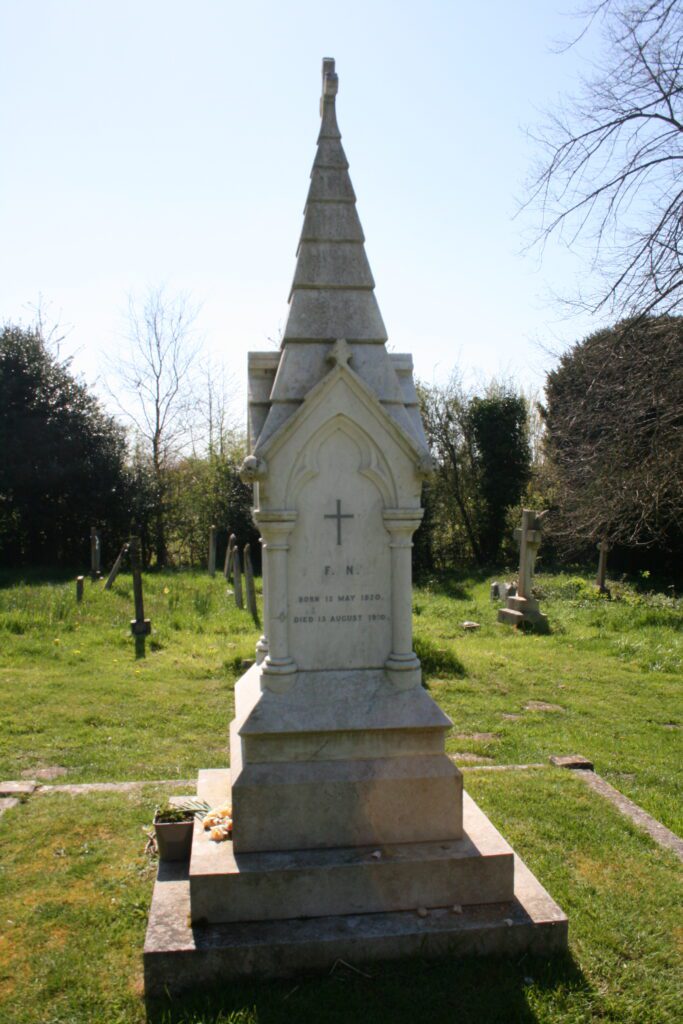
Nightingale was lauded by the press, received awards and decorations including the Order of Merit, and offered a burial in Westminster Abbey which in accordance with her prior request her family declined. She is buried in St. Margaret’s churchyard, East Wellow, Hampshire near her family home.
The rather stark grave of Florence Nightingale bears only her initials and dates of birth and death
Statues of Nightingale and Sidney Herbert flank the Crimean War Memorial at Waterloo Place in London
But Nightingale was not the only woman whose fame rested largely on her activities in the Crimea. Mary Seacole (1805-1881) was born in Jamaica where her mother ran a boarding house and convalescent home for military and naval staff. She was also a “doctress”: a woman who treated the sick with traditional Caribbean and African herbal medicines. Seacole worked alongside her mother, sometimes providing nursing assistance at the British Army Hospital.
In 1851 while visiting her brother in Panama she helped to treat victims of an outbreak of cholera. Spotting a business opportunity in Panama, where gold prospectors were passing to and from California, she opened the British Hotel and Restaurant to cater for them.
Seacole travelled to England initially to deal with investments which she had acquired in gold mining businesses. She then applied to the War Office to join the second contingent of nurses going to the Crimea, but the full complement had already been secured. She appealed to the trustees of the Crimea Fund, established to support the wounded in Crimea, for sponsorship to travel there but was refused. Seacole suspected a lack of appreciation of her skills as a doctress and an element of racism in this refusal:
In my country, where people know our use, it would have been different; but here it was natural enough…that they should laugh, good-naturedly enough, at my offer….Was it possible that American prejudices against colour had some root here? Did these ladies shrink from accepting my aid because my blood flowed beneath a somewhat duskier skin than theirs? (1)
Seacole used her own resources to travel to Crimea where she opened the New British Hotel at Balaclava in 1855 aiming to provide food and accommodation for sick and convalescent officers. The French chef, Alexis Soyer, who had come to Crimea to help improve the diet of British soldiers, advised her to concentrate on a food and beverage service as the officers slept on their ships or in camp.
For the duration of the war, Seacole combined a successful catering business with medical aid to the wounded. She served officers in the British Hotel and sold provisions near the British camp. After supplying food and drink to spectators who came to view the battles from Cathcart’s Hill, she would head for the battlefield to nurse the casualties.
WH Russell wrote:
She was a warm and successful physician, who doctors and cures all manner of men with extraordinary success. She is always in attendance near the battlefield to aid the wounded and has earned many a poor fellow’s blessing. (2)
“Mother Seacole” as she became known to the soldiers.
out of the goodness of her heart and at her own expense, supplied hot tea to the poor sufferers (wounded men being transported from the peninsula to the hospital at Scutari) while they are waiting to be lifted into the boats…She did not spare herself if she could do any good to the suffering soldiers. In rain and snow, in storm and tempest, day after day she was at her self-chosen post with her stove and kettle, in any shelter she could find, brewing tea for all who wanted it, and there were many. (3)
But Seacole did much more than provide tea; equipped with lint, bandages, needles, and thread she tended to the wounds of soldiers, prepared medicines, and performed minor surgery. (4)
When the war ended and the soldiers left Crimea, Seacole faced financial difficulties with provisions she could no longer sell and creditors demanding payment. But such was her celebrity and popularity that when she returned to England a fund supported by many military men was set up on her behalf.
Mary Seacole continued to travel and in 1857 published her autobiography, The Wonderful Adventures of Mrs. Seacole in Many Lands.
In 1860 she had converted to Catholicism, and when she died, she was buried in St. Margaret’s Roman Catholic Cemetery in Kensal Green.
But while Nightingale’s fame endured after her death, Seacole was all but forgotten for a century, until in 1973 her grave was rediscovered and restored by the Jamaican Nurses Association. A memorial service was held on the centenary of her death in 1981.
Grave of Mary Seacole…
..newly restored and easily located amongst the grey stones which surround it
In the 21st century Seacole has achieved more prominence, and since 2007 she has featured on the national curriculum alongside Florence Nightingale.
And then there is Mary Anne Bulkley (1789-1865), more commonly known as James Barry, army surgeon and Inspector General of Military Hospitals, whose passion for improved sanitation rivalled that of Nightingale, and whose emphasis on the importance of good diet surpassed that of Seacole.
Barry was born in Cork and assumed male identity in 1809 when she entered the medical faculty of Edinburgh university, where she would not at that time have been admitted as a woman. She came close to being banned from taking her final exams, not on the suspicion that she was a woman but that her delicate appearance indicated that she was underage. Only the intervention of an influential family friend secured her graduation.
She went on to qualify in surgery at St Thomas’ and Guy’s Hospital and became an army surgeon. Her career was marked by remarkable success and frequent promotions with postings all over the empire, interspersed with violent clashes with fellow surgeons, military officers and officials leading on one occasion to a duel, followed by arrest and demotion.
In Cape Town she became the Colonial Medical Inspector, and it was there that she performed one of the first successful Caesarean sections.
Throughout her career she was concerned with the welfare of the poor and underprivileged, and of rank-and-file soldiers. And from this sprang her obsession with clean water, spotless wards, sterile instruments, improved sanitation, and healthy diet.
Though her professional skill was never in doubt, she earned a reputation for being tactless, impatient, argumentative, imperious, and opinionated.
During the Crimean war she ran a hospital for convalescent soldiers in Corfu, as always putting emphasis on the paramount importance of hygiene, clean hands, and instruments. The hospital had some of the highest recovery rates of the conflict.
Soon after, in 1859, Barry was forcefully retired on the grounds of old age and ill health.
She had left instructions that there should be no examination of her body after death, that she should not be washed, but buried in the clothes she died in wrapped in her bedsheets. Nonetheless her landlady summoned a woman to lay out the body. On discovering that Barry was a woman the latter approached DR McKinnon, Barry’s own physician, hoping to be paid for her silence. When McKinnon refused saying that Barry’s sex was none of his business, she took her story to the press.
There resulted the prurient speculation which McKinnon, and others who had known of Barry’s sex, had sought to avoid. Fortunately, as McKinnon pointed out, there was no family to be distressed by this.
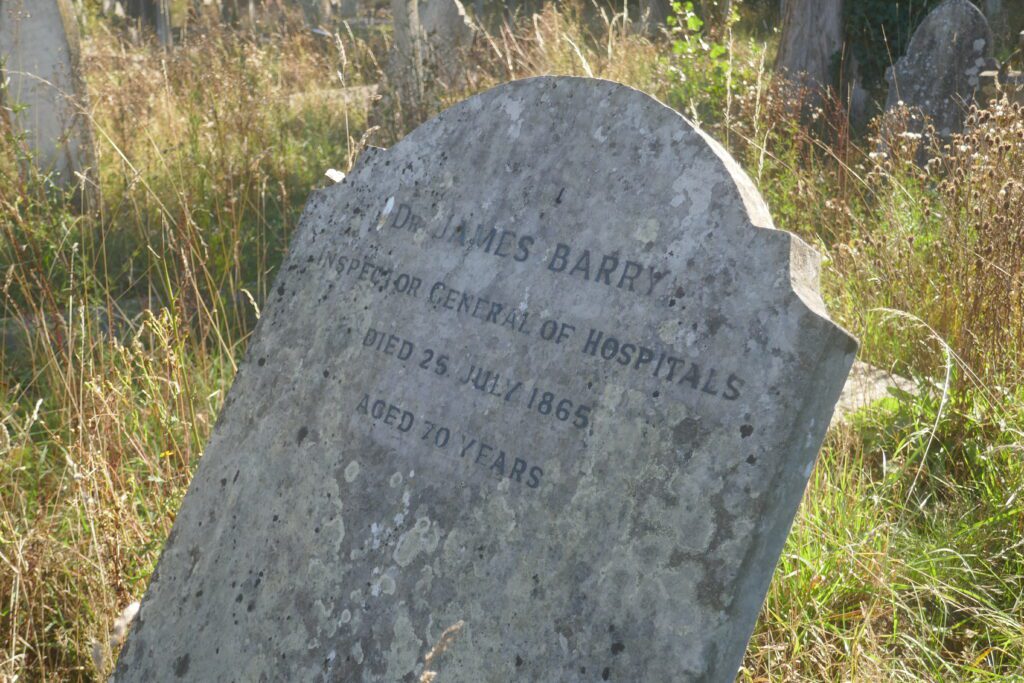
Barry was buried in Kensal Green but when I visited recently the grave looked a little forlorn and forgotten. It features in the cemetery guide produced by the Friends of Kensal Green but is not easy to find and was more overgrown than I remembered from earlier visits.
James Barry, not so easy to find
Barry does not feature on the national curriculum.
And Did The Three Ladies of the Crimea Ever Meet?
Nightingale and Seacole did meet in Scutari, when Seacole was en route to Crimea, and sought a bed for the night. Seacole recorded that one of Nightingale’s colleagues had rebuffed her thinking she sought to join their group, and she inferred that racism was at the root of the rebuttal. But later when Seacole was packing up to leave Crimea she told Soyer,
You must know, M Soyer, that Miss Nightingale is very fond of me. When I passed through Scutari, she very kindly gave me board and lodging.
When Soyer related this to Nightingale, she replied,
I should like to see her before she leaves, as I hear she has done a deal of good work for the poor soldiers. (5)
And yet, Nightingale did not want her nurses associating with Seacole, as she wrote to her brother-in-law, that although
She was very kind to the men and, what is more, to the Officers -and did some good, (she) made many drunk.
She added that Seacole kept “a bad house” in Crimea and that,
I had the greatest difficulty in repelling Mrs. Seacole’s advances, and in preventing association between her and my nurses (absolutely out of the question!). Anyone who employs Mrs. Seacole will introduce much kindness – also much drunkenness and improper conduct. (6)
Relations between Nightingale and Barry were even more fraught during their one recorded meeting. When Barry visited the hospital at Scutari in her role as Inspector General of Army Hospitals she was not impressed by the standards of hygiene and lectured Nightingale on the subject in the presence of her subordinates. For Nightingale who prided herself so much on the improvements which she had made in hygiene at Scutari this must have been particularly galling. After Barry’s death Nightingale wrote, in a letter fairly dripping with rage, and with a wild assortment of personal pronouns in parentheses,
I never had such a blackguard rating in all my life – I who have done more than any woman – from this Barry sitting on (her) horse, while I was crossing the Hospital Square, with only my cap on, in the sun. (He) kept me standing in the mist of quite a crowd of soldiers, commissariat servants, camp followers, etc etc, every one of whom behaved like a gentleman, during the scolding I received, while (she) behaved like a brute. After (she) was dead, I was told (he) was a woman. I should say (she) was the most hardened creature I ever met. (6)
There is no record of Seacole and Barry ever meeting.
And Today?
There are arguments that Seacole’s knowledge of medicine, her skills and her contribution to nursing surpassed those of Nightingale (7) whose work has been more critically reviewed in recent times. Yet others defend Nightingale’s achievements passionately, regarding Seacole as little more than a kind-hearted businesswoman. (8). The erection of a bronze statue of Seacole outside St. Thomas’ Hospital in 2016 proved controversial since the hospital is associated particularly with Nightingale.
Bronze of Mary Seacole placed outside St. Thomas’ Hospital in 2016
What is certain is that soldiers in the Crimea had reason to be grateful to both The Lady with the Lamp and to Mother Seacole – and to James Barry too.
Mary Seacole, The Wonderful Adventures of Mrs. Seacole in Many Lands
The Times, 20 September 1855
National Library of Jamaica, Mary Seacole
Mark Bostridge, Ministering on Distant Shores in The Guardian, 14 February 2004